
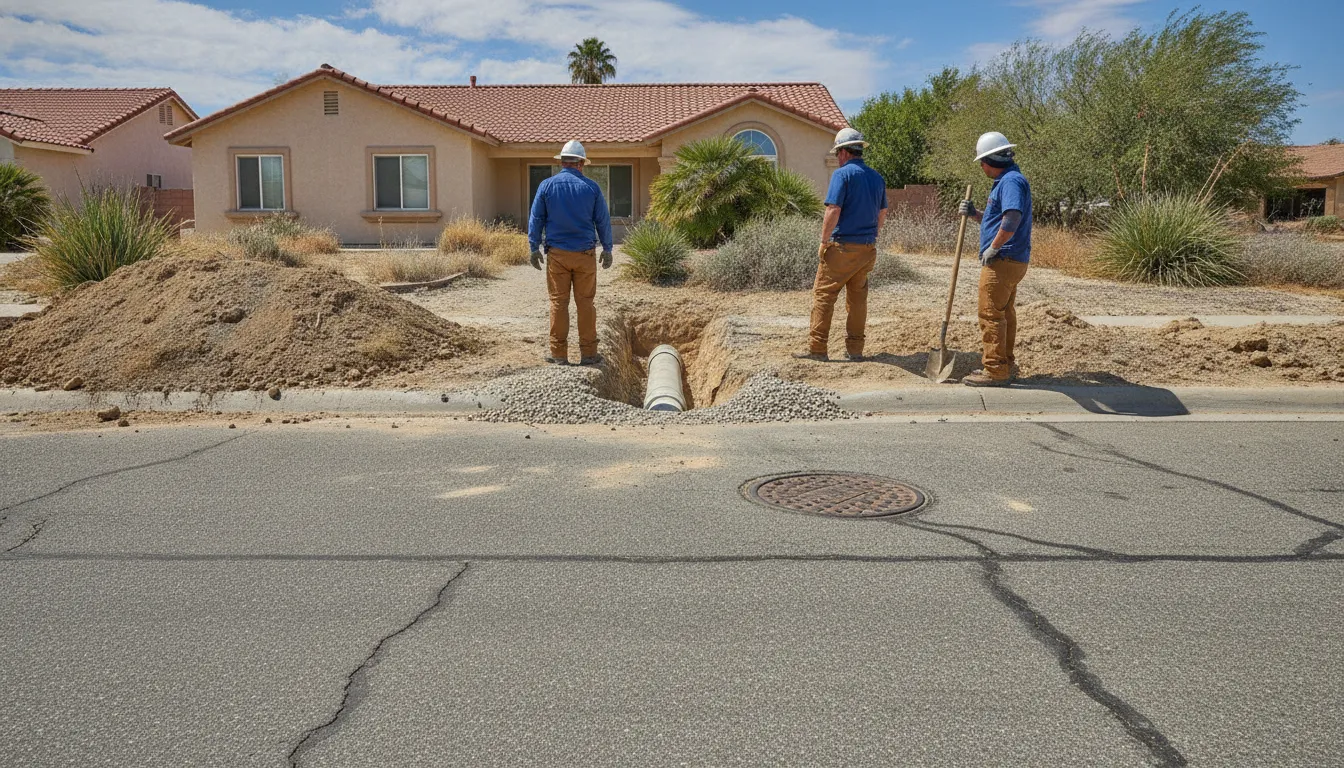
The septic to sewer conversion requirements Riverside County applies are not one countywide distance or one city form. Whether you must connect depends on sewer availability, system failure, and which city or district serves the parcel. Diamond House Plumbing works on septic systems and sewer laterals for homes and businesses across Riverside and San Bernardino County. That includes the connection and tank work that follows a county decision.
Ask Diamond House Plumbing to review your Riverside County conversion.
Septic to sewer conversion requirements Riverside County applies
Two county documents do most of the work for unincorporated Riverside County and the cities the county contracts to serve. Riverside County Ordinance 650.7 regulates sewage discharge and incorporates the Local Agency Management Program. The 2024 Riverside County LAMP sets the onsite wastewater standards the Department of Environmental Health uses.
Ordinance 650.7, Section 3.C, is the clearest rule. No onsite wastewater treatment system will be approved, and no application will be processed, where connection to a sanitary sewer is a practical option. The ordinance does not publish a single footage that makes sewer “practical” for every parcel. That call belongs to the Department, based on the project and the site.
A city inside Riverside County can add its own sewer-connection rules on top of the county program. Fontana is one example, and that city process is a separate question from the county rules here. If the property is inside a city, ask both the city or sewer district and the county environmental health office which part each one reviews.
How Riverside County septic-to-sewer requirements affect a conversion
The county looks at sewer proximity before it will let an owner keep or expand an onsite system. Under the 2024 LAMP, an onsite wastewater certification must state how close public sewer is. Based on the project scope, connection to sewer may be required.
The LAMP requires that certification in four situations.
- Any repair or modification of an existing system.
- New construction or a modification on a property that uses an onsite system.
- Any project that proposes to keep using an existing system.
- Any other case the Department requires.
A failed system is a separate trigger. Ordinance 650.7, Section 9.B, says that if the Director determines connection to sanitary sewer is an option, the owner must connect within a timeframe the Director sets. Failure, in the LAMP, includes effluent on the ground, sewage backing up into fixtures, or wastewater that is not treated before it disperses. The Department can issue a notice of violation and require the repair or connection under permit.
Holding tanks follow a narrower rule. When a sewer line becomes available, the LAMP requires the tank to be destroyed or removed as the Department approves. The connection must happen within 60 calendar days of sewer availability. That clock is for holding tanks only. It is not a general rule for every septic tank in the county.
Some places have extra limits. In the Desert Hot Springs aquifer area, the LAMP prohibits more waste from new or existing onsite systems if a sewer system is available. In Temecula Valley Wine Country, a commercial project over 1,200 gallons per day must connect to sewer when sewer is within 200 feet of the property line. If that connection is unavailable, the project goes to the San Diego Regional Water Board for temporary permitting. Those numbers do not apply to an ordinary house in Riverside, Corona, or Moreno Valley.
How do the requirements compare?
Use the table to see which rule applies before you assume a neighbor’s project matches yours. Confirm the current text with the Department. Ordinances and the LAMP are amended.
| Situation | County requirement | Source |
|---|---|---|
| New or replacement onsite system where sewer is a practical option. | No onsite system is approved, and the application is not processed. | Ordinance 650.7, Section 3.C. |
| Repair, remodel, or reuse of an existing system. | Certification must state how close sewer is. Connection may be required. | 2024 LAMP, Chapter 7. |
| Failed system and sewer is an option. | Owner must connect on the Director’s timeline. | Ordinance 650.7, Section 9.B. |
| Holding tank after sewer becomes available. | Destroy or remove the tank and connect within 60 days. | 2024 LAMP, holding-tank section. |
| Temecula Valley Wine Country commercial flow over 1,200 gallons per day. | Connect when sewer is within 200 feet of the property line. | 2024 LAMP, Chapter 10. |
| Abandoning a tank for a reason other than failure. | County destruction permit, pump-out, then fill or remove the tank. | 2024 LAMP, OWTS Destruction. |
Who reviews the property?
The county split is geographic. The Department of Environmental Health’s land development offices are at 4080 Lemon Street, 10th Floor, Riverside, and at 47-950 Arabia Street, Suite A, Indio. The LAMP points west-county projects to the Riverside office and desert projects to Indio. A sewer district or city still has to say whether it will accept the lateral, where the tie-in is, and which street permits apply.
Ask three separate questions, in writing when you can:
- Is sanitary sewer a practical option for this parcel, under Ordinance 650.7?
- Will the sewer provider issue a connection, and where is the main?
- What does Environmental Health require for the existing tank once the building is on sewer?
A main in the street is not the same answer as all three. Service boundaries, capacity, and easements can block a connection that looks close on a map. Diamond House Plumbing sees that split on sewer lateral work: the building side of the pipe and the public tie-in are often reviewed by different offices.
For a new onsite system, the county also wants a building permit from the local building and safety agency, a percolation report, a floor plan, and proof of water service. Those steps matter only if Environmental Health agrees an onsite system is still allowed. If sewer is the practical option, the Riverside County septic system requirements path stops and the conversion path starts.
What happens to the old septic tank?
Connecting the building does not leave the tank in service. The 2024 LAMP’s destruction rules apply to systems abandoned for reasons other than failure, which is the usual case when a property moves to sewer.
The LAMP requires all of the following:
- A destruction permit from the Department before the tank is destroyed. Fees are paid with the application, and the application includes a plot plan of the system.
- A liquid waste hauler approved by the Department pumps the tank, accessible parts of any seepage pit, and any sewage on the ground. The hauler’s documentation goes to the Department if requested.
- Tanks and seepage pits are removed or filled with earth, sand, gravel, or concrete. A tank that will be filled must have the top removed first, unless concrete slurry is piped in. Filled tanks are inspected before they are buried.
That is county environmental health work. It is separate from the plumbing permit for the new building drain and from the sewer agency’s permit for the lateral. Septic tank removal planning should start from this county sequence, not from a general abandonment checklist written for another state.
Substandard systems have a related limit. The LAMP says sites that do not meet minimum design standards cannot add future work that would increase wastewater flow. A remodel that adds bedrooms or fixtures can be the moment the county requires either a compliant repair or a sewer connection. Cesspools of any kind or size are prohibited.
What are the numbered stages of a Riverside County conversion?
The exact order comes from the agencies handling the parcel, but these numbered stages give owners a practical way to organize the work:
- Confirm the jurisdiction and sewer option. Identify the city or unincorporated area, sewer provider, service boundary, and whether connection is practical for the parcel.
- Request the agency requirements. Ask for the connection application, approved tie-in point, permits, fees, inspection checkpoints, and septic-destruction instructions.
- Assess the private route. Review the building drain, elevation, tank location, access, utilities, pavement, landscaping, easements, and any commercial operating constraints.
- Submit approvals before construction. Coordinate the sewer provider, building or land-use agency, and Environmental Health so the proposed scope matches the current requirements.
- Complete the lateral and inspections. Install the approved building sewer or lateral, schedule required inspections before backfill, and document the final connection.
- Close out the old system. Follow the county’s approved process for pumping, removing or filling the tank, inspection, and final records.
Numbering the stages helps separate agency review time from construction time. A contractor can plan private-side work, but the provider and permitting agencies control their own approvals and inspection schedules.
How should you plan the lateral and the site?
Once the county and the sewer provider agree a connection is the path, the physical work is a building sewer and a lateral, not a new leach field. Sewer lateral replacement covers the private pipe from the building to the provider’s main. Depth, cleanouts, pavement, and whether the line can be trenchless all come from the site, not from the ordinance.
Bring the parcel address, any older septic permits, and a simple site sketch to the first agency calls. Ask who issues each permit, whether a sewer availability letter is required, and whether the tank destruction inspection has to happen before the new lateral is covered. Write down the timeline the Director sets if the system is already in failure. That date controls the schedule more than a contractor’s preferred start day.
Homes on older onsite systems often have other plumbing that is the same age. A whole-home repipe is a different project, but it is worth flagging if galvanized water lines or failing drains will be opened during the same access. Keep that scope out of the sewer permit unless the building department asks for it.
Diamond House Plumbing installs and repairs septic systems and sewer laterals for residential and commercial properties. After you have the agency answers, the crew can walk the site so the quote matches the permits rather than a guess about footage.
What should you not assume from another county?
California does not use one conversion rule. Septic to sewer conversion requirements in California change with the regional water board, the county LAMP, and the city. San Bernardino County has its own program. Do not copy a San Bernardino, Orange County, or Fontana checklist onto a Riverside County parcel.
Also do not treat the general septic to sewer conversion planning steps as the legal test. Those steps help you organize records and compare proposals. The legal test here is whether sewer is a practical option. It also includes whether failure has already triggered Section 9. A special area can add a stricter rule. Temecula Valley Wine Country and the Desert Hot Springs aquifer are two examples.
Fees, connection charges, and inspection timing are set by the agency that issues each permit. This article does not quote a project price. A sewer district’s capacity fee, a street cut permit, and the county destruction fee are different bills, and they change.
Talk with Diamond House Plumbing about your conversion plans after you have the county or city answer.
What records should you gather first?
A short file saves a second trip to the counter. Start with the site address and, if you have it, the assessor parcel number. Add any older septic permits, pumping receipts, and a sketch that shows the house, the tank, the driveway, and the street.
Ask the sewer provider for a written note on whether service is available and where the main sits. Ask Environmental Health whether sewer is a practical option for this project, and which destruction permit applies if you connect. Keep those answers with the plot plan. Diamond House Plumbing can use that file to scope the lateral and the tank work without guessing which office still has to sign off.
If the house is in escrow or under a remodel, say so on the first call. Added bedrooms, a new bathroom, or a failing system can change the review. A sale by itself is not a county conversion trigger. The trigger is the project scope and whether sewer is a practical option under Ordinance 650.7.
Frequently asked questions
Does every Riverside County home have to convert from septic to sewer?
No. Ordinance 650.7 blocks a new or replacement onsite system only where connection to sanitary sewer is a practical option. Many parcels still qualify for an onsite system. The Department decides that from the project and the site, not from a single countywide distance.
Who do I call first?
Start with the Department of Environmental Health land development office for your area, Riverside or Indio, and with the city or sewer district that would provide service. Ask whether sewer is a practical option, whether a connection will be issued, and what destruction permit the existing tank needs. Use the septic services team once you know which of those answers applies.
Can I leave the old tank in the ground after I connect?
Not as an active system. The LAMP requires a destruction permit, a pump-out by an approved hauler, and removal or filling that the Department inspects. A tank that is filled has to have the top removed first, unless concrete slurry is piped into it.
Does the 200-foot rule apply to my house?
Only in the specific case the LAMP states. In Temecula Valley Wine Country, commercial projects over 1,200 gallons per day must connect when sewer is within 200 feet of the property line. It is not a countywide rule for single-family homes.
What if my system is already backing up?
That can be a failure under the LAMP. If the Director decides sewer is an option, Ordinance 650.7 requires the connection on the Director’s timeline. If sewage is reaching a public area or a waterway, the ordinance calls for an immediate remedy. Call the county and a licensed plumber rather than waiting on a remodel schedule. Residential plumbing help can cover the backup while the connection path is confirmed.

Leave a Reply