A sewer lateral compliance certificate is not a universal Inland Empire form with one standard price. The required document, inspection method, and approval steps can depend on the city, sewer agency. Property type, and reason for the request, such as a sale, transfer, permit, or repair.
Contact Diamond House Plumbing about your sewer lateral requirements
So, how much is a sewer lateral compliance certificate? There is no verified universal fee. Your total may reflect the authority’s requirements, inspection and testing, permits, access, documentation, and any repair, replacement, or surface restoration needed before verification. Confirm the current requirement first, then request an on-site evaluation and written scope.
For Riverside and San Bernardino County properties, start by identifying the governing city or sewer agency and asking exactly what must be inspected, tested, witnessed, or submitted. Understanding what the certificate may document will make that conversation more productive.
What Is a Sewer Lateral Compliance Certificate?
A sewer lateral compliance certificate is a document that shows a private sewer lateral has met a particular authority’s inspection or verification requirements. A sewer lateral is the privately maintained pipe that carries wastewater from a property toward the public sewer system. The certificate may identify the parcel, the lateral or laterals reviewed, the test performed, and whether the system passed. It is not a universal document with one standard format or pass rule throughout Riverside and San Bernardino Counties.
Requirements are jurisdiction-specific. Before relying on a certificate for a sale, remodel, permit, repair, or other transaction, confirm with the city, sewer agency, or other authority that controls the property. Also ask what portion of the system must be inspected and whether the authority requires its own form, test, witnessing, or approval. A document accepted in one service area may not satisfy another.
What the certificate may verify
As one clearly labeled example outside the Inland Empire. Guidance from the East Bay Municipal Utility District (EBMUD) describes a compliance certificate issued when all private sewer laterals associated with a parcel pass verification. Its example verification checks whether the laterals are leak-free and convey wastewater rather than stormwater. EBMUD also describes a process involving parcel information, the number of laterals, required permits, completed work, inspection scheduling, testing, and certificate access. Those details illustrate how a program may work, but they are not an Inland Empire rule.
The inspection scope can change when a property has multiple laterals, private manholes, or other sewer-system components. Defects may also require repair or replacement before the authority will accept a verification test. For practical help understanding the condition and scope of a private line, review Diamond House Plumbing’s drains and sewer services. The next step is still to confirm the governing authority’s current requirements before scheduling work.
How Much Is a Sewer Lateral Compliance Certificate in the Inland Empire?
There is no verified universal Inland Empire fee for a sewer lateral compliance certificate. The amount, if a certificate is required at all, depends on the city, sewer agency, property, and transaction involved. Start by confirming the governing authority and the exact document it requires. Then separate the cost of inspection and documentation from any work needed to correct a defect.
For context, some sewer-lateral programs require parcel information, a count of laterals, permits, testing, and access to the completed certificate. EBMUD guidance, for example, states that multiple laterals or private manholes can expand the system that must be tested. That guidance is an example from another service area, not an Inland Empire rule, so Riverside and San Bernardino County owners should confirm local requirements.
| Cost driver | Why it matters |
|---|---|
| Authority or agency requirements | The responsible city, utility, or sewer district may set its own application, inspection, witnessing, and documentation requirements. |
| Inspection and testing scope | The work may involve locating the lateral, checking its condition, performing a required test, and preparing records for review. |
| Permits and scheduling | Required municipal permits, inspector coordination, or agency scheduling can add steps before verification is completed. |
| Access and site conditions | Buried cleanouts, limited access, private manholes, occupied buildings, and difficult site conditions can affect the work plan. |
| Number of laterals | A parcel with multiple laterals or connected sewer components may require a broader inspection and testing scope. |
| Repairs, replacement, and restoration | Leaks or other defects may require correction before verification. Excavation, surface restoration, and retesting can then become part of the project. |
Diamond House Plumbing does not publish a standard certificate price because the scope cannot be confirmed from the certificate name alone. Estimates follow an on-site evaluation and consultation. A practical first step is to request the agency’s current requirements, then have the lateral evaluated against that scope. Our drains and sewer services can help property owners identify the inspection, repair, or replacement work that may be relevant before documentation is submitted.
Keep the authority’s written instructions, inspection findings, permit records, repair documentation, and test results together. Those records can make it easier to confirm what remains before a certificate is issued or a property transaction moves forward.
What Does the Inspection and Verification Process Include?
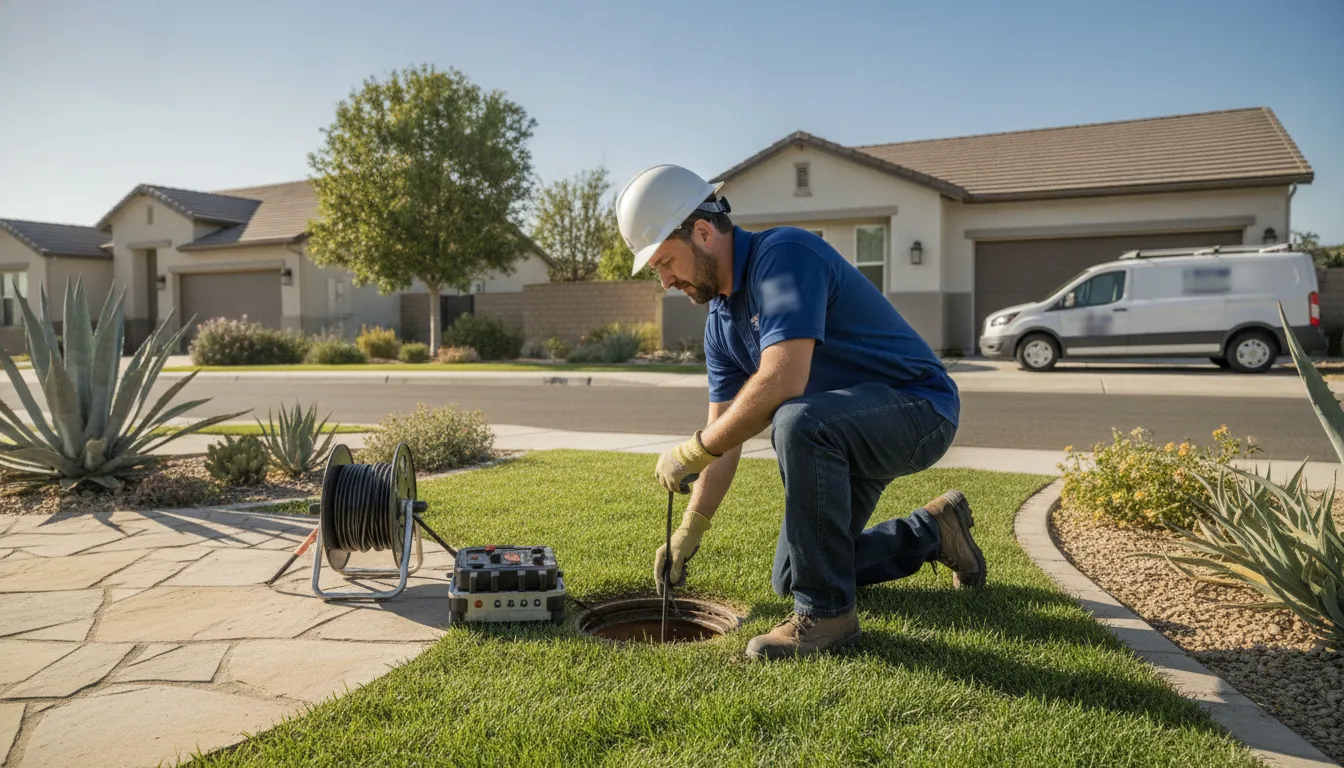
A practical inspection usually begins with confirming the property, the governing authority, and the sewer lateral layout. The reviewer may need to identify how many laterals serve the parcel, where private cleanouts or manholes are located, and which portions fall within the requested scope. A property with multiple laterals can require a broader review than a single-line connection.
Confirm the system and access points
Before testing, the contractor or authority may compare parcel records with visible plumbing features and determine how the lateral can be accessed. That can include locating cleanouts, private manholes, connection points, or other appurtenances. Clear access helps the inspection stay focused and shows whether the visible system matches the records.
Inspect, test, and address required work
The next step is an inspection and verification test appropriate to the applicable local standard. As one example from outside the Inland Empire, EBMUD describes verification as demonstrating that private laterals are leak-free and convey wastewater rather than stormwater. Its contractor guidance also includes checking the parcel and laterals, obtaining required permits, completing required work, scheduling the inspection, and performing the test. That sequence is an example, not a universal Riverside or San Bernardino County rule.
If the inspection identifies a leak, defect, or inaccessible section, the owner may need repairs, replacement, permits, or additional testing before the process can continue. For a clearer view of what a sewer evaluation may involve, review this main sewer line inspection information.
Witnessing and certificate issuance
Some authorities require an inspector or other designated representative to witness the test. Confirm that step before scheduling work, because the applicable agency may specify who performs the test, how results are documented, and where records are submitted. A certificate is generally issued only when the relevant standard is met. In EBMUD’s example, all private laterals associated with the parcel must pass verification. Inland Empire owners should confirm the current requirement with the responsible city, sewer agency, or transaction professional rather than assume that example applies locally.
When Might a City or Property Transaction Require One?
A sewer lateral compliance certificate may become relevant when a local authority connects sewer condition to a property sale, transfer, building permit, nuisance finding, or voluntary repair. Those triggers are not uniform across the Inland Empire. Before scheduling an inspection, identify the agency with authority over the property and ask which document, test, and deadline currently apply.
Common triggers in some jurisdictions
Other California jurisdictions illustrate the types of events that can prompt a compliance process. Berkeley, for example, describes certificate requirements connected to a sale or transfer, certain major construction permits. A city finding that a private lateral may be a nuisance, and an owner’s decision to repair or replace the lateral. Its guide also describes verification after repair or replacement. These are Berkeley rules, not Riverside or San Bernardino County law. And they should not be used to assume that every Inland Empire city has the same threshold or procedure.
In practice, a buyer, seller, escrow professional, building department, or sewer agency may raise the issue during a transaction or permit review. A municipality may also become involved after a complaint, investigation, or observed sewer defect. Commercial owners should confirm requirements before work affects tenants, operations, or a change in use. Diamond House Plumbing provides commercial sewer line repair for property owners planning work around occupied buildings, but the governing agency determines what documentation is accepted.
How to confirm the Inland Empire rule
For Riverside County properties, start with the official Riverside County code page and then confirm whether a city, sewer district, or county service area has additional requirements. For San Bernardino-area properties, review the San Bernardino Municipal Water District private sewer lateral information and the county’s wastewater and land-use guidance when applicable. These sources help identify the responsible authority, but a current written confirmation is still important for a specific parcel and transaction.
Ask the agency whether a certificate is required, what event triggers it, who may perform the inspection. Whether an inspector must witness testing, and whether repairs or permits must be completed before approval. That confirmation keeps the inspection scope tied to the actual property and avoids treating a neighboring city’s process as your requirement.
What If the Sewer Lateral Does Not Pass?
A failed verification usually means the inspection identified a leak, defect, or another condition that does not meet the applicable authority’s standard. The first step is to document the finding clearly. Ask for the affected segment, observed defect, test result, and any photographs or video that help explain the condition. If the property has multiple laterals, private manholes, or other sewer components, confirm whether the required scope includes the full system. Some agency guidance requires all associated laterals and appurtenances to be tested, but that is not a universal Inland Empire rule.
Confirm the required next step
Before scheduling construction, identify which city, sewer agency, or other authority controls the requirement. A permit may be needed before repair, replacement, excavation, or a repeat test. The authority may also specify who can perform the work, how the test must be conducted, whether an inspector must witness it, and what documentation is needed afterward. For example, guidance from another California jurisdiction describes permitting and completion of required work before verification, followed by a witnessed test. Treat that as an example of process, not as a rule for every Riverside or San Bernardino County property.
Repair, replace, and retest
The appropriate scope depends on the defect, pipe condition, access, and the authority’s acceptance criteria. Work may involve repairing a localized connection or replacing a larger section of the lateral. A contractor should explain the proposed scope, access requirements, restoration needs, and testing plan before work begins. Diamond House Plumbing provides sewer line repair options for owners evaluating those next steps.
After the work is complete, arrange the required retest through the responsible authority or its designated process. Keep the original inspection report, repair records, permit information, test results, approval, and any issued certificate together. Preserving that file can make a future sale, permit review, or maintenance decision easier, even when the local process does not issue a document called a compliance certificate.
How Should Inland Empire Owners Confirm the Current Requirement?
Before budgeting for a sewer lateral compliance certificate, confirm which agency or transaction party is setting the requirement. A city, sewer district, county department, escrow team, or another authority may use different terminology and procedures. Riverside County owners can start with the official Riverside County sewer-service code. San Bernardino County owners should also review the San Bernardino County Environmental Health Services wastewater guidance and contact the applicable local agency.
Ask these questions before scheduling work
- Who is the authority? Identify the city, sewer district, county office, or transaction professional responsible for the request. Confirm that the property falls within that jurisdiction.
- What document is required? Ask whether the requirement is a compliance certificate, inspection report, repair verification, permit record, or another form. Request the current form or written instructions.
- What must be tested? Confirm the lateral boundaries, whether there are multiple laterals or private manholes, and whether the authority expects a particular camera inspection, leak test, flow test, or other method.
- Who witnesses or approves it? Ask whether an agency inspector, utility representative, or approved contractor must be present. Also confirm how the completed result is submitted and who issues the final document.
- What happens if defects are found? Request the repair, replacement, permit, retest, and restoration steps in writing before authorizing work.
For a useful estimate, provide the property address, the requesting document or notice, available site plans, and any prior inspection records. Ask for a written scope that separates testing, access, permits, repairs, and surface restoration. That makes it easier to compare proposals without assuming the lowest initial number covers every required step.
Keep copies of agency instructions, permits, inspection footage or reports, invoices, repair photographs, test results, and the issued certificate or approval. Requirements can change, so preserve the date and issuing authority with each record. If you need help evaluating the sewer lateral scope,
Contact Diamond House Plumbing for an evaluation
.
Frequently Asked Questions
How much is a sewer lateral compliance certificate?
There is no verified universal price for an Inland Empire certificate. Your total may depend on the governing authority, the number of laterals, inspection or testing, permits, access, required repairs, and restoration. An on-site evaluation is the appropriate starting point because pricing is consultation-based. The customer knowledge base does not verify a standard certificate fee or inspection charge.
What does a sewer lateral compliance certificate document?
It generally documents that the required sewer lateral inspection or verification was completed and that the system met the applicable authority’s standard. The exact document, test, and pass criteria vary. For example, EBMUD says its certificate is issued when all private laterals associated with a parcel pass verification. But that example should not be treated as an Inland Empire rule. EBMUD contractor guidance
When might a city or property transaction require one?
A requirement may arise during a sale or transfer, a major construction or remodel permit, a city-identified sewer concern, or voluntary repair work. Those are examples from other jurisdictions, not a universal Inland Empire standard. Before relying on a certificate, ask the city, sewer district, or other governing authority what applies to your property and transaction.
How can Inland Empire owners confirm the current requirement?
Identify the city, sewer district, or county agency responsible for the property. Then ask what certificate or inspection record is required, who performs or witnesses testing, and whether permits or repairs come first. Riverside County owners can review the county code, while San Bernardino-area owners should also check their applicable local utility or county guidance. Confirm details directly because rules can differ by jurisdiction.
Contact Us About Your Sewer Lateral Questions
Because requirements can depend on the city, utility, property type, and inspection findings. A clear review can help you understand the likely documentation and work scope for your property. Contact us to ask Diamond House Plumbing about sewer lateral inspection, repair scope, or compliance documentation. Reach out through our contact page to get started with the next step.

Leave a Reply