.
Replacing a main water line is not only a pipe decision. It is a property-planning decision that can affect access, water service, landscaping, driveways, tenants, customers, and the schedule for everyone using the building. In Riverside and San Bernardino County, the right contractor should be able to explain what needs attention, define the work clearly, and coordinate the project around the property.
Contact the plumbing team to discuss your water line project
The best main water line replacement companies make the scope easy to evaluate before work begins. Look for a company that verifies the problem, documents the line segment and proposed replacement, explains permits or utility coordination. Provides proof of licensing and insurance when applicable, and puts scheduling, restoration, and warranty terms in writing.
Residential owners may be focused on protecting access and daily routines, while commercial owners also need a plan that limits disruption to staff, tenants, customers, or deliveries. Start by examining how a prospective contractor approaches the project, not simply what service it lists.
What to Look For in Main Water Line Replacement Companies
Choosing among main water line replacement companies is not simply a matter of finding someone who can install pipe. The right contractor should first establish what is failing, define the section that needs attention, and explain how the work will affect your property. Look for a company that can discuss diagnosis, replacement scope, utility coordination, site access, scheduling, restoration, and warranty terms before you authorize the project.
Start by asking whether the contractor handles water-line repair and installation as part of its regular plumbing work. Ask what information will be included in the written proposal, such as the affected line segment, anticipated access requirements. Pipe material or size where known, and the boundary between the contractor’s work and any utility-controlled equipment. A clear scope makes it easier to compare proposals without relying on broad promises.
Questions that help separate a suitable contractor from a poor fit
- What inspection or testing supports the recommendation to replace the line?
- Which permits, utility approvals, or coordination steps may apply to this property?
- How will the crew protect driveways, landscaping, parking areas, or business access?
- What schedule assumptions, service interruptions, cleanup, and restoration are included?
- Can the company provide current licensing and insurance information for verification?
Residential owners may focus on access, water interruptions, and finished-surface restoration. Commercial owners should also ask how the plan accounts for customers, employees, deliveries, and other daily operations. The contractor-selection factors are similar, but the consequences of an unclear schedule can be greater at a high-traffic property.
For property owners in Riverside and San Bernardino Counties, Diamond House Plumbing serves residential and commercial customers across the Inland Empire. To compare providers, review each company’s stated plumbing scope, then ask whether the proposal covers diagnosis, water-line repair or replacement, and water-supply-system maintenance. You can use Diamond House Plumbing’s broader plumbing services page as one starting point while comparing the specific scope and documentation offered for your project.
Start With Diagnosis and a Clearly Defined Replacement Scope
A reliable replacement recommendation starts with identifying what is actually failing. A qualified company should investigate the leak or pressure problem, trace the affected line. And explain whether the appropriate response is a targeted repair, a system upgrade, or replacement of a larger segment. The evaluation should begin with the condition of the system rather than an assumed replacement outcome.
Ask what the diagnosis confirmed and what remains uncertain. The written scope should identify the line segment involved, its access points. The existing pipe material and size when they can be verified, and the boundary between private plumbing and utility-connected components. A public water project from Durham offers a useful example of this level of specificity: it identified an approximate line length. The existing diameter, and the proposed replacement diameter while describing the work as both replacement and upsizing. That does not establish a requirement for your property, but it shows the detail a property owner can reasonably request in a proposal.
The scope should also state what is not included. Clarify whether the work reaches the water meter, whether service connections are part of the project, and who will coordinate any utility review. The Portland Water Bureau describes service lines as the lines connecting the main pipe to a property water meter. A distinction that can prevent vague assumptions about responsibility and completion. Confirm the boundary for your own jurisdiction and property before authorizing work.
For commercial properties, diagnosis should account for access, occupants, and business operations without turning the assessment into a full installation tutorial. If the concern involves an active leak, you can review these commercial water leak warning signs, then ask the contractor to connect the observed symptoms to documented findings, proposed work, and restoration needs.
Verify Qualifications, Insurance, and Local Coordination
Before comparing main water line replacement companies, ask each contractor how qualifications and project coordination will be documented. Request the business name and license information, current proof of insurance, recent references for comparable work. And a clear description of who will handle utility communication, permits, inspections, and restoration. These questions do not replace your own verification, but they make it easier to identify gaps before work begins.
Utility requirements can also shape contractor selection. Cal Water states that when a developer uses its own contractor, a license, insurance, project references, and additional information may be required before construction. Read the Cal Water contractor requirements directly, then ask whether the proposed work falls within a similar utility review process. The answer may depend on the property, the line segment, and the utility serving it.
Confirm the meter boundary and responsible party
Do not assume that the property owner and utility have the same responsibilities everywhere in Riverside and San Bernardino County. Riverside Water Rule 11 says the Water Utility owns and maintains water service connections up to and through the rear water meter union. It also assigns customers responsibility for apparatus needed to receive, control, regulate, and use the supplied water. That is Riverside-specific guidance, not a universal rule for every jurisdiction.
Ask the utility to confirm the responsibility boundary for your address before approving a scope. This water line responsibility guide can help you prepare questions about the street-to-house connection, but the serving utility remains the appropriate source for a property-specific determination.
Plan for approvals on larger or unusual connections
For properties with more than one water service connection, Riverside requires advance Water Utility approval and may require an approved backflow prevention assembly. Commercial owners should raise this issue early, especially when a project changes service configuration or supports multiple buildings. Include the utility contact, approval status, backflow requirements, and inspection responsibilities in the written proposal. A contractor who explains these coordination steps clearly gives you a more useful basis for comparing proposals than one that provides only a construction method and a start date.
Compare Replacement Methods and Property Protection
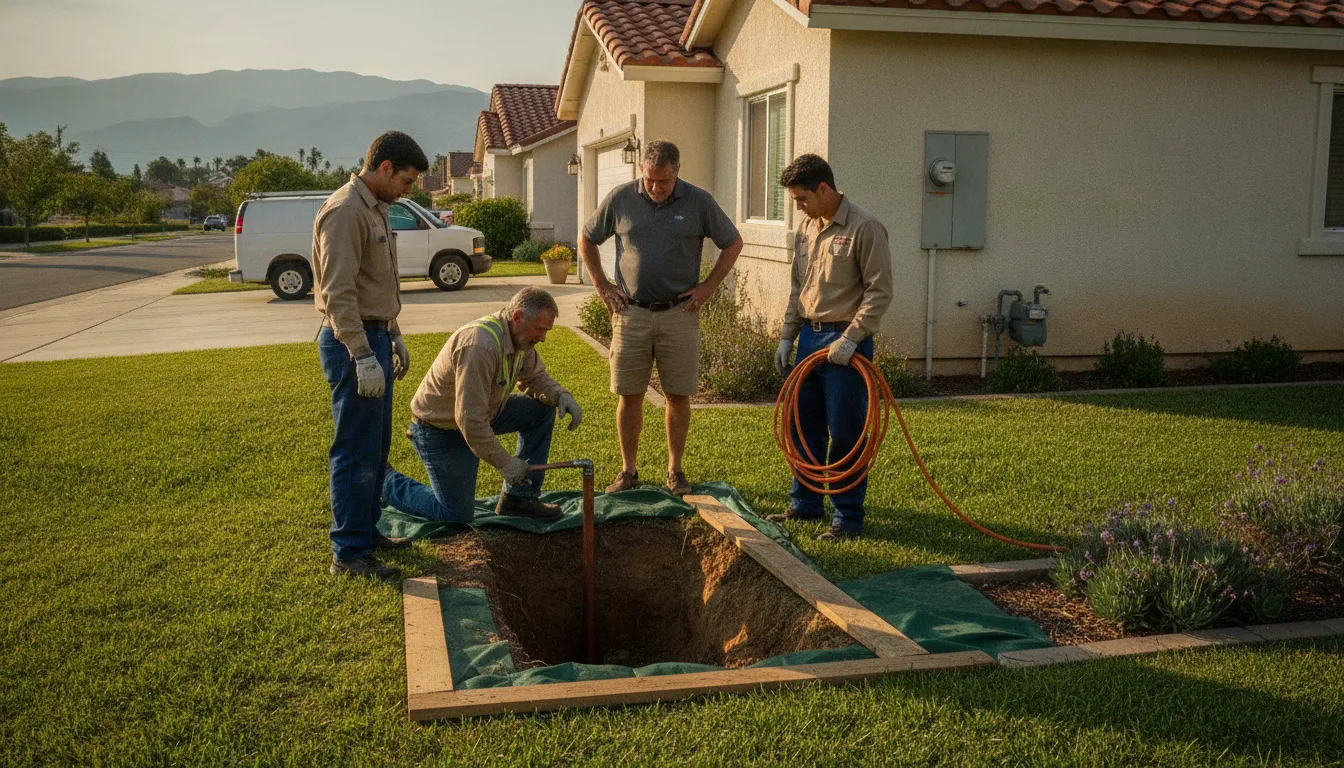
A qualified contractor should recommend a replacement approach based on the line’s location, access, pipe condition, surface above it, and the property’s operating needs. Traditional excavation may provide direct access for inspection and installation. While a less disruptive approach may be worth evaluating where site conditions and the existing line make it practical. The important question is not which method sounds newest. Ask what evidence supports the recommendation and what work is included if conditions differ from expectations.
| Decision factor | What to ask | Why it matters |
|---|---|---|
| Access and existing surfaces | Where will equipment enter, and what happens to driveways, landscaping, parking, or finished areas? | It sets realistic expectations for access, protection, and restoration. |
| Pipe condition and route | Does the proposed method fit the line’s material, route, depth, connections, and known defects? | A method should fit the actual site, not just a sales description. |
| Service interruption | When will water be shut off, and how will occupants or staff be notified? | Residents and businesses can plan around the disruption. |
| Restoration and contingencies | What surfaces will be restored, and how are unexpected conditions handled? | The written scope is clearer before authorization. |
Public water-line projects commonly warn that work can affect traffic, driveways, parking, and water service. Longmont’s project guidance also notes that schedules are approximate and can change with weather or other factors. Portland’s replacement-project description acknowledges that construction can be disruptive for residents home during the day: review its resident impact example. These sources are useful planning references, not promises about a local project’s timing.
Before signing, require the proposal to identify protection measures, access limits, shutdown planning, cleanup, and restoration responsibilities. That level of detail lets you compare main water line replacement companies on project control and property care, rather than on method labels alone.
Ask How the Company Handles Scheduling, Shutoffs, and Restoration
A well-planned water line project should account for more than the pipe itself. Before hiring one of the main water line replacement companies you are considering, ask how the work will affect your household, tenants, customers, employees, parking, and daily access. The answers can reveal whether the contractor has thought through the project from start to finish.
Confirm the outage plan before work begins
Ask when water must be shut off, how long each interruption is expected to last, and who will receive notice. Planned interruptions should not come as a surprise. A public water-line project in Durham, North Carolina, states that residents will be notified in advance of short-term planned water interruptions. Which is a useful communication standard to ask about locally: review the project notice. Your contractor should also explain any utility coordination, access requirements, and steps needed before the crew arrives.
Discuss access, schedule changes, and business continuity
Clarify where crews, equipment, and materials will be staged. Ask how driveway access, tenant entrances, parking, landscaping, or customer traffic will be managed. Weather, site conditions, and discoveries below ground can affect a planned schedule, so ask how changes will be communicated and who your point of contact will be. For a commercial property, request a plan for protecting operations during the work. Diamond House Plumbing works with high-traffic properties and dealerships with a focus on limiting business disruption, an important consideration for Inland Empire businesses.
Put restoration and warranty terms in writing
The proposal should state what happens after the new line is installed. Ask who is responsible for backfilling, surface cleanup, and restoring affected areas, and whether those items are included in the written scope. Also ask what warranty applies, what it covers, how long it lasts, and how a concern is reported. Clear written terms for schedule, restoration, and warranty give residential and commercial property owners a practical basis for comparing contractors, rather than relying on verbal assurances.
What Should Homeowners and Businesses Ask Before Hiring?
The right questions help you compare main water line replacement companies on project fit, communication, and coordination rather than on a vague promise. For properties in Riverside and San Bernardino Counties, ask the following before selecting a contractor.
- Homeowners: What portion of the line will you evaluate and include? Ask the contractor to explain the project boundary, the connection points, and what remains outside the proposed work. Because water-line responsibility can vary around the meter and by jurisdiction, ask what you should confirm with your local utility.
- Homeowners: How will you document the proposed scope? Request a written explanation of the diagnosis, access needs, expected water shutoffs, restoration work, and any decisions you must make before scheduling. Ask who will communicate changes if site conditions alter the plan.
- Homeowners: What terms should I review before approving? Clarify the schedule, cleanup and surface restoration, warranty language, and the process for questions during the project. A clear answer is more useful than a broad assurance that everything will be handled.
- Business owners: How will the work limit disruption to customers, staff, and operations? Ask about access, staging, parking, water interruptions, and communication with your property manager or tenants. Commercial work should account for business continuity, especially at high-traffic properties and dealerships.
- Business owners: What coordination is needed for multiple service connections? If the property is in Riverside and has more than one water service connection per parcel, ask how the contractor will address utility approval and possible backflow-assembly requirements. Riverside Water Rule 11 says advance Water Utility approval may be required: review the local rule and confirm the current process.
- Business owners: Who owns communication from planning through restoration? Establish one point of contact, update expectations, restoration responsibilities, and how schedule changes will be documented. For additional commercial selection guidance, read how to choose a commercial plumbing company.
How to Compare Proposals Without Choosing on Price Alone
A proposal is useful when it lets you compare the work, not just the total. Main water line replacement companies may describe similar projects in very different levels of detail. Look for a written scope that explains how the problem was evaluated, which section of line is included. How access will be handled, and what happens after the pipe work is complete.
| Proposal element | What it should explain | Why it matters |
|---|---|---|
| Diagnosis | The observed issue, testing or inspection performed, and the reason replacement is recommended. | Shows that the proposed work follows a defined problem rather than an assumption. |
| Scope and materials | The line segment, access needs, pipe details, connections, and included restoration. | Reduces ambiguity about what the contractor will actually complete. |
| Coordination | Permits, utility requirements, meter boundaries, inspections, and customer responsibilities. | Surfaces approvals or handoffs that could affect the project plan. |
| Schedule and communication | Expected sequence, access windows, service interruptions, updates, and schedule-change process. | Helps households plan and helps businesses protect daily operations. |
| Restoration and warranty | Cleanup, driveway or landscape restoration, warranty terms, and how follow-up concerns are handled. | Clarifies what happens after installation instead of leaving closeout undefined. |
Also verify the basics before comparing scope. Cal Water notes that a contractor’s license, insurance, project references, and other information may be required in some construction processes. Requirements vary by project and jurisdiction, so ask each company what documentation applies to your property rather than assuming one process fits every location.
Ask whether the company can evaluate the issue, explain the proposed scope, and coordinate the practical details in one clear plan. The written proposal should make the contractor’s responsibilities and any utility or property-owner responsibilities easy to distinguish.
Contact the plumbing team to discuss diagnosis and project planning.
Frequently Asked Questions
Do plumbers replace main water lines?
Yes. A qualified plumbing contractor can evaluate the affected line, confirm whether repair or replacement is appropriate, define the work area, and coordinate the installation. Ask whether the proposal identifies the line segment, access requirements, pipe size and material, shutoff plan, restoration, and warranty terms.
How much does a main water line replacement cost?
The project cost depends on the line’s length, depth, material, access, connection points, surface restoration, and local coordination requirements. Request a written proposal after an on-site diagnosis. It should separate the scope of work from optional items so you can compare proposals accurately without relying on a generic estimate.
Does homeowners insurance cover main water line replacement?
Coverage depends on the policy, the cause of the damage, exclusions, and whether the affected portion is considered part of the home or an outside service line. Review your policy and contact your insurer before authorizing non-emergency work. A plumber can document observed conditions, but the insurer determines coverage.
What should I verify before hiring a replacement contractor?
Verify applicable licensing and insurance, relevant residential or commercial experience, references, the diagnosis, written scope, utility or meter coordination, schedule, restoration plan, and warranty terms. Requirements can vary by jurisdiction, so confirm which approvals apply to your Riverside or San Bernardino County property.
Plan Your Water Line Replacement With a Clearer Next Step
A clear diagnosis and written project scope can help you understand the work ahead and compare options with greater confidence. Diamond House Plumbing serves residential and commercial property owners across Riverside and San Bernardino Counties. To discuss your situation and next steps, contact the plumbing team through the contact page.

Leave a Reply