
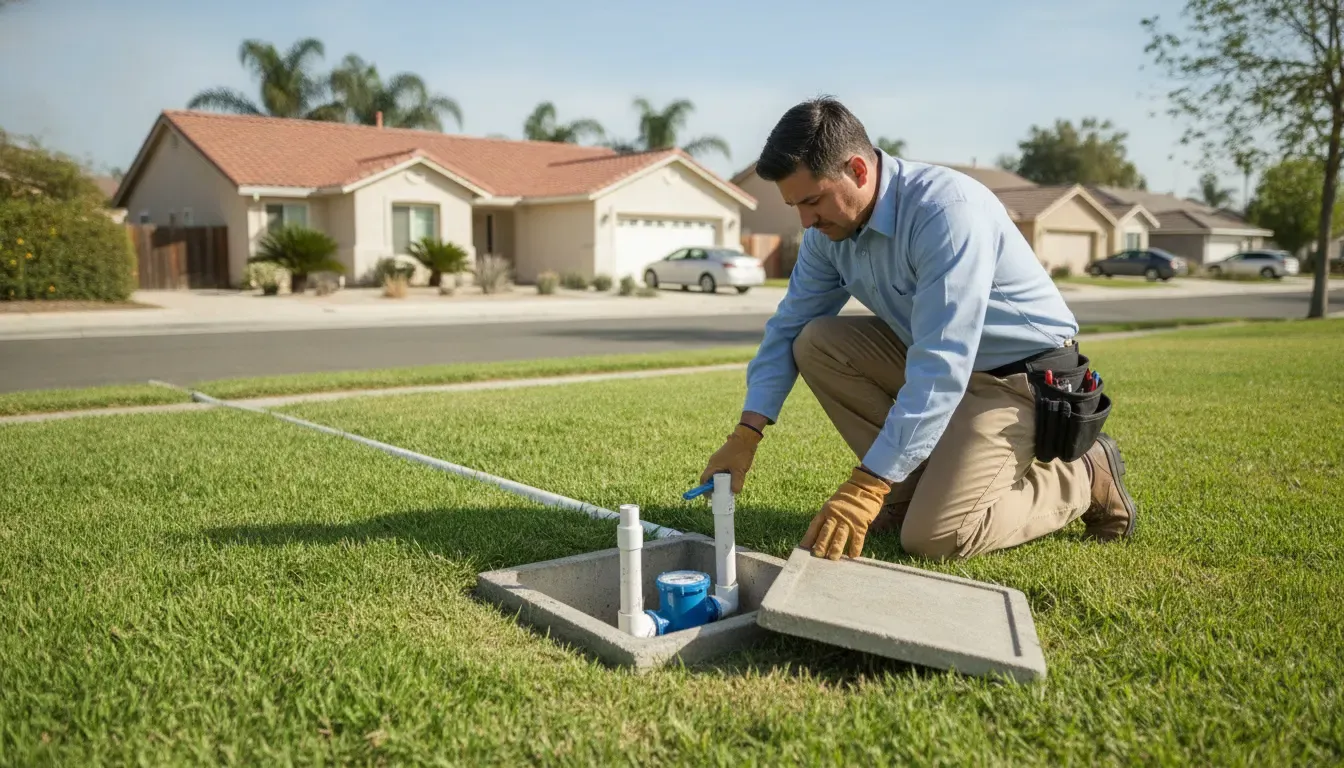
If you are asking who is responsible for the water line from the street to the house, start with the water meter. In many service areas, the water provider maintains the public portion up to the meter, while the property owner maintains the private line from the meter to the home. The exact boundary can vary by utility rules, easements, and the location of the leak, so confirm responsibility before authorizing work.
Contact Diamond House Plumbing if you need help evaluating an owner-side water line problem in Riverside or San Bernardino County.
Where does utility responsibility usually end?
The usual responsibility boundary is the water meter, but the precise point may be the meter outlet coupling, a curb stop, or another connection defined by the local provider. The utility generally manages its public water main and the service connection on the utility side. The owner generally manages the private service line and plumbing after the provider’s connection point.
That pattern is documented by several California water providers. San Jose Water says it is responsible from the water main to the meter outlet coupling, while the customer is responsible from that coupling to the home. Cal Water states that its responsibility is on the utility side of the meter and customers maintain plumbing on their side. The City of Sonoma describes the public portion as the pipe from the main to the meter and the owner portion as the pipe from the meter to the building.
These examples are useful guidance, not a substitute for your own provider’s rules. In Riverside and San Bernardino County, the water agency, city, or district serving your address may define the boundary differently. An easement, shared service line, private water system, or unusual meter arrangement can also change who must coordinate the repair.
For primary-source examples, review San Jose Water’s service-line responsibility guide, Cal Water’s guidance on plumbing leaks, and the City of Sonoma’s water service-line explanation.
Which part of the water line is the property owner’s responsibility?
In a typical individually metered property, the owner-side portion starts at the utility’s designated connection at or near the meter and continues to the house or other building. It may run under a lawn, driveway, walkway, landscaping, or another part of the property. The owner-side system can include the private service pipe, a house shutoff valve, and interior or exterior plumbing after the meter.
| Location or component | Typical party to contact first | Why confirmation matters |
|---|---|---|
| Water main under the public street | Water provider | The main is normally part of the public distribution system. |
| Connection from the main toward the meter | Water provider | The provider’s service rules define the maintenance boundary. |
| Meter and meter box | Water provider | Do not tamper with or remove the meter. |
| Private line from the meter to the house | Property owner and a qualified plumber | This is commonly owner-side plumbing, but easements and local rules can affect responsibility. |
| House shutoff, fixtures, and interior pipes | Property owner and a qualified plumber | These components are part of the property’s plumbing system. |
The table shows the common pattern, not a guarantee for every address. A provider’s service agreement, rate rules, or field representative may control the final answer. If the line serves more than one property or crosses an access easement, ownership and repair coordination can require additional review.
How can you tell whether a leak is before or after the meter?
A leak’s location can offer a useful first clue, but it does not establish responsibility by itself. Water near the street, meter box, or public-side connection should be reported to the water provider. Water between the meter and the house often points to the private service line. A professional evaluation can help identify the affected section without relying only on where water appears at the surface.
- Check whether the water meter continues moving when every indoor and outdoor fixture is off, if your provider allows you to observe the meter.
- Look for unexplained wet soil, a soft area, erosion, or unusually green vegetation along the route from the meter to the house.
- Notice whether water pressure has changed throughout the property rather than at only one fixture.
- Check visible shutoff areas for standing water, but do not open, remove, or tamper with a utility meter.
- Ask the water provider whether it can inspect or identify the utility-side connection before arranging private work.
Surface water can travel away from the actual break, and irrigation leaks can resemble a service-line leak. A pressure issue can also come from a valve, fixture, or interior plumbing. Diamond House Plumbing can help property owners investigate the private side when the provider confirms that the issue is beyond the utility’s responsibility.
What should you do before calling a plumber?
Before scheduling a water line repair, gather enough information to avoid sending the wrong party to the wrong section of pipe. Start with the water provider for your address, then document what you observe. The goal is not to diagnose the buried line yourself. The goal is to establish the likely location, protect the property, and give the plumber useful facts for planning.
- Identify the provider. Use a recent water bill or the provider’s service-area lookup. Save the emergency or leak-reporting contact information.
- Ask where the provider’s responsibility ends. Request the exact point used for your address, such as the meter outlet, coupling, or curb stop.
- Ask about shutoff procedures. If water must be turned off at the meter, follow the provider’s instructions. Do not force a stuck valve or disturb the meter assembly.
- Document the symptoms. Take photos of wet areas, note when the problem occurs, and record any change in pressure or water use.
- Check for property records. Site plans, prior repair records, and easement documents may show the service-line route or a shared connection.
- Arrange an owner-side evaluation. If the provider confirms the suspected problem is on private property, contact a plumbing professional to assess the line and discuss repair options.
Review Diamond House Plumbing’s residential plumbing services for help with private-side plumbing concerns in the Inland Empire.
When does a private water line need repair or replacement?
A private service line may need repair or replacement when it has a persistent leak, repeated failures, severe corrosion, crushed or displaced sections, or a material and condition that no longer support reliable service. A plumber should evaluate the line’s condition and route before recommending a full replacement. One visible wet spot does not automatically mean the entire line must be replaced.
Repair may be appropriate when the damage is isolated and the remaining pipe is in suitable condition. Replacement may make more sense when failures recur, access is difficult, or multiple sections have deteriorated. The best approach depends on the pipe material, depth, route, soil, access, connections, and local requirements. Diamond House Plumbing’s main water line repair guide explains warning signs and evaluation considerations, while the existing main water line replacement guide covers replacement planning and process questions.
Ask for a clear explanation of which segment is affected, how the diagnosis was made, what access the work requires, and whether utility coordination or permits may be needed. You can also ask how water service will be protected during the work and how disturbed surfaces will be addressed. These questions help you compare the scope of proposed work without choosing a method based only on the symptom.
Does the water meter always determine responsibility?
The meter is a helpful reference point, but it does not always settle the question by itself. Local rules may assign responsibility to a particular coupling or valve, and a private easement or shared line can create additional obligations. The provider’s written service rules and a property-specific inspection are more reliable than a general assumption about where the meter sits.
Responsibility can be less straightforward in several situations:
- The meter is located far from the property line or house.
- A private line crosses a public easement or serves multiple buildings.
- The property uses a shared meter, master meter, well, or private water system.
- The visible leak is inside a meter box or near a provider-owned valve.
- A prior owner installed or altered part of the service connection.
- The property is part of a commercial, condominium, or multi-unit development with separate maintenance documents.
For properties in Riverside or San Bernardino County, contact the water provider first when the leak appears close to the street or meter. If the provider confirms that the affected segment is owner-side, Diamond House Plumbing can help assess the plumbing conditions and outline practical next steps for the property.
Frequently asked questions
Who is usually responsible for the water line from the street to the meter?
The water provider is usually responsible for the public water main and the service connection up to a provider-defined point at or near the meter. The exact boundary varies, so contact the provider serving your address before arranging work near the street or meter.
Who is usually responsible for the line from the meter to the house?
The property owner is usually responsible for the private service line from the meter to the house, along with the home’s plumbing. Easements, shared lines, private systems, and local service rules can change that result, so confirm the boundary for the specific property.
Should I call the water company or a plumber first?
Call the water provider first when the leak appears at the street, public-side connection, or meter area, or when you are unsure where the boundary lies. Contact a plumber when the provider confirms the issue is on the private side or when the problem is clearly beyond the meter.
Can I turn off the water at the meter?
Follow the instructions of the water provider serving your address. Do not remove, tamper with, or force a utility meter or its fittings. If water needs to be shut off urgently, ask the provider how to do so safely or use the property’s owner-side shutoff when it is accessible and functioning.
Does a leak after the meter always require water line replacement?
No. A leak after the meter may involve an isolated repair, a valve, a fixture, or a larger section of private service line. A plumbing evaluation can help determine the location and condition of the pipe before you choose between repair and replacement.
What information should I give a plumber about a suspected service-line leak?
Share the provider’s responsibility determination, the approximate meter and house locations, photos of wet areas, pressure changes, timing, prior repairs, and any available site or easement records. This information helps the plumber plan an evaluation and explain the next step.
If you need help with a suspected private water line issue, contact Diamond House Plumbing to discuss the property and the next evaluation step.

Leave a Reply