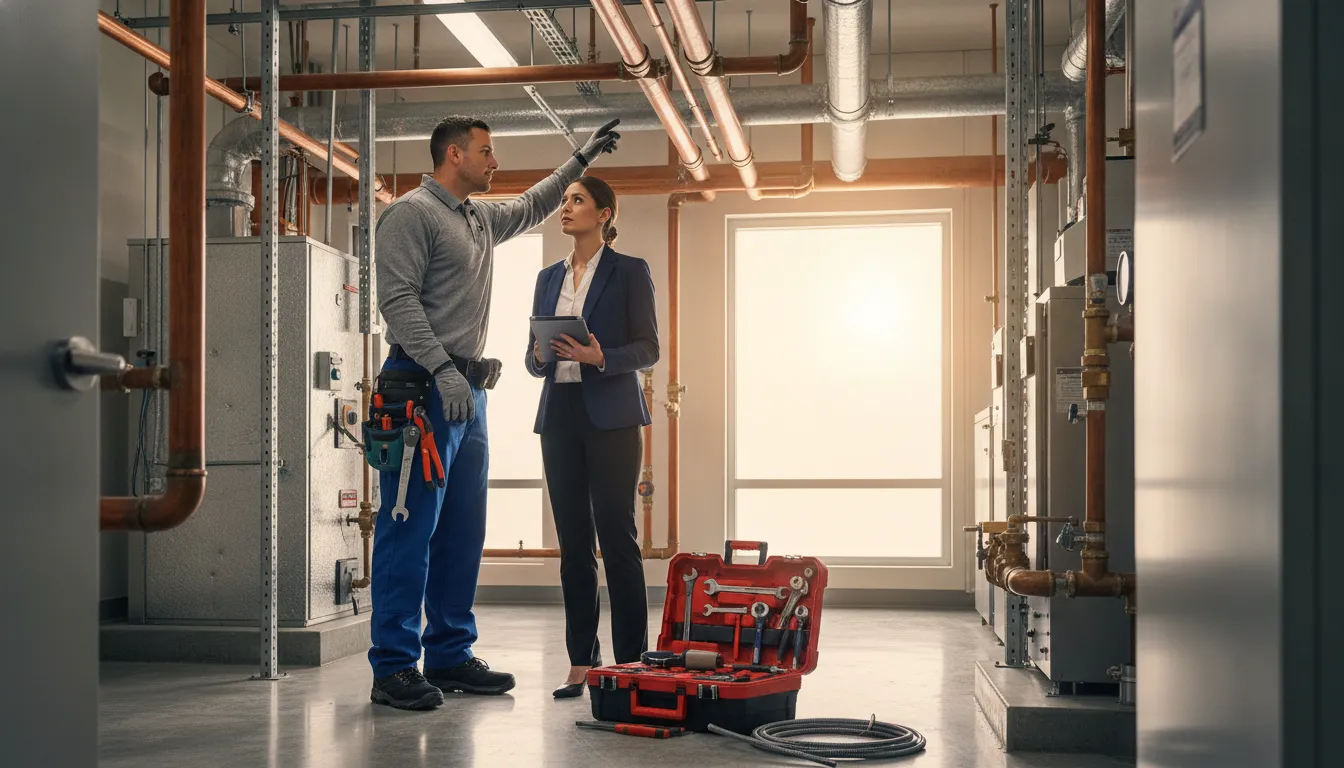
For a business owner or property manager, the right commercial plumber does more than fix a visible leak. The contractor should understand occupied buildings and protect daily operations. The plumber should also explain the scope clearly and recognize aging water or sewer infrastructure.
The best commercial plumbers are selected by relevant commercial experience, clear diagnosis, and code-aware work. They should also offer continuity planning, service coverage, and transparent communication, not just a vague claim or lowest quote. In Riverside and San Bernardino County, compare how each provider fits your property, systems, and operational needs.
That evaluation starts with practical questions about the building, the plumber’s capabilities, and the evidence behind the proposed work. The following criteria can help you make a confident comparison before a plumbing issue disrupts your property.
How to Choose the Best Commercial Plumbers for Your Property
There is no universal ranking that identifies the right commercial plumber for every property. The best fit depends on the building, plumbing systems, operational risks, and scope of work. A retail site, office building, dealership, and industrial property may each need a different combination of repair, maintenance, sewer, water, and emergency support. If you are evaluating a project in Riverside or San Bernardino County, contact Diamond House Plumbing about commercial service and discuss the property conditions before comparing proposals.
Look for relevant commercial experience
Ask whether the plumber regularly works in occupied commercial properties similar to yours. Commercial work requires more than technical repairs. It may involve coordinating access, protecting customers and employees, limiting disruption, documenting findings, and restoring affected areas. Ask for examples of work involving your property type and the systems that matter most to your operation.
Match the service scope to the property
A provider should be able to explain which parts of the project it can handle and when a specialist or additional trade is needed. Useful capabilities may include leak detection, water lines, fixtures, water heaters, drains, sewer laterals, lift stations, hydro jetting, system upgrades, and preventive maintenance. A contractor with experience in complex sewer infrastructure or septic systems may be especially relevant when those systems serve the property.
Review the provider’s commercial plumbing services in the Inland Empire and confirm that the listed services align with your actual needs. For a facility that relies on hot water, also ask about commercial water-heater services and ongoing support.
Evaluate planning and communication
Before work begins, ask how the plumber will diagnose the issue, define the scope, communicate changes, and plan around business hours. Discuss emergency response procedures, scheduled maintenance, access requirements, expected disruption, and property protection. Clear answers are more useful than broad promises.
Request documented capability and a clear evaluation
Confirm that work will be performed by qualified, licensed plumbers in accordance with applicable local plumbing codes. A dependable proposal should reflect an on-site evaluation, explain the recommended work, identify assumptions, and separate confirmed findings from items that require further investigation. Pricing should be explained as part of the consultation rather than treated as the only measure of value.
Finally, consider local accountability. A locally owned provider serving the Inland Empire can offer relevant knowledge of regional properties while maintaining direct responsibility for communication and follow-up. Choose the plumber whose experience, scope, planning, and documentation best match the way your property operates.
What Experience Should a Commercial Plumbing Company Have?
Commercial plumbing experience should extend beyond fixing an isolated leak. The right contractor understands how plumbing work affects employees, customers, tenants, inventory, and daily operations. That matters whether the property is an office, retail establishment, car dealership, older commercial building, or another occupied facility in Riverside or San Bernardino County.
Start by asking whether the company regularly works in occupied commercial properties. Experienced commercial plumbers should be able to discuss access, work areas, communication, cleanup, and ways to limit disruption while the business remains open. They should also understand that a plumbing issue may require coordination with a property manager, facilities team, tenants, or other trades.
Look for a service scope that matches the property
Commercial systems can involve more than visible fixtures. A capable company should be comfortable evaluating water lines, fixtures, leaks, water heaters, drains, sewer lines, sewer laterals, and system upgrades. Depending on the site, the scope may also include lift stations, hydro jetting, preventive maintenance, or system rerouting. This breadth helps a business owner avoid choosing a contractor who can address one symptom but cannot investigate the larger system.
Older infrastructure deserves particular attention. Aging pipes, outdated layouts, recurring blockages, and complex sewer systems may require careful diagnosis before a repair or replacement plan is proposed. Ask how the plumber identifies the source of a problem, explains options, and distinguishes an immediate repair from a longer-term upgrade.
Ask about specialized commercial and site conditions
Some properties depend on sewer laterals or septic systems, while others have high-use restrooms, commercial water heaters, or demanding drainage needs. A contractor with relevant experience should be able to explain the equipment and methods appropriate to the site without turning the evaluation into a generic repair tutorial. Professional-grade equipment can support diagnosis and cleaning, but the equipment should serve a clear scope of work.
Code-aware planning is another important criterion. Work should account for applicable local plumbing requirements, the property’s configuration, access conditions, and restoration needs. Ask what documentation will be provided and how the proposed work will be explained before it begins.
For a contractor that covers these considerations, review the scope of commercial plumbing services in the Inland Empire and compare it with your property’s actual needs. The best commercial plumbers are not defined by a label alone. They are evaluated by relevant experience, clear communication, appropriate equipment, and a plan that protects business continuity.
How Can You Compare Commercial Plumbers Before Hiring?
The best commercial plumbers for one property may not be the right fit for another. A retail site, office building, dealership, or older commercial property can have different access limits, operating schedules, and plumbing infrastructure. Compare providers against the work your property actually needs, then ask for evidence that supports each answer.
| Evaluation factor | Questions to ask | Evidence or signal |
|---|---|---|
| Commercial experience | Have you worked in properties similar to ours, such as offices, retail locations, or dealerships? | Relevant project examples, a clear understanding of occupied commercial sites, and a plan for protecting daily operations. |
| Service scope | Can your team handle the likely systems, from fixtures and water lines to drains, sewer laterals, lift stations, or water heaters? | A defined service range that matches the property’s needs, including specialized sewer or septic infrastructure when applicable. |
| Diagnosis | How will you identify the cause before recommending repair or replacement? | A site evaluation, clear explanation of findings, and a proposed solution tied to observed conditions rather than assumptions. |
| Continuity and disruption planning | How will you limit interruptions to employees, customers, tenants, or vehicles? | Discussion of access, work sequencing, affected areas, shutdown requirements, cleanup, and restoration after the work. |
| Communication | Who explains the scope, changes, and next steps to the property contact? | One accountable point of contact, plain-language updates, and a process for documenting decisions or changed conditions. |
| Maintenance support | Can you help us plan ongoing service after the immediate issue is addressed? | A practical maintenance discussion based on the property’s systems, usage, recurring concerns, and operational priorities. |
| Estimate clarity | What is included, what conditions could change the scope, and how will those changes be explained? | An evaluation-based estimate that separates the recommended work, access or restoration considerations, and any stated assumptions. |
Do not treat a polished proposal as a substitute for technical fit. A provider should be able to explain how the diagnosis supports the proposed work and how the project will affect the property. For a deeper look at ongoing planning, review this guide to commercial plumbing maintenance planning.
For businesses in Riverside and San Bernardino Counties, local coverage can also matter when follow-up, infrastructure knowledge, or coordination with an occupied property is important. The strongest comparison is the one that leaves you with a clear scope, realistic operational plan, and an understandable path from evaluation to completion.
What Should a Commercial Plumbing Proposal Include?
A useful proposal should help a business understand the problem, the planned work, and how the project will affect daily operations. Review it as an operating plan, not just a description of plumbing tasks.
- A clear problem definition. The proposal should identify the reported issue, the affected areas, and the business impact. A recurring drain problem, hidden leak, sewer backup, or failing water line may affect different parts of the property and require different planning.
- Diagnosis and supporting findings. Look for the method used to evaluate the condition, such as visual inspection, leak detection, or sewer video inspection. Ask whether the proposal explains the limits of the diagnosis and includes useful records, photos, or inspection documentation. Detailed records can help property owners make informed decisions about sanitary sewer work.
- Access and site requirements. The scope should explain where technicians need access, whether equipment must be moved, and how tenants, customers, employees, or delivery areas may be affected. This is especially important for occupied offices, retail locations, dealerships, and other active properties.
- Operational downtime planning. A commercial proposal should address how work will be sequenced to limit disruption. It may identify shutdown areas, coordination responsibilities, temporary facilities, or steps for maintaining essential operations. These details are more useful than a vague promise that the work will be convenient.
- Restoration and property care. Confirm what happens after the plumbing work, including cleanup, access-point treatment, surface restoration, and removal of equipment or debris. Underground sewer work may require particularly clear restoration expectations.
- Communication and documentation. The proposal should name the communication process, decision points, approvals, and records the property owner will receive. Ask how changes in scope, newly discovered conditions, and completion status will be documented.
- An evaluation-based estimate. Favor an estimate tied to an on-site evaluation, defined scope, and explained assumptions. Diamond House Plumbing describes its estimates as following an on-site evaluation, with scope and pricing discussed during consultation. A clear proposal should make it possible to compare the work being recommended, not just a headline figure.
Why Local Coverage Matters for Inland Empire Businesses
For a commercial property, plumbing support is tied to more than the repair itself. A backed-up drain, failing water line, or sewer problem can affect employees, tenants, customers, deliveries, and daily operations. Choosing a contractor that serves Riverside and San Bernardino Counties gives property owners a practical advantage when continuity and clear communication matter.
Support for occupied properties
Commercial work often takes place while a building remains active. Retail establishments, offices, dealerships, and other occupied properties may need a plan that limits disruption, protects surrounding areas, and explains what access or temporary shutdowns are required. A contractor familiar with commercial settings can discuss the work in operational terms, not only describe the plumbing component that needs attention.
Local coverage can also make coordination more straightforward. Facility managers and property owners may need to align plumbing work with tenants, vendors, building access, or other contractors. Clear updates about diagnosis, scope, scheduling, and restoration help the right people make decisions before the work expands.
Accountability across the service area
Local accountability matters when a property needs follow-up, preventive maintenance, or additional work after an evaluation. Diamond House Plumbing serves commercial and residential properties throughout Riverside and San Bernardino Counties and more than 30 Inland Empire cities. Its scope includes general commercial plumbing, water lines, fixtures, water heaters, drains, sewer laterals, lift stations, and system upgrades.
That breadth is useful when a commercial issue involves connected systems rather than a single fixture. It is also important for older properties and sites with more complex sewer infrastructure. Where the right provider should explain the condition found on site and the available path forward. Learn about Diamond House Plumbing and its local service approach before choosing a contractor for your property.
Local service does not replace careful evaluation. Ask how the plumber will protect business continuity, communicate with stakeholders, document the scope, and restore affected areas. Those answers are stronger evidence of fit than a generic claim to be the best.
When Should a Business Schedule Commercial Plumbing Service?
Businesses should schedule commercial plumbing service when a problem is recurring, disrupting operations, or likely to affect customers, employees, equipment, or the property. Waiting until a fixture stops working can turn a manageable concern into an interruption that requires urgent attention. A timely evaluation also helps decision-makers choose the right scope instead of authorizing temporary work without understanding the underlying issue.
Do not ignore recurring warning signs
Slow drains, repeated backups, sewer odors, inconsistent water pressure, unexplained moisture, and fixtures that frequently need attention all deserve review. These symptoms may point to a larger issue in a building drain, sewer lateral, water line, or older plumbing system. Businesses with septic systems or lift stations should also plan service when performance changes, rather than waiting for a complete failure.
Schedule service when leaks or water damage appear
A visible leak is a reason to act promptly, even when the affected area seems minor. Leaks can damage finishes, interrupt operations, and create conditions that become more difficult to address over time. A commercial plumber can assess the source, explain the likely scope, and help the property owner plan access and restoration around the business schedule.
Plan for drains, sewer systems, and water heaters
Drain or sewer concerns should be evaluated when backups recur, flow changes, or odors return after prior service. This is especially important for occupied properties that depend on reliable restrooms, kitchens, production areas, or customer-facing spaces. Water heaters also warrant attention when hot water becomes inconsistent, recovery slows, or the system no longer fits the building’s needs. Review available commercial water-heater services when repair, replacement, or a system upgrade is being considered.
Schedule before a system change or busy period
Renovations, tenant changes, added fixtures, equipment installation, and building expansions can alter demand on existing plumbing. An evaluation before work begins may identify rerouting, capacity, sewer, or code-related considerations early. Preventive planning is also useful before a seasonally busy period or when a property manager needs documented continuity planning. The goal is not to perform an extensive checklist at every visit. It is to address meaningful signals, understand the system’s condition, and schedule work with less disruption to the business.
Frequently Asked Questions
What should I look for when choosing the best commercial plumbers?
Look for relevant commercial experience, clear communication, code-aware work, a service scope that fits your property, and a plan for minimizing disruption. Ask how the plumber documents findings, protects the site, coordinates access, and handles follow-up after the work.
How can I tell whether a plumber has enough commercial experience?
Ask about comparable properties and systems, such as offices, retail locations, dealerships, water lines, sewer laterals, lift stations, or water heaters. A qualified provider should explain its diagnostic process and show how it adapts the work plan to an occupied business.
What should a commercial plumbing proposal include?
A useful proposal should define the observed problem, recommended work, access requirements, expected disruption, restoration responsibilities, documentation, and communication process. It should separate confirmed findings from items that require additional investigation.
How should a business prepare for a plumbing emergency?
Identify the shutoffs, document critical plumbing equipment, establish an emergency contact process. And ask prospective plumbers how they handle sewage backups, system failures, and communication during an active incident. Planning ahead can support continuity when a problem affects operations.
How does the estimate process for commercial plumbing usually work?
A responsible estimate begins with an on-site evaluation so the plumber can inspect conditions and understand access, scope, and operational constraints. The consultation should explain the recommended work and pricing before you authorize the project.
Get Started With a Commercial Plumbing Evaluation
The right commercial plumbing partner can help you clarify the issue, plan the work, and protect day-to-day operations at your property. If you manage a business, facility, or commercial property in Riverside or San Bernardino County, contact Diamond House Plumbing through the contact page to discuss your needs and request an evaluation. Sharing your property type, current concern, and scheduling requirements can help the team understand how to assist.

Leave a Reply