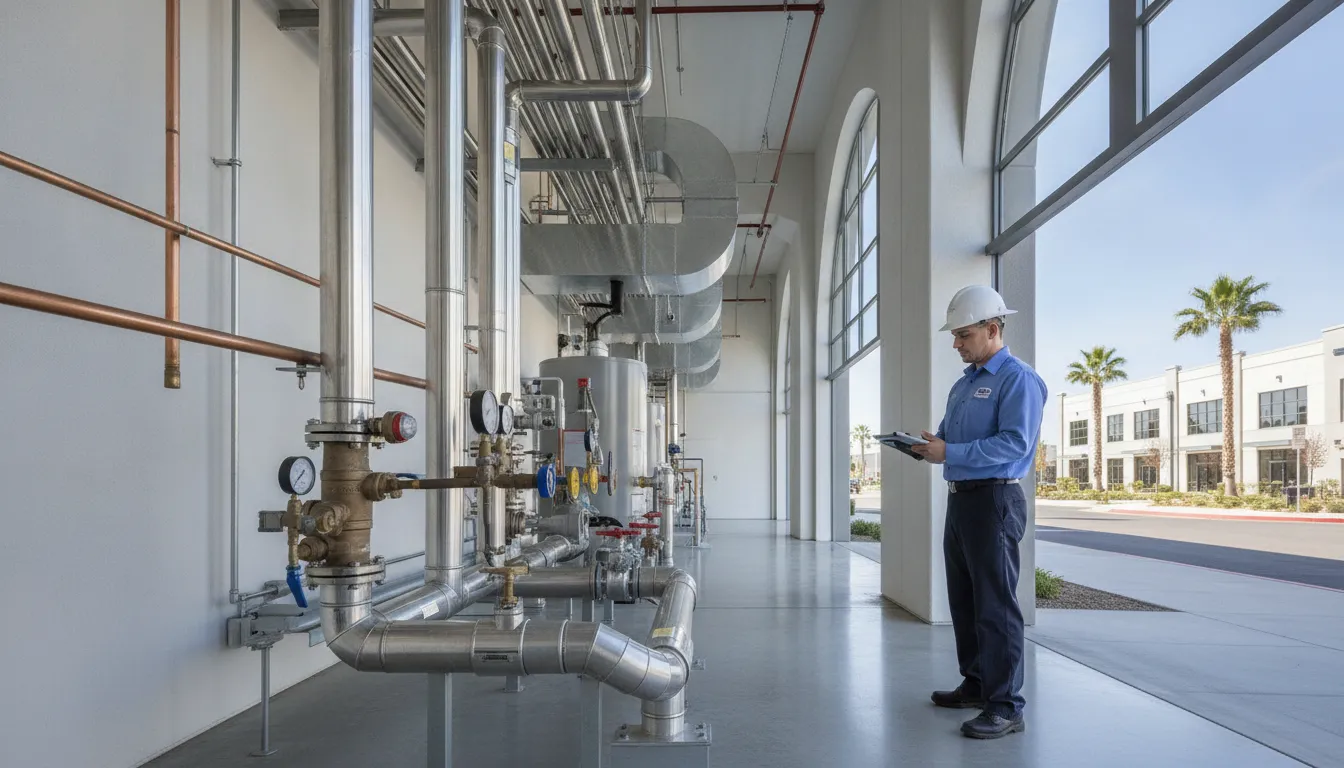
A plumbing failure can interrupt operations long before it becomes a visible flood. For Inland Empire businesses, grease buildup, aging sewer laterals, backflow risks, and overlooked fixture leaks can create downtime, water damage, and unplanned repair costs.
Commercial plumbing maintenance Inland Empire businesses can rely on combines scheduled drain and sewer inspections. Regular grease trap service, certified backflow testing, leak checks, and documentation of required compliance work. A preventive plan helps facility managers address small issues before they become emergencies and supports continuity across Riverside and San Bernardino County properties.
Regional conditions make consistent inspections especially important. Inland Empire properties with older plumbing infrastructure may need closer attention. While commercial facilities must also account for local requirements and the practical demands of keeping employees, customers, and tenants safe. The right maintenance schedule starts with understanding which systems place the greatest risk on your operation.
Commercial Plumbing Maintenance Inland Empire: Why Commercial Plumbing Maintenance Matters for Inland Empire Businesses
For a business in Riverside, San Bernardino, or a neighboring Inland Empire community, plumbing is part of daily operations. Restrooms, kitchens, production areas, tenant spaces, and fire-safety systems all depend on reliable water and drainage. When a failure shuts down part of a facility, the disruption can extend beyond the repair itself. Staff may lose productive time, customers may face limited access, and a business may need temporary facilities while major work is completed. Regular commercial plumbing maintenance helps identify developing problems before they become an operational emergency.
Aging buildings deserve closer attention
Much of the Inland Empire’s building stock dates to the 1980s and 1990s. Older supply lines, drains, fixtures, and connections can continue serving a property effectively, but they should not be treated as maintenance-free. Age, use, water conditions, prior repairs, and building renovations can all affect how a system performs. More frequent inspections give facility managers an opportunity to spot leaks, corrosion, slow drainage, pressure changes, or other warning signs while the response can still be planned. This local aging-infrastructure concern is especially relevant for commercial properties with high occupancy or extended operating hours.
Planned repairs are easier to manage
Scheduled service gives owners and facility managers time to coordinate access, protect inventory, notify tenants, and choose an appropriate repair window. Emergency work is often more disruptive because the problem dictates the timing and scope. A proactive program can also prevent premature failure of plumbing components and reduce unplanned capital expenditures, helping businesses manage long-term facility costs. Service agreements with a professional plumber can make routine expenses easier to forecast instead of leaving every repair to an urgent decision.
Preventive service helps limit water damage
A small leak or weakening connection can affect walls, flooring, equipment, stored materials, and neighboring spaces if it goes unnoticed. Preventive maintenance reduces the risk of water damage and related property loss by addressing vulnerable components before they fail. It should include appropriate inspections, drain and sewer-line attention, and clear documentation of findings. For businesses seeking commercial plumbing maintenance in the Inland Empire, a local professional can help build a practical schedule around the property’s age, use, and operating needs.
Grease Trap Maintenance: Keeping Your Commercial Kitchen Compliant
Commercial kitchens need a dependable grease management system because fats, oils, and grease can accumulate in traps and downstream sewer lines. Without routine attention, that buildup can restrict flow, create foul odors, and contribute to a blockage that disrupts food service. Grease management is a core part of commercial plumbing maintenance Inland Empire businesses should plan rather than handle only after a drain has stopped working.
Set a service schedule based on kitchen use
Grease traps must be serviced and inspected regularly to support compliance with applicable pretreatment requirements and keep the drainage system functioning properly. The right interval depends on factors such as the trap or interceptor size, kitchen volume, menu, and the amount of grease entering the system. A high-volume restaurant may need more frequent service than a smaller facility. Your plumber can evaluate operating conditions and recommend a documented schedule.
Between professional visits, kitchen staff should avoid sending cooking oil, grease, food scraps, and excessive solids into sinks. Staff should also watch for slow drains, recurring backups, sewage odors, or visible grease near access points. These signs warrant prompt inspection, not repeated use of chemical drain products that may create additional problems.
Document inspections and corrective work
Keep service records that show the date of each pumping or cleaning, inspection findings, disposal documentation, and any repairs. A clear log helps facility managers demonstrate that maintenance is being performed and gives technicians useful history when diagnosing recurring problems. Local pretreatment agencies may also have specific requirements for inspection, access, cleaning, and record retention. So confirm the rules that apply to your Riverside or San Bernardino County facility.
Address neglect before it becomes an interruption
Neglected grease traps can allow material to reach sewer laterals, increasing the risk of blockages and emergency cleanup. Noncompliance may also lead to notices, enforcement action, or fines, depending on the applicable local requirements and severity of the issue. If your property also relies on onsite wastewater infrastructure, review related needs through Diamond House’s septic services team. Professional inspection and timely servicing protect kitchen operations, plumbing assets, and the surrounding sewer system.
Backflow Prevention: Protecting Your Commercial Water Supply
Commercial water systems can connect drinking water to equipment, irrigation, fire protection, or process lines. If pressure changes reverse the normal flow, contaminated water may enter the public supply. Backflow prevention protects customers, employees, neighboring properties, and the municipal system from that risk. California requires backflow prevention where cross-connections could create a hazard, and testing must be completed by certified professionals. The state’s Cross-Connection Control Policy Handbook took effect July 1, 2024.
Annual testing keeps assemblies reliable
Installing a backflow assembly is only the first step. Many commercial properties must have their assemblies inspected and tested annually, with certification submitted according to the requirements of the responsible water supplier or authority. Testing confirms that check valves, relief components, and related parts respond as intended. It can also identify corrosion, debris, failed seals, or changes in the system that could compromise protection.
Inspection and certification of backflow prevention assemblies are mandatory for many commercial and industrial facilities because they safeguard municipal water infrastructure. Requirements can vary based on the assembly type, the degree of hazard, and the local water purveyor. A missed test may lead to notices, additional administrative requirements, or loss of approved water protection until the issue is corrected.
Local compliance in Riverside and San Bernardino County
Businesses in Riverside and San Bernardino County should maintain an accurate inventory of backflow devices and confirm the testing schedule with the applicable city or water agency. Local requirements may differ between jurisdictions, especially for restaurants, medical facilities, industrial sites, irrigation systems, and properties with fire protection connections. Keep test reports, repair records, and certification documentation with the facility’s plumbing records so managers can respond quickly to an inspection notice.
A certified tester can evaluate each assembly, document the results, and recommend repairs or replacement when a device fails. Including backflow testing in a broader commercial plumbing maintenance Inland Empire plan helps facility managers address compliance work before it becomes a disruption to operations or a threat to water quality.
Drain Cleaning and Sewer Line Maintenance for Commercial Properties
Commercial drains and sewer laterals carry a heavier, more varied load than residential lines. Grease, sediment, scale, and recurring debris can gradually restrict flow, while a partial obstruction may become a backup during the busiest part of the workday. Regular cleaning and inspection help facility managers protect operating hours and address developing problems before they require an emergency shutdown.
| Method | Best for | How it works | Limitations |
|---|---|---|---|
| Drain snaking. | Localized clogs from hair, paper, or soft debris. | Metal cable breaks through or retrieves the obstruction. | Leaves grease and scale on pipe walls; may not fully restore flow capacity. |
| Hydro jetting. | Heavy grease, tree roots, stubborn buildup. | High-pressure water scours the interior of the line. | Requires sound pipe condition; not recommended for fragile or severely damaged piping. |
Choosing between snaking and hydro jetting
Drain snaking uses a cable to break through or retrieve an obstruction. It can be useful when a line has a localized blockage and the pipe condition is suitable for the equipment. However, opening a passage does not always remove the material clinging to the pipe walls.
Hydro jetting uses high-pressure water to scour buildup from the inside of a line. It is particularly effective against heavy grease, tree roots, and other stubborn obstructions that traditional snaking may not fully remove. High-pressure jetting can also clear buildup in smaller commercial lines and help restore available flow capacity. The appropriate method depends on the obstruction, pipe material, access points, and the condition of the line. A professional assessment should come first, especially when older or damaged piping is involved.
For a closer comparison of the two approaches, review commercial plumbing maintenance options for hydro jetting and drain cleaning.
Use camera inspections to find sewer lateral problems
Cleaning addresses current restrictions, but it does not necessarily explain why a sewer line keeps backing up. Periodic camera inspections allow technicians to view the interior of a lateral and identify conditions that are difficult to locate from the surface. Commercial sewer laterals can develop root intrusion or offset pipe sections over time, and these issues may cause repeated stoppages even after a line has been cleared.
Camera findings can guide the next decision: schedule another maintenance cleaning, remove an intrusion, repair a damaged section, or plan a larger correction during a controlled maintenance window. Keeping the inspection footage and service notes with the property record also gives facility managers a clearer history for future budgeting and scheduling.
Build cleaning into the maintenance plan
Rather than waiting for slow drains, odors, or backups, businesses can schedule drain cleaning based on line use, previous service history, and the materials entering the system. A technician can recommend an interval after reviewing the property and may pair scheduled jetting with camera inspections when recurring buildup or root intrusion is present. This practical approach supports reliable drainage while reducing disruption to staff, tenants, customers, and daily operations.
Plumbing Inspections and Code Compliance in the Inland Empire
For Inland Empire businesses, a plumbing inspection is more than a response to a visible leak. It is a practical review of the systems that support daily operations, protect the property, and keep planned improvements on track. A qualified technician can evaluate supply lines, drainage, fixtures, shutoff points, and other components for conditions that may become disruptive if left unaddressed.
Facility audits reveal hidden water waste
Leaks are not always obvious, especially in walls, mechanical areas, restrooms, or rarely occupied parts of a commercial building. A professional facility audit can identify leaks and inefficient water-using fixtures, giving managers a clearer baseline for reducing unnecessary consumption. The U.S. Environmental Protection Agency recommends evaluating water use and equipment as part of a broader approach to commercial water efficiency. EPA WaterSense guidance can help inform that process.
An inspection may also uncover worn valves, poor drainage, recurring pressure issues, or fixtures that no longer match the building’s needs. Addressing these conditions during scheduled maintenance is usually easier to coordinate than responding after a failure interrupts employees, tenants, customers, or production.
Permits and local requirements matter
Major commercial plumbing renovations and replacements in Riverside and San Bernardino counties may require specific permits. Requirements can vary with the project’s scope, property type, and jurisdiction, so facility managers should confirm the applicable process before work begins. Proceeding without the required approvals can create delays during inspections and complications when a property is sold, expanded, or renovated later.
Code compliance and knowledge of local plumbing regulations are core competencies for a professional plumbing contractor. Certified technicians bring the training to assess existing work, identify safety concerns, explain what needs attention, and coordinate permitted repairs when required. That local knowledge is especially valuable when a business operates across multiple Inland Empire jurisdictions. To learn more about the experience and service approach behind these inspections, visit our team.
Ask for clear documentation after the inspection, including observed deficiencies, recommended priorities, and any permit or follow-up considerations. A useful report helps owners and facility managers budget responsibly while maintaining a safer, more reliable commercial plumbing system.
Building a Preventive Commercial Plumbing Maintenance Schedule
A useful maintenance schedule turns plumbing care into a repeatable operating process rather than a response to the latest leak or blockage. For businesses in Riverside, San Bernardino, and the wider Inland Empire. The plan should account for the building’s equipment, water use, occupancy, compliance requirements, and the consequences of downtime.
-
Assign responsibilities and communication paths. Name the facility staff members who will watch for leaks, pressure changes, unusual odors, slow drains, and other early warning signs. Then define what staff can document or address and what must be referred to the plumbing contractor. Clear roles between employees and contractors improve monitoring and make it easier to act before a minor issue becomes a service interruption. The CDC’s water management guidance also emphasizes defining responsibilities and communication among the people involved in managing building water systems: CDC water management checklist.
-
Inventory the system and set service intervals. Record fixtures, water heaters, shutoff valves, backflow assemblies, drains, grease management equipment, pumps, sewer connections, and any onsite wastewater components. Use that inventory to assign monthly, quarterly, semiannual, and annual tasks. Properties that rely on septic infrastructure should include appropriate inspections and servicing in the plan, with specialized support available through Diamond House Plumbing’s septic services. Keep inspection findings, repairs, and follow-up dates in one maintenance log.
-
Build a water management program for health and safety. A water management program should map the building’s plumbing and identify locations where controls are needed. The CDC explains that this process can help facilities evaluate water systems and identify control locations that reduce risks such as Legionella growth. Include responsible personnel, monitoring procedures, corrective actions, and documentation rather than treating water safety as an occasional inspection: CDC water management guidance.
-
Review the schedule and budget with a contractor. A professional contractor can adjust service frequency based on usage, building age, recurring problems, and operating conditions. A scheduled maintenance contract gives the business a clearer plan for routine plumbing expenses and can reduce reliance on costly, unplanned emergency work. Review the agreement each year, confirm included tasks and response expectations, and update it when the facility expands or its water demands change.
Documented roles, water safety procedures, and planned service visits give facility managers a practical way to protect operations while making commercial plumbing costs more predictable.
Emergency Response Planning for Commercial Plumbing Failures
A preventive maintenance strategy should account for failures that cannot be scheduled. A burst supply line, major drain backup, or sudden loss of water can interrupt operations, damage property, and force a business to rely on temporary facilities. Emergency repair services should therefore be built into the maintenance plan, not treated as an unrelated service reserved for the worst moment. Diamond House Plumbing identifies incorporating 24/7 emergency response into maintenance agreements as an important part of business continuity. Contact us to discuss response planning for your Inland Empire facility.
Define the response before a failure occurs
Facility managers, on-site staff, and plumbing contractors should know who has authority to shut off water, who contacts the plumber, and how affected areas will be isolated. Keep shutoff locations, equipment details, access instructions, and escalation contacts current. Clear communication reduces delays when a failure occurs outside normal business hours. It also helps staff protect occupants and nearby equipment while a qualified technician diagnoses the problem.
Use monitoring to find leaks earlier
Smart water monitoring can strengthen an emergency plan by alerting facility managers to unusual consumption patterns. According to the U.S. Environmental Protection Agency, real-time monitoring alerts can support early leak detection before a small problem develops into a major one. These systems do not replace inspections or professional repairs, but they give managers another way to notice activity that may not be visible during a routine walk-through. Alerts can be reviewed alongside water-use records and maintenance logs to help identify recurring concerns.
Plan for continuity while repairs are underway
Response planning should address more than the first service call. Identify critical areas that must remain operational, establish procedures for protecting inventory and equipment, and document when a temporary closure is necessary. A maintenance agreement with defined emergency support can make it easier to coordinate diagnosis, repair, and follow-up without losing sight of business operations. For companies evaluating commercial plumbing maintenance Inland Empire options, the strongest plan combines routine inspections, smart monitoring, and a clear emergency pathway that limits downtime when an unexpected failure occurs.
Frequently Asked Questions
How often should a commercial property schedule plumbing maintenance?
There is no single interval for every business. A restaurant, multifamily property, warehouse, and office have different water use, grease exposure, occupancy, and sewer demands. Start with a professional inspection, then set recurring checks for drains, fixtures, water pressure, sewer lines, and known problem areas. Properties with repeated backups, aging infrastructure, or high-volume use may need more frequent service than a low-use office.
How often should a commercial kitchen service its grease trap?
Grease traps should be serviced and inspected on a schedule based on the trap size, kitchen volume, and the amount of grease entering the system. Regular service helps maintain proper operation, reduce blockages, and support compliance with applicable pretreatment requirements. Keep service records and ask your plumbing professional to recommend an interval based on observed buildup rather than relying on a calendar alone. Local pretreatment guidance also emphasizes regular maintenance.
Who can test a commercial backflow prevention assembly?
Backflow testing should be performed by a properly certified professional. Backflow prevention protects the public water supply from contamination, and many commercial and industrial facilities must have assemblies inspected and certified. California’s Cross-Connection Control Policy Handbook took effect July 1, 2024, so businesses should confirm current testing and reporting requirements with their water purveyor or plumbing professional. California Water Boards guidance provides the applicable policy reference.
When should a business schedule a sewer camera inspection?
Schedule a camera inspection when a property has recurring backups, unexplained drainage problems, or a history of root intrusion and offset pipes. Camera work can identify conditions inside the sewer lateral before a blockage becomes a major interruption. It is also useful when planning renovations or evaluating a property with older plumbing, because the findings can help prioritize repairs and maintenance.
Ready to Schedule Your Commercial Plumbing Maintenance Assessment?
A clear maintenance plan can help your Inland Empire business stay prepared, protect daily operations, and address plumbing needs before they disrupt your facility. Schedule your commercial plumbing maintenance assessment by contacting Diamond House Plumbing. Share your property details and service priorities so our team can discuss a practical next step for your business.

Leave a Reply