
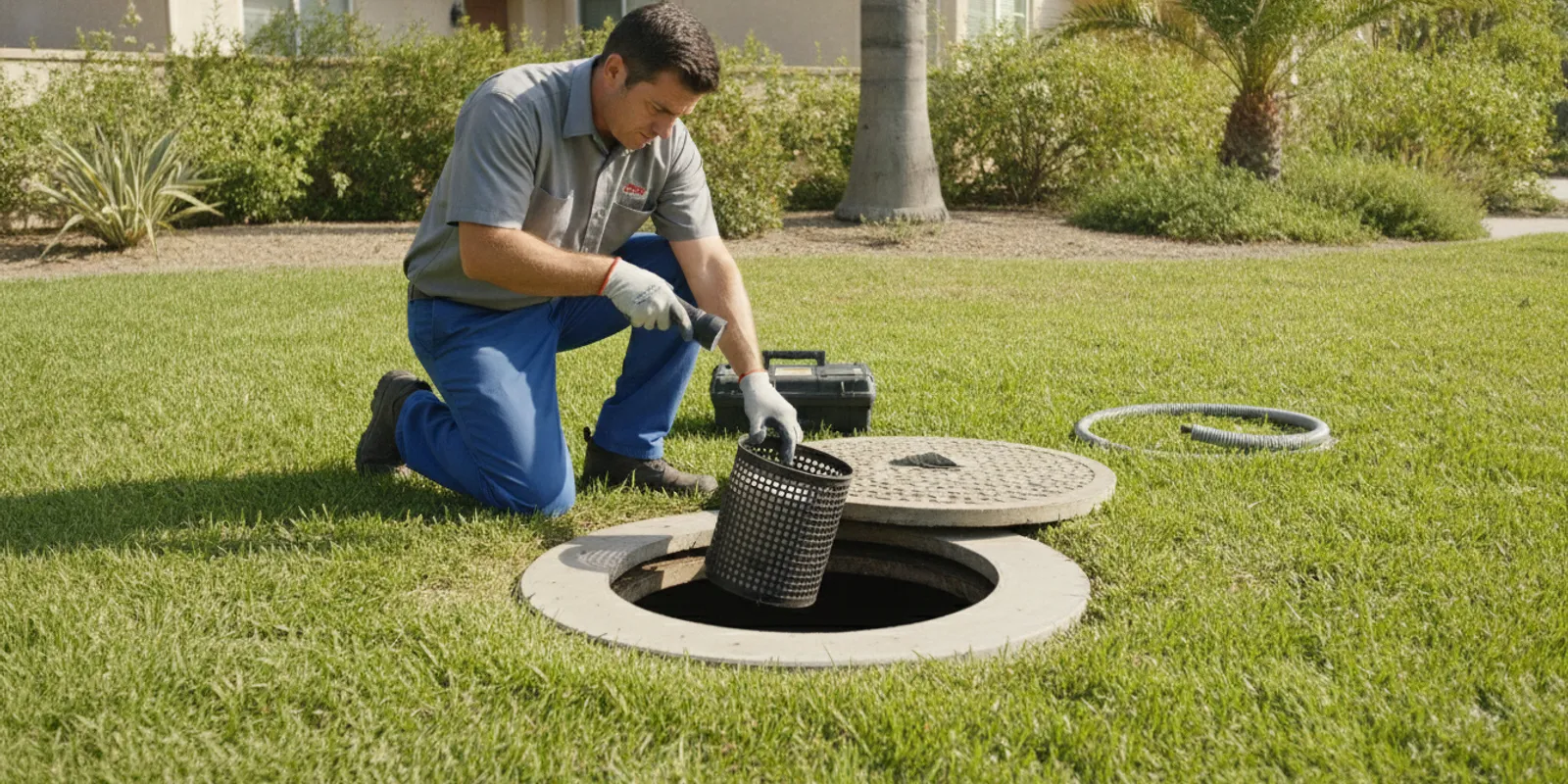
A septic tank effluent filter helps keep suspended solids from leaving the tank and entering the drain field or downstream treatment equipment. If you own a septic system in Riverside or San Bernardino County, understanding the filter can help you notice trouble early, plan maintenance, and request the right service. The filter is important, but it is only one part of a larger system that includes the tank, outlet components, soil treatment area, and access points.
What Is a Septic Tank Effluent Filter?
A septic tank effluent filter is a screened or slotted device installed near the tank outlet. Wastewater flows through the filter after heavier solids settle in the tank and lighter materials remain near the surface. The filter is designed to intercept remaining particles before they move toward the drain field or another treatment stage.
That job protects the next part of the system from solids that could restrict flow. It does not replace pumping, tank inspection, drain field care, or repairs. It also does not make it safe to pour inappropriate materials down household drains. A filter that is blocked, damaged, missing, or difficult to access can create a different set of problems.
The exact filter design depends on the septic tank and local installation. Some filters are installed in an outlet baffle or tee. Others are housed in a separate cartridge or access assembly. Because configurations vary, a property owner should identify the system before assuming that a particular cleaning method or replacement part will fit.
Why Does the Filter Matter?
The filter provides a final barrier against solids leaving the septic tank. When it is present and maintained, it can help reduce the amount of material carried into the soil absorption area. That can support more predictable flow and may help protect a component that is more difficult and costly to access.
It is useful to think of the filter as a safeguard, not a cure. A filter cannot correct a tank with excessive sludge, a failed baffle, a damaged outlet pipe, a saturated drain field, or a system that is overloaded. If wastewater is backing up, the cause needs to be evaluated instead of treating the filter as the only possible explanation.
Government guidance also treats regular attention to the entire onsite wastewater system as important. The Missouri Department of Health and Senior Services owner’s manual discusses warning signs and maintenance planning for onsite wastewater systems. Filter care should fit into that broader maintenance plan rather than being treated as a separate household chore.
Where Is a Septic Tank Effluent Filter Located?
Most filters are located at or near the tank outlet, often below an access cover. The outlet side is the point where clarified liquid leaves the tank. Finding the correct access point matters because opening the wrong cover or disturbing the wrong component can create an unnecessary safety risk or lead to an incomplete inspection.
Property records, installation drawings, risers, and visible access lids may help identify the tank. However, records can be incomplete, and older systems may have hidden or hard-to-reach components. A professional can help locate the relevant access point and confirm whether the tank has a filter, an outlet tee, a baffle, or another configuration.
For background on related components, see this guide to septic tank baffle failure signs. A baffle and a filter perform different functions, but damage to either outlet-side component can affect how wastewater leaves the tank.
What Maintenance Does an Effluent Filter Need?
Maintenance usually involves checking the filter during an appropriate septic inspection or tank service and removing accumulated solids when needed. The timing depends on the system design, use, tank condition, household loading, and the filter’s condition. There is no single interval that fits every property.
A typical professional evaluation may include the following:
- Locating and safely accessing the septic tank and outlet area.
- Confirming whether an effluent filter is installed and identifying its type.
- Checking for visible damage, blockage, improper fit, or missing parts.
- Assessing the tank’s liquid level and accumulated solids.
- Reviewing signs of restricted flow or unusual operating conditions.
- Cleaning, repairing, or replacing the filter when the system and component call for it.
- Documenting recommended follow-up, such as pumping, repair, inspection, or further diagnosis.
Cleaning is not simply a matter of pulling out a cartridge and rinsing it wherever wastewater can run. Septic tanks may contain harmful gases and biological hazards, and the work can expose a person to contaminated wastewater. The filter must also be returned to its proper position so the outlet remains protected. Use a qualified septic professional when access, cleaning, or diagnosis is needed.
For a broader overview of service planning, read the septic system inspection guide. If the tank itself needs attention, a septic tank pumping service may be part of the recommended plan.
What Happens During a Filter Inspection?
A useful inspection connects the filter to the rest of the wastewater path. The technician first needs to understand the reported symptom: for example, whether several fixtures are slow, whether a backup occurred after heavy water use, or whether an odor is present outside. Those details help determine which parts of the system deserve attention.
The access area can then be evaluated for safe entry and for evidence of prior work. The filter may be examined for accumulated solids, cracks, deformation, an incorrect fit, or a missing handle. The outlet assembly and baffle deserve attention as well. A clean filter does not prove that the outlet line, tank, or drain field is operating correctly.
Service findings should be explained in practical terms. Ask whether the observed condition is a restriction, a component failure, a maintenance issue, or an indication that more testing is appropriate. Ask what was inspected, what was not accessible, and what symptoms should prompt a return visit. Keeping that information with pumping and repair records makes future service more efficient.
How Do You Know When the Filter May Be Blocked?
A blocked filter can restrict the movement of wastewater out of the tank. The symptoms may look like other septic or plumbing problems, so they should be treated as reasons for evaluation rather than proof of a filter failure.
Possible warning signs include:
- Slow drainage at several fixtures rather than at only one sink or tub.
- Gurgling sounds from toilets or drains.
- Wastewater backing up into a low fixture or floor drain.
- Unusually high liquid levels in the tank or signs of restricted outlet flow.
- Wet, unusually lush, or foul-smelling areas near the tank or drain field.
- Repeated problems after a recent pumping or plumbing repair.
- Odors near the tank or drain field that are not part of normal operation.
Odors deserve attention, but they do not identify one specific failed component. The University of Maryland Extension’s septic records and maintenance guidelines notes that odors can be an early warning sign when a system is not operating properly. A professional should evaluate the location, timing, and other symptoms.
What Is the Difference Between a Blocked Filter and a Full Tank?
A blocked filter and a full tank can produce similar drainage symptoms, but they are not the same problem. A filter may restrict outlet flow even when the tank has not reached its normal pumping limit. A tank with too much sludge or scum can also reduce effective capacity and send solids toward the outlet.
Other causes can include a damaged baffle, a broken or settled outlet line, a clogged building sewer, a failing drain field, or unusually high water use. A property owner may not be able to distinguish these causes by looking at a drain or opening a cover. That is why service should include diagnosis rather than an automatic filter replacement.
| Possible condition | What may be noticed | What professional service may assess |
|---|---|---|
| Blocked effluent filter | Slow drainage, rising tank level, or recurring backup | Filter condition, outlet flow, fit, and cleaning or replacement needs |
| Excess solids in the tank | Reduced capacity, odors, or solids near the outlet | Sludge and scum levels, pumping history, and tank condition |
| Damaged baffle or outlet component | Unusual flow, solids migration, or repeated filter fouling | Baffle, tee, outlet, and connection condition |
| Drain field or soil treatment problem | Wet ground, surfacing wastewater, or persistent odor | Distribution, site conditions, loading, and possible failure indicators |
| Building sewer or plumbing blockage | Symptoms limited to fixtures or a line inside the property | Drain and sewer lines, cleanouts, and flow path before the tank |
What Can Cause an Effluent Filter to Clog Repeatedly?
Repeated fouling deserves more attention than a single dirty filter. A filter can collect solids as it is designed to do, but unusually frequent blockage may point to conditions upstream or to a filter that is not suited to the installation. Excess solids in the tank, a damaged baffle, an incorrectly seated cartridge, or materials entering the system can all change how the component performs.
Household habits can contribute as well. Wipes, grease, paper products other than toilet paper, and other non-flushable materials can add solids or create restrictions. Leaking fixtures send unnecessary water through the system. A sudden increase in occupancy, laundry, guests, or commercial use can also change the system’s loading. These details are useful to share during service because they help explain why the symptom developed.
Repeated filter problems should not be solved by removing the filter and leaving the outlet unprotected. That may allow more solids to travel toward the drain field. Instead, ask the technician to assess the filter type, tank condition, outlet assembly, and maintenance history together.
Can You Clean a Septic Tank Effluent Filter Yourself?
Property owners sometimes consider cleaning a filter without professional help. The main concern is not only the filter cartridge. It is the tank access, toxic gases, contaminated contents, fall hazard, disposal of wastewater, and possibility of missing a more serious system problem.
A safer approach is to record the symptoms, limit unnecessary water use if wastewater is backing up, keep people and pets away from wet or contaminated areas, and request septic service. Do not enter a septic tank. Do not lean over an open tank or use a flame near the opening. If sewage has entered the home, avoid contact and ask a professional about cleanup and disinfection.
If an inspection shows that the filter is serviceable, the technician can explain the appropriate maintenance plan. If it is damaged or repeatedly clogs, the next step may involve repair, replacement, pumping, or a larger system evaluation. The right action depends on the findings.
What Should You Do Before Septic Service Arrives?
Small preparations can help protect the property and give the technician better information. Stop using water unnecessarily if drains are backing up, but do not shut off equipment or disturb the septic components unless instructed. Keep children, pets, and visitors away from standing wastewater and from tank covers. Never drive over an access area that may be weak or unsupported.
Write down when the symptoms began and whether they affect one fixture, several fixtures, or the entire property. Note recent pumping, plumbing work, unusual water use, heavy rain, landscaping changes, or changes in occupancy. If you know where the tank and cleanouts are located, share that information without opening or moving covers. Have any service records available for review.
For a related planning resource, see the guide to septic inspection for a home purchase. A clear history is useful whether the property is a residence, a rental, or a commercial site.
When Should You Request Professional Septic Service?
Call for service when several fixtures drain slowly, wastewater backs up, odors persist, the yard becomes wet near the septic components, or a filter has not been inspected in the course of normal system maintenance. Prompt attention is especially important when a warning sign is repeated after pumping or when a property changes ownership.
Diamond House Plumbing provides septic system installation, repair, and replacement services as part of its specialized plumbing scope. For property owners in the Inland Empire, a service visit can help determine whether the concern involves the effluent filter, tank, outlet components, sewer lateral, or another part of the wastewater path. You can also review the company’s septic services before requesting an appointment.
Have service records available if possible. Useful information includes the last pumping date, prior inspections, the location of access covers, recent plumbing work, changes in household or business use, and the exact fixtures showing symptoms. Clear details can help the technician plan the evaluation.
How Can You Reduce Effluent Filter Problems?
Good septic care reduces the load placed on the tank and filter. Spread laundry and other heavy water use across the week when practical. Repair leaking fixtures. Keep grease, harsh chemicals, wipes, and non-flushable materials out of the wastewater system. Use toilets only for human waste and toilet paper.
Protect the tank and drain field from vehicle traffic, structures, and activities that compact soil or block access. Keep accurate records of pumping, inspections, repairs, and unusual symptoms. If you are buying a property, arrange a septic inspection rather than relying only on a seller’s description or a visible access cover.
Landscaping choices matter too. Deep excavation, irrigation changes, and new structures can interfere with access or alter how water moves across the property. Before making a major yard change, identify the tank, outlet route, and soil treatment area. The related septic tank replacement guide explains why the condition of the wider system matters when planning larger work.
Frequently Asked Questions
What does a septic tank effluent filter do?
It screens or restricts suspended solids at the tank outlet so fewer solids move into the drain field or downstream treatment components. It does not replace pumping or correct every septic problem.
How often should an effluent filter be cleaned?
There is no universal schedule. The appropriate interval depends on the filter, tank, wastewater use, solids accumulation, and inspection findings. A septic professional can recommend a schedule based on the property.
What happens if the filter is clogged?
Flow out of the tank may become restricted. Slow drains, gurgling, backups, odors, or wet areas can result, although these signs can also come from other plumbing or septic conditions.
Should a homeowner remove the filter?
Removing a filter without understanding the system can create exposure and safety risks and may leave the outlet unprotected. Have a qualified professional inspect, clean, repair, or replace it.
Can Diamond House Plumbing inspect or repair septic system components?
Diamond House Plumbing’s documented service scope includes septic system installation, repair, and replacement. Contact the company to discuss the symptoms and determine the appropriate service.
Request a septic service evaluation
A septic tank effluent filter is a small component with an important protective role, and timely inspection can help connect warning signs to the right repair or maintenance step before a minor concern becomes a larger wastewater problem.

Leave a Reply