
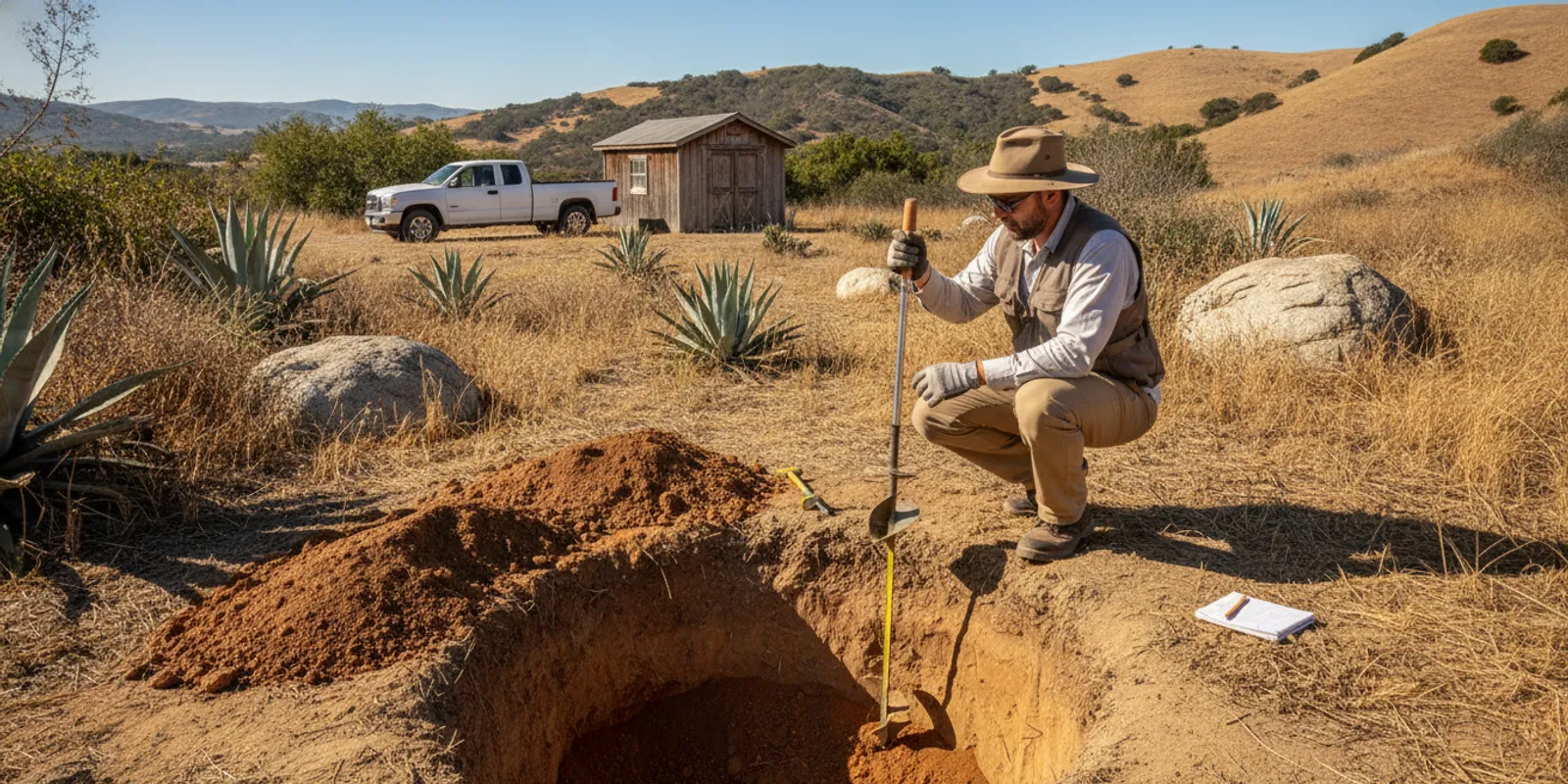
A septic perc test measures how quickly water moves into soil at a proposed septic system location. For Inland Empire property owners, the result can help local authorities and qualified professionals determine whether a site may support an onsite wastewater system and what design constraints may apply. It is one part of septic planning, not a standalone approval or guarantee.
Discuss your septic project with Diamond House Plumbing
What does a septic perc test evaluate?
A percolation, or “perc,” test evaluates the rate at which water is absorbed by soil under specified field conditions. A professional prepares a test area, adds water according to the applicable procedure, and records how the water level changes over time. The result offers information about soil absorption at the location tested.
That information matters because a septic system relies on soil to receive and treat wastewater after it leaves the tank. Soil that absorbs water too slowly may limit how wastewater can be dispersed. Very rapid absorption can also raise design and review concerns, since wastewater needs appropriate treatment as it moves through the soil. The test is not a direct measure of every soil property, and a single result does not describe every part of a parcel.
Site conditions can vary across a property. Soil layers, slope, groundwater conditions, nearby features, and the planned location of system components may all be relevant to the overall evaluation. The responsible authority may require additional site information or testing beyond a perc test. A useful report therefore needs context: where the test took place, which procedure was used, and how the location relates to the proposed system area.
When is a septic perc test used?
A perc test is commonly considered during septic planning when a property needs a new onsite wastewater system or when a proposed project requires a new or revised design. It may be part of evaluating a vacant lot, replacing an existing system, or reviewing a change in use or capacity. The specific trigger and procedure depend on local requirements and the facts of the project.
Do not assume that an old test automatically applies to a new proposal. A test may be tied to a specific location, design, or set of site conditions. Ask the local permitting authority whether prior results remain acceptable and whether the current project needs updated work. For existing systems, a perc test is not the same as an inspection of the tank, piping, or operating condition.
- New construction: Early site evaluation can reveal whether septic planning is feasible before a design is finalized.
- Replacement or repair: The authority or designer may request soil information if work changes the system footprint or disposal area.
- Property purchase: Buyers should confirm what reports exist, where testing occurred, and whether they meet current project requirements.
- Expansion: A proposed increase in wastewater flow may require review of system capacity and applicable approvals.
For a buyer, the practical question is not only whether a report exists, but whether it belongs to the parcel and project being considered. Ask for the full report rather than relying on a summary from a listing or prior owner. Check the test date, location map, procedure, and any agency comments. If the intended building location or system area has changed, an old result may not answer the current question.
Who conducts and oversees the testing?
The local authority sets or administers the applicable requirements and determines what documentation is needed for review. Depending on local rules, testing may be performed by a qualified professional or under a specified procedure. The property owner should confirm required credentials, test method, witnessing rules, and report format with the responsible agency before scheduling field work.
Do not treat a contractor’s general assessment as an official test result unless the authority accepts it. Likewise, passing a test does not itself authorize installation. Permits, design review, setbacks, site constraints, and other applicable conditions may still need to be addressed.
For San Bernardino County properties, the official Percolation Testing and Reporting Standards explain that a soil report uses site-specific water absorption rates together with topographic, geologic, and hydrologic information to inform onsite wastewater treatment system design. The document says the Notice of Intent to Perform Percolation Testing must be submitted to Environmental Health Services at least two working days before testing, and that the department may schedule a field inspection. It also says completed reports and required fees must be submitted before approval of the use of an onsite wastewater treatment system and application of the design rate.
For Riverside County properties, the county’s 2024 Local Agency Management Program includes county-specific onsite wastewater report, percolation testing, and exploratory boring procedures. Because requirements can depend on the parcel and project, confirm the current process, required notice, and accepted qualifications with the responsible county department before scheduling field work.
Diamond House Plumbing provides septic system services, but this article does not represent the company as the testing or permitting authority. Start by asking the county or local environmental health department what steps apply, then coordinate with qualified design and installation professionals as required. The local reviewer can also say whether an application requires a site evaluation beyond a percolation test, and what plans or supporting records must accompany the results.
How can you prepare for a perc test?
- Identify the project. Clarify whether you are planning a new system, replacement, repair, or property purchase review. The scope affects what information may be needed.
- Contact the local authority. Ask which department handles onsite wastewater permits and request its current testing and submittal requirements.
- Gather site records. Bring available parcel plans, existing septic records, prior reports, and information about wells, structures, slopes, or known site constraints.
- Confirm the professional and procedure. Verify who may conduct the test, whether the authority must observe it, and how results must be documented.
- Plan the test location. Coordinate the proposed test area with the professional and design process. Results from one area should not be assumed to apply everywhere.
- Wait for review before committing. Use accepted findings and any additional site evaluation to inform design and permitting before scheduling installation.
Before the appointment, make access straightforward and identify any known underground utilities or site restrictions for the appropriate professionals. Avoid choosing a test spot solely because it is easy to reach; it should be relevant to the potential system area and acceptable under the authority’s process. If the site has multiple candidate areas, ask whether testing more than one could help answer the planning question. Do not make assumptions about excavation, water use, or preparation steps: the professional and local agency should give instructions for the approved procedure.
Keep a written record of who will perform the work, whether agency witnessing is required, and what deliverables are included. A clear scope reduces the risk of receiving informal notes when the reviewer expects a particular report format. If the property has prior plans, share them before field work so the test location and intended use can be discussed together.
How do results affect septic system design?
Test results help inform whether soil absorption at the tested location is suitable under local criteria and how a system may need to be configured. The design professional considers the accepted results alongside site conditions, expected wastewater flow, applicable standards, and authority requirements. Depending on the findings, the project may proceed to a proposed design, require more investigation, need a different location, or face limitations.
A perc rate is not a complete system design. It does not by itself establish tank size, system layout, required setbacks, or permit approval. Nor should property owners compare a result to a generic threshold found online and assume that it determines eligibility. Procedures and criteria vary, and the reviewing authority’s rules control the project.
Results should be read in the context of the complete site and application. A favorable measurement at one point may still leave unanswered questions about the proposed disposal area, the usable space available, or the relationship to other site features. Conversely, a result that raises a concern does not automatically tell an owner what alternative is permitted. The authority and design professional can explain whether further evaluation, a different location, or another locally accepted design approach is appropriate.
| Finding or issue | What it may mean | Practical next step |
|---|---|---|
| Results meet applicable criteria | The tested area may be considered for further design review; this is not a permit by itself. | Ask the designer and authority what submittals, setbacks, and approvals remain. |
| Absorption is outside local criteria | The proposed location or conventional design may need reconsideration. | Confirm whether additional evaluation, an alternate area, or another approved design approach is allowed. |
| Results vary by test location | Conditions may differ across the site, limiting what one test can establish. | Ask whether further tests or site characterization are required. |
| Prior report is old or incomplete | The authority may not accept it for the current application. | Check validity, location, procedure, and documentation requirements before relying on it. |
What should you ask before approving work?
Clear questions help prevent confusion between a test, a design, and an approved installation. Before authorizing field work, consider asking:
- Which agency reviews this property’s septic application?
- Is a perc test required for this project, and what method does the agency accept?
- Who is qualified to perform or witness the test?
- Does the test location match the proposed disposal area?
- What additional evaluations, reports, or permits may be required?
- How long can the results be used, and what could make them no longer applicable?
- What happens if results are inconclusive or do not meet local criteria?
- Will the report include a location sketch, method, observations, and limitations?
- Who will submit the findings, and who will explain agency comments or requested revisions?
Keep copies of the test report and agency correspondence with your property records. Make sure the report identifies the location and procedure clearly, and ask the reviewer to explain any limitations. For broader planning, review the company’s septic services information and its septic system inspection guide. An inspection guide can help distinguish evaluation of an existing system’s condition from soil testing for a proposed disposal area.
How does local review fit into Inland Empire planning?
Requirements are not necessarily identical across all jurisdictions in Riverside and San Bernardino counties. The reviewing authority can clarify which process applies to your parcel, whether additional site evaluation is needed, and how the results fit into an application. This is especially important when an existing system is being replaced, when a property has limited usable area, or when records are incomplete.
Start local conversations before choosing a system layout or setting a construction date. If a septic system project is being planned in the Inland Empire, Diamond House Plumbing can discuss the plumbing and septic service scope while you confirm testing and permit requirements with the responsible authority. You can learn about Diamond House Plumbing, review its septic service information, and consider the septic system component overview as background for conversations about a system layout.
Think of the work as a sequence rather than one test appointment: identify the authority and project requirements, gather records, complete accepted site evaluation, develop a design, and obtain required review before installation. That order helps keep a soil test in its proper role and makes it easier to identify missing information early. It also gives property owners a clear point of contact for questions at each stage, rather than expecting a single professional to decide every permitting and design issue.
Talk with Diamond House Plumbing about your septic project
Frequently asked questions
Does a septic perc test guarantee that a septic system can be installed?
No. The result informs site evaluation, but local approval, design review, permits, and other requirements may still apply. The authority determines what the findings mean for a specific application.
Can one perc test represent an entire property?
Not necessarily. Soil and site conditions can vary. The authority or design professional may require multiple test locations or additional evaluation to understand the proposed system area.
Is a perc test the same as a septic inspection?
No. A perc test evaluates water absorption in soil at a test location. An inspection looks at some aspects of an existing system’s condition and operation. One does not substitute for the other.
Who should I call first?
Contact the local agency responsible for onsite wastewater permitting to confirm the procedure and accepted qualifications. Then coordinate with qualified professionals involved in the project’s evaluation, design, and installation.
A septic perc test is a useful planning input, but the complete path from soil evaluation to installation depends on local review, site conditions, and an approved system design.

Leave a Reply