
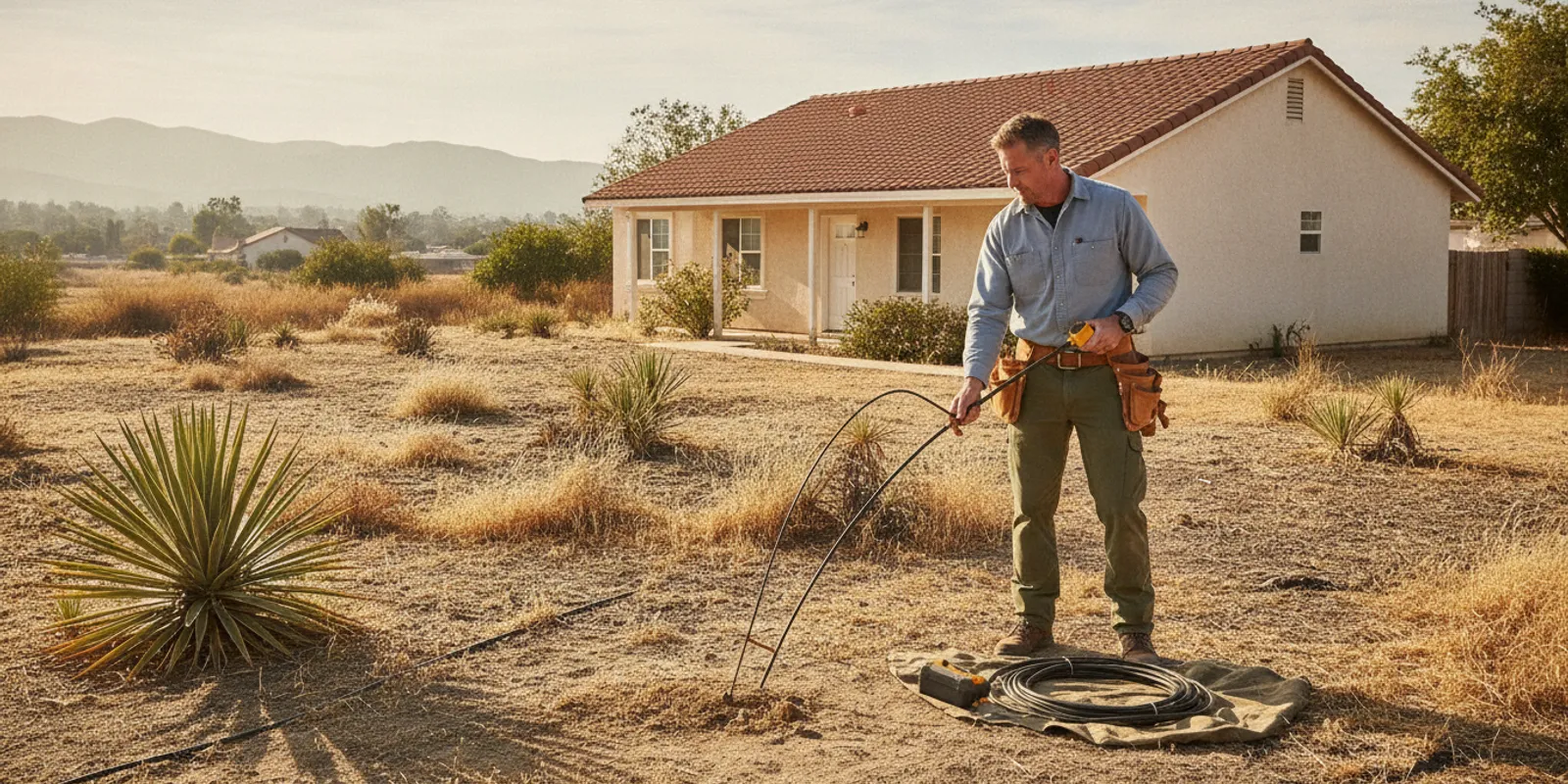
If you are wondering how to find your septic tank, start with records and safe visual clues—not with a shovel. The tank is often buried, and its exact position can be hard to judge from the yard alone. A methodical search can help you narrow down the location while protecting the tank, pipes, and people on the property.
Ask about septic locating help
Why can a septic tank be hard to locate?
Septic tanks are commonly installed below ground, with access covers that may be buried beneath soil or landscaping. Over time, the property may change: a lawn is regraded, a patio is added, shrubs grow, or ownership records are lost. The visible yard may not show where the tank sits.
There may also be more than one underground component to identify. The tank receives wastewater from the home, while the outlet leads toward a drain field or another approved dispersal area. A cleanout, inspection port, tank access opening, and drain-field feature are not interchangeable. Finding one clue does not necessarily confirm the tank’s full location or condition.
Knowing the location matters before excavation, landscaping, a home addition, or septic service. It also helps you avoid driving heavy equipment over system components. If you are not certain where the tank is, treat the area as unknown rather than testing it with digging or probing.
What should you check before searching outside?
Look for property and service records
Begin with documents already associated with the home. Useful records may include an original site or building plan, septic installation or repair paperwork, a property inspection report, and invoices from previous service visits. Look for a drawing that marks the house, property boundaries, tank, and dispersal area. A diagram may be approximate, so use it as a starting point, not as permission to excavate.
Check the paperwork for details such as the tank’s distance from a building corner, the direction of the outlet pipe, or a stated depth. If you find an old service company name, ask whether it has a location sketch or notes from prior visits. Owners who have recently moved can also ask the seller or property manager for system records.
When you review a drawing, check when it was made and whether it appears to show the original installation or a later repair. Compare the drawing with the current shape of the property: a shed, driveway, or addition may have been built after the plan was prepared. Note measurements and labels, but do not treat a hand-drawn line as a precise underground map. Keep a copy available for the technician, even if you are unsure how to interpret it.
Ask the local authority about available records
Depending on the property and the history of the system, an appropriate county or local office may have permit or installation information. Availability and record detail differ, so be ready to provide the property address and ownership information. Ask what records exist and whether the drawing indicates tank location, system layout, or only a permit.
Do not assume that a record from one property or jurisdiction describes another. Inland Empire owners should confirm which local agency handles the property before relying on a process or document. When requesting records, ask whether the file includes an as-built plan, later alterations, or only the initial permit. If the agency has no drawing, ask whether it can point you to the office or former contractor most likely to hold one. Keep a note of the address and any parcel information you used so future calls start with the same details. If you need help with an onsite wastewater system, Diamond House Plumbing provides septic services in the Inland Empire.
How can the home’s plumbing help narrow the search?
The building sewer pipe carries wastewater away from the house toward the tank. A visible sewer cleanout can give you a useful direction to investigate, but the pipe may change direction underground and a cleanout does not mark the tank itself.
- Find the building sewer cleanout, if visible. It may be near an exterior wall or in a landscaped area. Do not remove a cap if you are unsure what it is or if there are signs of a backup.
- Note the likely direction the pipe leaves the building. Use the layout of bathrooms and plumbing as a general clue only. Interior plumbing paths are not always straight or obvious.
- Compare that direction with your records. A plan or prior service note may help explain where the buried line turns or where the tank was placed.
- Look for safe, surface-level evidence. A visible access cover or a small, localized change in the ground can help guide a professional. Neither clue alone confirms the system layout.
For questions about the building sewer or buried lines, review the company’s drain and sewer services or its guide to what a sewer lateral is. A sewer lateral is related to a property’s sewer connection, but it is not a substitute for identifying a septic tank on an onsite system.
What surface clues might point to a tank?
Walk the property and note clues without disturbing the ground. Look for a small lid or access cover, a patch of soil that appears different from the surrounding area, or a route between the home and a suspected tank location. Check any old sketch against fixed landmarks such as the house corners, driveway, or property boundary.
These clues are imperfect. A cover may be hidden by soil or plants, and ground conditions can change with weather, maintenance, or landscaping. An unusually green patch or a shallow dip is not proof that a tank is present or failing. Avoid drawing conclusions from odors, wet ground, or plant growth alone; those conditions can have multiple causes and may need prompt professional attention.
Take notes instead of trying to expose a suspected feature. Record its position relative to a permanent landmark, the approximate size of the area, and whether anything has changed recently. You can share those observations with a technician without disturbing the soil. If you find several possible lids or cleanouts, label them in your notes as possibilities rather than opening them to identify what is underneath.
Do not use a metal rod or other tool to probe the yard. It can damage buried pipes or system components, and guessing at the tank’s position can create a safety risk. Do not lift a heavy or stuck cover. If a cover is exposed, keep people and pets away and ask a qualified professional to inspect it.
Which locating approach makes sense?
| Approach | What it can tell you | Limit to keep in mind |
|---|---|---|
| Property and service records | May show a planned location, system layout, or prior service notes. | Records can be missing, incomplete, or approximate. |
| Visible plumbing and surface clues | Can help narrow the likely direction from the house and point to possible access areas. | Clues do not confirm the tank position, depth, or condition. |
| Professional locating visit | A qualified technician can assess records and site clues and select an appropriate locating method. | The method and level of certainty depend on site conditions and access. |
| Unplanned digging or probing | It may expose an object, but that does not establish the full system layout. | It can damage components and create hazards; do not use it as a locating method. |
A professional may use specialized locating equipment or other methods appropriate to the property. Ask what the visit is intended to establish: approximate tank location, access-cover location, system layout, or a condition assessment. These are different outcomes. An inspection can provide more information about a system, but locating the tank alone does not certify that the tank or dispersal area is functioning properly.
Before scheduling, explain why you need the location and whether there is a deadline tied to planned work. Ask what information the technician needs in advance, what parts of the property should be accessible, and whether you will receive a written note or sketch afterward. If you need the system marked for excavation, be clear that a general estimate of the tank’s position may not be enough for that purpose. Confirm the intended scope before anyone begins work.
How should you prepare for a locating visit?
A few details can make the visit more focused. Gather any plans, permit paperwork, invoices, inspection notes, and previous pumping records you have. Mark areas where you already suspect the tank may be, and identify features that could affect access, such as a patio, fence, retaining wall, or landscaping. Tell the technician about recent construction or grading.
Before the visit, keep vehicles and heavy equipment away from areas where system components may be located. Make sure the technician can reach the yard and any relevant records. If there is sewage backing up inside, standing wastewater, or an exposed or damaged cover, explain that when you call instead of treating the request as routine locating.
Diamond House Plumbing has information about the main parts of a septic system and what to expect during a septic inspection. Those topics can help you describe what you are trying to find, but an article cannot verify the exact underground layout of a specific property.
What should you do once you find the tank?
Record the location while it is accessible. Take clear photos from more than one angle and note measurements from stable landmarks, such as a building corner. Keep the records with other home maintenance documents and share them with future owners or contractors who may work near the system.
Ask a qualified septic professional to identify which cover or access point serves which part of the system and whether the location record should include the outlet route or dispersal area. Do not assume that one access lid reveals every component. If you are planning a project, have the relevant system area assessed before excavation or construction begins.
For broader background on septic systems and wastewater, you can consult the U.S. Environmental Protection Agency. Local requirements and system records should still be confirmed with the authority responsible for your property.
Frequently asked questions
Can I find a septic tank from inside the house?
Interior plumbing can offer a rough directional clue because wastewater leaves the building through a sewer pipe, but it does not show where that pipe ends. Start with records and an exterior cleanout if one is safely visible, then have the location confirmed before any ground disturbance.
How deep is a septic tank buried?
There is no single depth that applies to every property. Installation, later landscaping, and site conditions affect how far below grade the tank and access points sit. Use records or professional locating rather than assuming a depth and digging toward it.
Is the septic tank the same as the drain field?
No. The tank and the area that receives its outflow are separate parts of a system. Finding the tank does not identify the full dispersal area, so keep the broader system layout in mind before planning landscaping or construction.
When should I stop searching and call a professional?
Call when records are unavailable, the likely route is unclear, you encounter an unknown cover, or you need the location before excavation or a building project. Contact a qualified professional promptly if wastewater is backing up, you see sewage, or a cover appears damaged. Stay clear of exposed openings.
Contact Diamond House Plumbing about your septic system
The safest way to locate a buried septic tank is to combine records and surface clues, then get professional confirmation before disturbing the ground.

Leave a Reply