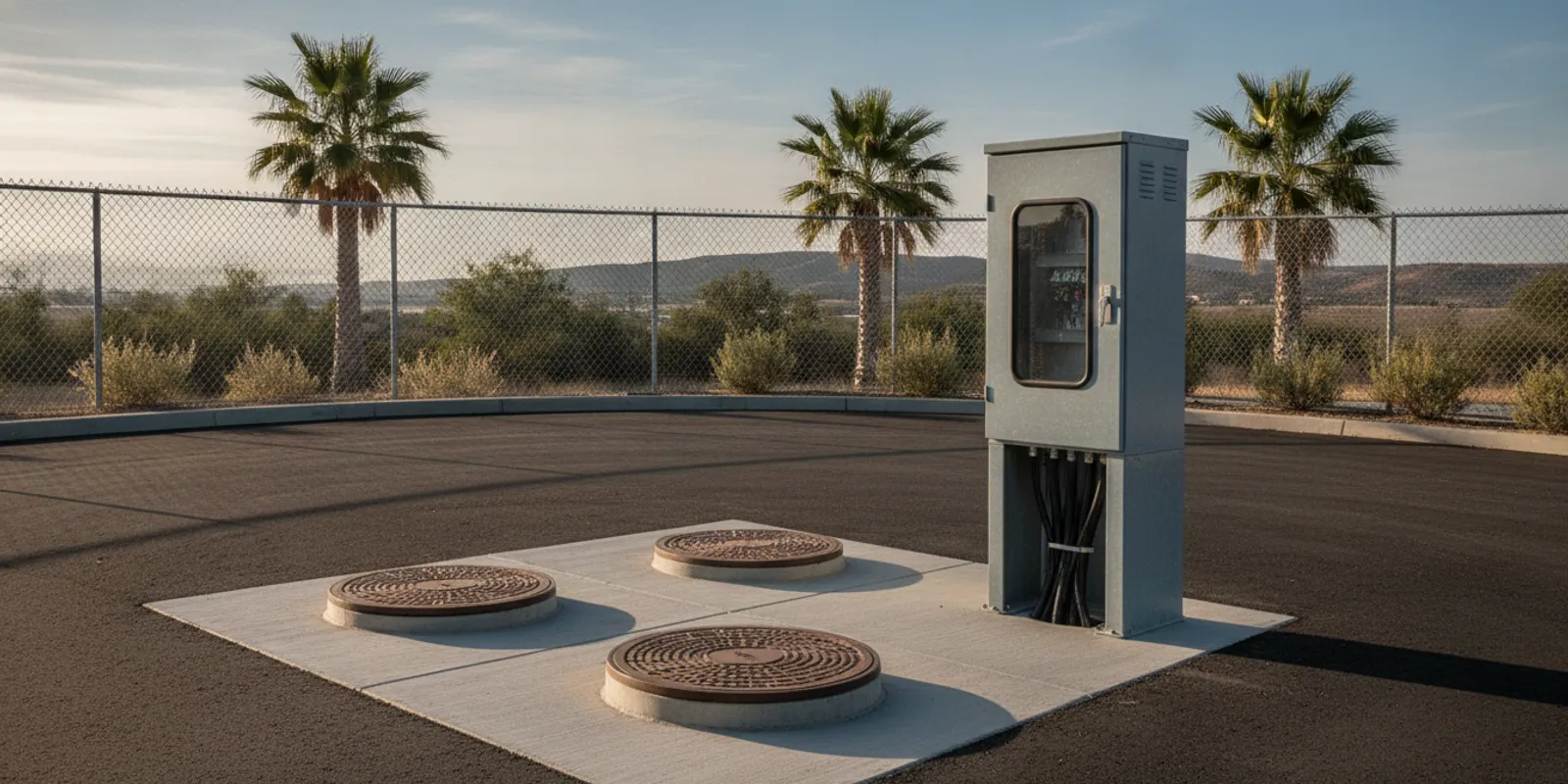
If you are asking what is a lift station, the short answer is this: it is a sewage collection system that uses pumps to move wastewater from a lower elevation to a higher one when gravity alone cannot carry it to the sewer main or treatment system. Lift stations are common at commercial properties, large developments, and complex sites with low areas, long sewer runs, or challenging grades.
Contact Diamond House Plumbing about your commercial property
A lift station is more than a pump in a tank. It is a coordinated system of wet-well storage, pumps, controls, valves, piping, alarms, and electrical equipment. Each part must work together to protect the property, keep wastewater moving, and reduce the risk of an overflow. Owners managing broader plumbing needs can also review commercial and residential plumbing services for related systems.
What is a lift station and what does it do?
Most sewer systems are designed to move wastewater downhill through gravity sewers. That approach is dependable when the building, collection lines, and public sewer are positioned at workable elevations. It becomes difficult when a property sits below the connection point, when the site has a flat grade, or when a sewer line must cross a rise in the terrain.
A lift station collects wastewater at a low point and temporarily holds it in a basin called a wet well. When the wastewater reaches a set level, one or more pumps start. The pumps push the wastewater through a pressurized force main to a higher manhole, gravity sewer, treatment connection, or another collection point. The cycle repeats as wastewater enters the system.
Lift stations are installed at low points in a collection system where continued gravity flow is not possible or practical. The Environmental Finance Center Network explains the basic operation and maintenance considerations for lift stations, including the importance of keeping pumps and controls operating reliably.
For a commercial owner, the practical purpose is continuity. The station allows restrooms, kitchens, process areas, and other plumbing fixtures to discharge wastewater even when the receiving sewer is at a higher elevation.
Design decisions should be documented rather than based on pump size alone. A government technical memorandum on lift stations and force mains illustrates how conceptual planning can address the station, force main, site layout, and related infrastructure together.
What is a lift station used for at a commercial property?
A lift station is usually considered during site planning, a building expansion, a sewer conversion, or a major repair. The need depends on the site elevation, the public sewer location, expected flow, and local design requirements. A property owner may need a lift station when:
- The building sewer is lower than the available public sewer connection.
- The site is in a depression or has a low-lying section that cannot drain by gravity.
- A long property or campus would require an impractical depth of gravity sewer.
- New construction changes the grade or adds fixtures below the existing sewer elevation.
- A commercial facility needs to move wastewater from a basement, parking structure, or below-grade area.
- A development is located far from the nearest practical gravity connection.
- An existing gravity system has reached the end of its useful service life and a redesigned pumping arrangement is more workable.
Restaurants, office buildings, retail centers, industrial properties, apartment communities, schools, and municipal facilities can all have pumping systems. The exact design must match the use of the property. A facility with grease, solids, high flows, or intermittent occupancy may require different equipment and controls than a small office building.
Before approving a project, have a qualified professional evaluate the site survey, sewer elevations, anticipated flows, force-main route, electrical supply, access, and applicable authority requirements. A lift station should not be selected from capacity alone. A system that is too small may cycle excessively or surcharge. One that is poorly matched to the flow pattern may create odor, solids, or maintenance problems.
What are the major components of a lift station?
Although designs differ, most sewer lift stations include the following components.
Wet well or collection basin
The wet well receives wastewater from the building sewer or collection system. It provides enough storage for the pumps to operate through a control cycle and helps limit unnecessary starts. The basin may be constructed from concrete, fiberglass, or another approved material. Its size, depth, access, and interior configuration affect maintenance and pump performance.
Pumps
Pumps provide the force needed to move wastewater through the discharge piping. A station may use one pump for a smaller application or multiple pumps for redundancy and higher flow. Duplex systems commonly alternate the lead pump so operating time is shared. If incoming flow exceeds the capacity of one pump, a second pump may assist.
The pump type should account for solids, expected flow, total dynamic head, discharge piping, and the type of wastewater. A pump that is appropriate for clear water may not be appropriate for sewage. Access for removal and service also matters, because even reliable equipment eventually needs inspection or repair.
Level sensors and controls
Controls tell the pumps when to start and stop. Common systems use floats, pressure sensors, ultrasonic instruments, or other level-sensing equipment. A control panel manages pump sequencing, alternation, overload protection, and alarm conditions. If a sensor sticks or a control relay fails, the pumps may run too long, fail to start, or cycle at the wrong levels.
Force main and discharge piping
The force main is the pressurized pipe that carries wastewater from the lift station to the discharge point. Its route, diameter, material, fittings, and elevation changes influence pump selection and system performance. Check valves help prevent wastewater from flowing backward after a pump stops. Isolation valves allow equipment to be serviced.
Alarm and notification system
An alarm warns the owner or operator when the wet-well level rises too high, a pump fails, power is lost, or another monitored condition occurs. Alarms may include a local light or horn and remote notification. The alarm is an important layer of protection, but it is not a substitute for regular inspections and a response plan.
Electrical supply and backup provisions
Pumps and controls need a suitable electrical supply. Commercial owners may also evaluate generator connections, automatic transfer equipment, or other backup provisions when an outage could cause an overflow or interrupt essential operations. Backup requirements depend on the property, design, regulations, and risk tolerance.
How does a lift station cycle work?
Wastewater flows into the wet well while the pump is off. As the level rises, the control system reaches its start setting and activates the lead pump. The pump sends wastewater through the force main until the level falls to the stop setting. The controls then stop the pump and prepare the system for the next cycle.
In a duplex station, the controls may alternate which pump starts first. If the level continues to rise, the lag pump can start. If the level reaches the high-water setting, the alarm activates. This sequence gives the operator an opportunity to respond before the wet well overflows, but the available response time depends on the basin volume and incoming flow.
Healthy operation generally includes predictable pump cycles, reasonable run times, working alarms, normal current draw, and no unusual odor or surface discharge. A service record can help identify gradual changes before they become an emergency.
What are common signs of lift station trouble?
A failing station may show an obvious alarm, or it may develop less dramatic symptoms first. Property owners and facility teams should take the following signs seriously:
- High-water alarm: The wet-well level has exceeded its normal operating range or a pump has not kept up with incoming flow.
- Frequent pump cycling: Pumps start and stop unusually often, which may point to control settings, inflow, leakage, a stuck sensor, or inadequate storage.
- Longer run times: A pump runs longer than usual to reach the stop level, suggesting a restriction, worn pump, changing flow, or force-main problem.
- Unusual noise or vibration: Grinding, rattling, humming, or strong vibration can indicate debris, bearing wear, impeller damage, cavitation, or a motor issue.
- Slow drainage or backups: Wastewater may back up into fixtures or low areas when pumping capacity is reduced or the discharge route is restricted.
- Odor near the station: Odor can result from long holding times, poor ventilation, solids accumulation, stagnant flow, or a cover or seal problem.
- Wet ground or visible discharge: Standing wastewater, saturated soil, or a wet area around the basin or force main needs prompt attention.
- Repeated breaker trips: Electrical faults, motor overload, damaged wiring, or a pump problem may be involved.
- Remote alerts or communication loss: A notification failure can leave an operator unaware of a high-level condition.
Do not silence an alarm and assume the issue is resolved. Reduce wastewater use when appropriate, keep people away from suspected sewage, and arrange qualified service. A commercial property should also follow its emergency response plan and any applicable reporting requirements.
What can cause a lift station failure?
Lift station problems can come from mechanical, electrical, hydraulic, structural, or operational conditions. Common causes include debris or non-flushable material entering the pumps, a clogged impeller, worn seals, a failed motor, a stuck float, a damaged control panel, a tripped breaker, or a failed check valve.
The discharge side can create problems too. A partially blocked force main, closed valve, damaged pipe, air pocket, or unexpected change in elevation can increase the load on the pumps. Excessive infiltration and inflow can send more water to the station than the original design anticipated, especially during wet conditions or when private drainage is connected improperly.
Structural concerns may include corrosion, cracks, a damaged access cover, deteriorated guide rails, or infiltration through joints. Odor and solids issues may develop when wastewater remains in the wet well too long or the station is not matched to the property’s usage pattern.
Because the same symptom can have multiple causes, replacing a pump without testing the controls, piping, sensors, and incoming flow may not solve the underlying problem. A complete diagnosis is more useful than guessing from the alarm alone.
How is a lift station diagnosed and serviced?
A service visit should begin with a safety review and a conversation about what the property team has observed. Useful information includes alarm times, pump run times, recent electrical work, backups, odor, changes in occupancy, and any work performed on nearby sewer lines.
- Review the system: The technician identifies the pumps, controls, level devices, valves, force main, alarm equipment, and available records.
- Check operating conditions: The wet-well levels, pump starts and stops, current draw, voltage, run time, and alarm sequence are evaluated as appropriate.
- Inspect pumps and sensors: Equipment is checked for blockage, wear, damage, float movement, sensor accuracy, and abnormal vibration or noise.
- Evaluate discharge flow: The technician considers check valves, isolation valves, force-main restrictions, and whether the pump is producing expected flow.
- Assess related sewer lines: If the station is receiving restricted flow or the property has backups, connected building sewers and laterals may also need inspection. A sewer camera inspection can help evaluate connected piping where appropriate.
- Document the findings: The owner receives a clear explanation of the immediate condition, risks, recommended repair, and any follow-up evaluation.
Diamond House Plumbing provides sewer and plumbing services for Inland Empire homes and businesses. Property owners can review the company’s drain cleaning and sewer line service information when a lift station concern may involve connected sewer piping, or learn more about commercial sewer line repair when the discharge or collection piping needs further attention.
Should you repair or replace a lift station?
The right choice depends on the condition of the complete system, not simply the age of one pump. Repair may be practical when the basin is structurally sound and the issue is limited to a replaceable component, such as a float, check valve, control part, alarm device, seal, or pump assembly.
Replacement or a major rehabilitation may deserve consideration when the station has repeated failures, obsolete controls, severe corrosion, damaged structural components, inadequate capacity, or pumps that can no longer meet the required duty. A change in the property’s use may also make the original design unsuitable.
| Situation | Repair may fit | Replacement or rehabilitation may fit |
|---|---|---|
| Equipment condition | One component has failed and the remaining equipment is serviceable. | Multiple pumps, controls, sensors, or valves are failing repeatedly. |
| Wet well and structure | The basin, covers, rails, and connections are in sound condition. | There is significant corrosion, cracking, infiltration, or unsafe access. |
| Capacity | Existing capacity still matches current flows and discharge conditions. | Expansion, occupancy, or inflow has exceeded the original design. |
| Controls | Controls can be tested, supported, and upgraded with available parts. | Controls are obsolete, unreliable, or unable to provide needed alarms. |
| Operating history | The problem is isolated and the station has a stable service history. | Backups, alarms, and emergency calls continue after prior repairs. |
| Long-term planning | A targeted repair restores safe, dependable operation. | A planned project can reduce recurring service interruptions and improve access. |
A repair estimate should explain what is being replaced, what is being tested, and what risks remain. A replacement discussion should address the basin, pumps, controls, valves, force main, electrical service, access, permitting, and temporary wastewater management. The least expensive immediate action is not always the best life-cycle decision, particularly for a facility that cannot tolerate downtime.
How can commercial owners reduce lift station problems?
Preventive care begins with knowing how the station is designed to operate. Keep equipment records, pump model information, control settings, wiring diagrams, service history, and alarm contacts in an accessible location. Make sure the facility team knows who responds to an alarm and what information to provide.
- Schedule inspections based on the station’s design, use, operating history, and manufacturer guidance.
- Test alarms and remote notifications so a warning reaches the right person.
- Watch for changes in pump run time, cycling, current draw, odor, vibration, or wet-well levels.
- Keep access covers, panels, and the surrounding area clear for safe service.
- Prevent grease, wipes, rags, chemicals, and other damaging material from entering the collection system.
- Review flows after a renovation, tenant change, kitchen expansion, or new connection.
- Keep a plan for power outages and arrange backup provisions where the property’s risk requires them.
Maintenance does not eliminate every failure, but it can make problems easier to identify and decisions easier to plan. It also gives the service professional useful operating history instead of leaving diagnosis to a single emergency visit.
What should a property owner ask before approving work?
Ask whether the recommendation addresses the cause or only the symptom. Confirm which components were tested, whether the pumps are meeting expected flow, whether the alarm works, and whether the force main or connected sewer lines could be contributing to the issue.
For a larger project, ask about expected capacity, access for future maintenance, backup operation, electrical requirements, controls, alarms, site restoration, and coordination with the applicable authority. Request a written scope that separates urgent work from recommended improvements. Clear documentation helps an owner compare repair and replacement options without making a decision based only on a single part’s price.
When a lift station serves a business, communication matters as much as equipment. The service plan should account for occupants, customers, employees, deliveries, restrooms, kitchen operations, and any area that must remain open. A qualified plumbing contractor can help identify practical next steps for the property and its connected sewer system. For related planning, owners can also review this guide to commercial plumbing repair.
Have a commercial sewer concern? Contact Diamond House Plumbing about your property to discuss practical next steps.
Frequently asked questions
Is a lift station the same as a sewage ejector pump?
They use similar pumping principles, but the terms often describe different scales of application. A sewage ejector pump may serve a limited below-grade area or building fixtures. A lift station commonly refers to a larger collection and pumping system serving a commercial property, development, or broader sewer network. The actual design and local terminology can vary.
Can a lift station operate without electricity?
No. The pumps and controls need power to operate. During an outage, wastewater may continue entering the wet well while pumping stops. Properties should evaluate generator connections, backup equipment, alarm notification, and emergency procedures based on their flow and overflow risk.
How often should a commercial lift station be serviced?
There is no single interval for every property. Service frequency depends on the station design, wastewater type, pump history, incoming flow, solids, access, and applicable requirements. A qualified professional can recommend an inspection and testing schedule after reviewing the system and its operating history.
What should I do when the high-water alarm activates?
Follow the property’s emergency plan, contact the designated service provider, and limit wastewater use when appropriate. Keep people away from sewage and do not enter a wet well or electrical area. Provide the technician with the alarm time, recent pump behavior, outage information, and any visible discharge or backup.
Does a lift station always need complete replacement after a failure?
No. A failed float, alarm component, check valve, pump, or control part may be repairable when the remaining system is sound. Replacement becomes more compelling when failures recur, the structure is damaged, capacity is inadequate, or the equipment is obsolete. Testing the entire station helps distinguish a targeted repair from a larger project.
Contact Diamond House Plumbing about your property
Understanding what a lift station does helps commercial property owners recognize warning signs, plan maintenance, and compare repair or replacement options before a wastewater problem disrupts the site.

Leave a Reply