
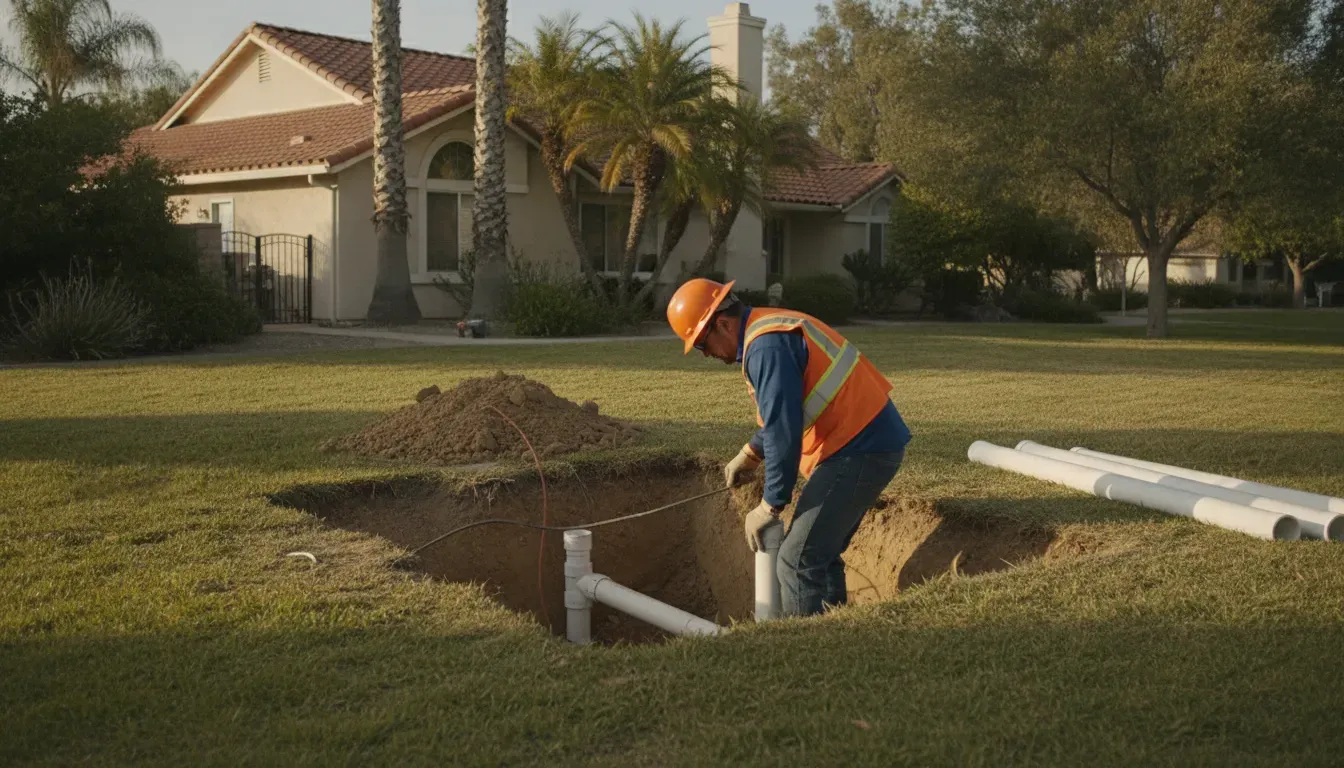
A sewer lateral replacement removes a failing private sewer connection and installs a new pipe between a building and the public sewer main or another approved connection point. Property owners usually consider replacement when the existing lateral has collapsed, has widespread structural damage, or keeps failing after temporary repairs. The right answer depends on the pipe’s condition, location, access, and local requirements, not on one symptom alone.
Need help understanding the next step? Contact Diamond House Plumbing to discuss a sewer lateral concern with a local plumbing team serving Riverside and San Bernardino County.
What is a sewer lateral replacement?
A sewer lateral is the underground pipe that carries wastewater from a home or business to the public sewer system. In some properties, the connection serves a septic or other private wastewater arrangement instead. The exact responsibility for the pipe, connection point, permits, and restoration can vary by city and property, so owners should confirm the local rules before work begins.
Replacement is a structural project. It is different from clearing a blockage, hydro jetting, or making a small point repair. During a replacement, the damaged section is removed or permanently abandoned according to the approved method, and new pipe is installed with the correct alignment, slope, connections, and access points. The work may use an open trench or a trenchless installation method when the site and pipe qualify.
If you need the basic parts explained first, read what a sewer lateral line is and why it matters. This article focuses on the separate decision of when replacement is appropriate and what owners should plan for.
When is sewer lateral replacement necessary?
A camera inspection and site assessment should guide the decision. Repeated symptoms are important, but they do not prove that replacement is the only option. A qualified professional looks at the type and extent of damage, whether the remaining pipe is structurally sound, and whether a repair can provide a dependable result.
- Collapse or severe deformation: A collapsed section can stop wastewater flow and may not leave enough sound pipe for a lasting repair.
- Damage across multiple sections: Several breaks, separated joints, or widespread deterioration may make a series of small repairs less practical than replacing the affected run.
- Recurring failures after repair: If the same lateral continues to back up after appropriate cleaning or point repairs, the underlying pipe may have a broader structural problem.
- Bellies or poor grade: A low section that holds wastewater can continue to cause blockages. The solution depends on the cause, depth, access, and the amount of pipe affected.
- Root intrusion with damaged pipe walls: Roots can enter cracks and open joints. If the pipe wall is still sound, a repair or rehabilitation option may be possible. If the pipe is failing in several places, replacement may be considered.
- Obsolete or badly deteriorated pipe: Old materials and long-term soil movement can leave a lateral fragile throughout its length rather than at one isolated point.
Frequent backups, slow drains, sewer odors, and wet or unusually green areas of the yard can signal a lateral problem. For a fuller symptom checklist, see sewer lateral repair signs homeowners should know. The purpose of that inspection is not to self-diagnose a replacement. It is to help you describe the problem accurately and arrange the right evaluation.
How do professionals confirm the need for replacement?
The first goal is to identify the actual failure instead of replacing pipe based on a guess. A sewer professional typically uses the following information:
- Camera inspection: A camera can show cracks, root intrusion, offsets, collapsed areas, buildup, and the location of a defect. It may also show whether a damaged area is isolated or part of a longer deteriorated run. A professional sewer line inspection can help establish the condition before a repair or replacement plan is selected.
- Access and cleanout review: Existing cleanouts and accessible connection points affect how the line can be inspected, repaired, or replaced. A missing or poorly located cleanout may become part of the project scope.
- Route, depth, and utility review: The team needs to understand where the lateral runs and what is above it. Driveways, patios, mature landscaping, walls, foundations, and other utilities can affect the method and restoration plan.
- Flow and grade assessment: The new line must carry wastewater consistently. The contractor considers slope, connection points, standing water, and other conditions that could cause a repeat failure.
- Local requirements: Permit, inspection, right-of-way, and connection requirements vary across Riverside County and San Bernardino County. The property owner and contractor should confirm which city or utility approvals apply to the address.
A good evaluation should explain what the inspection found, which section is included, why replacement is being considered, and what alternatives may be reasonable. If the only recommendation is a replacement with no explanation of the observed damage, ask for the inspection findings and project boundaries before authorizing work.
What are the main sewer lateral replacement methods?
The two broad approaches are traditional open-cut replacement and trenchless replacement. Neither is automatically best for every property. The condition of the existing line, its route, access at both ends, soil, nearby structures, and local approval requirements all matter.
| Method | What it involves | Important planning considerations |
|---|---|---|
| Open-cut replacement | The work area is excavated so the damaged pipe can be removed and new pipe installed directly. | Provides direct access to the full work area, but surface restoration may be needed for landscaping, paving, walkways, or other improvements. |
| Trenchless replacement | Specialized access pits and equipment are used to install a new pipe with less continuous excavation when the site qualifies. | Requires suitable alignment, access, surrounding soil, and pipe conditions. It may not work for every bend, depth, connection, or failure pattern. |
Trenchless work is not simply a promise of no disruption. It still requires access points, equipment, preparation, and restoration around those points. Open-cut work is not automatically the inferior choice either. It may be the clearest way to correct a collapsed, badly misaligned, or inaccessible section. For a more detailed comparison, review trenchless sewer work versus traditional digging.
What happens during a sewer lateral replacement?
While each property is different, most projects follow a sequence similar to this:
- Inspection and scope definition: The contractor reviews the symptoms, inspects the line, identifies the affected section, and explains whether repair, rehabilitation, or replacement is being considered.
- Site and utility planning: The route, access points, surface features, and nearby utilities are reviewed. The work plan should identify areas that may need protection or restoration.
- Permits and approvals: The required plumbing, excavation, right-of-way, connection, or inspection approvals depend on the jurisdiction and project location. The contractor should explain who is responsible for each step.
- Preparation: The work area is marked and prepared. The team establishes access, protects nearby property where practical, and coordinates the sequence of excavation or trenchless work.
- Removal or abandonment and installation: The damaged section is removed or handled through the approved replacement method. New pipe is installed to the planned route and grade, with compatible connections and access points.
- Inspection and testing: The completed work is checked for flow, alignment, connection integrity, and other requirements before final backfill or closeout, as applicable.
- Restoration: Excavated areas and disturbed surfaces are restored according to the agreed scope. Ask in advance whether the plan includes soil, concrete, asphalt, pavers, irrigation, or landscaping work.
The timeline depends on the length and depth of the lateral, access, method, permitting, weather, surface conditions, and whether the work is residential or commercial. A contractor should provide a project sequence rather than promise a fixed schedule before the site has been evaluated.
What should Inland Empire property owners consider?
Properties in Riverside and San Bernardino County can have very different site conditions. A sewer lateral serving a home in Riverside may have a different route and surface profile from one serving a property in Redlands, Fontana, Beaumont, or Moreno Valley. Older neighborhoods may also have aging underground infrastructure, mature trees, additions, driveways, or hardscape installed after the original plumbing.
Local requirements are another reason not to rely on a generic online checklist. The city, sewer utility, or other authority may have specific rules for connection points, inspections, traffic areas, right-of-way work, and restoration. The exact boundary between private and public responsibility can also vary. Ask the contractor to identify the private section being addressed and confirm which approvals are needed for your address.
Commercial property owners should also plan around business access and continuity. A lateral replacement near a parking area, customer entrance, loading zone, or tenant space may require a phased work plan. Discuss safe access, working hours, temporary facilities, communication, and surface restoration before scheduling the project.
Diamond House Plumbing provides residential and commercial sewer lateral services across the Inland Empire. Request a project consultation if you need help evaluating a recurring sewer problem or planning the next step.
Questions to ask before authorizing replacement
A written scope helps prevent misunderstandings. Before work begins, ask:
- What did the camera inspection show, and where is the affected section?
- Is the problem isolated, or is there evidence of damage along a larger portion of the lateral?
- Why is replacement recommended instead of cleaning, a point repair, or another rehabilitation option?
- Which replacement method is being proposed, and what site condition makes it suitable?
- What permits, inspections, utility locates, or right-of-way approvals apply?
- Where will excavation or access pits be located?
- Which surfaces, plants, irrigation components, walls, or other features may be disturbed?
- What restoration is included in the written scope, and what is excluded?
- How will the completed line be tested before the work area is closed?
- What maintenance or follow-up steps should the property owner plan after completion?
These questions are useful whether the property is a home, rental, commercial building, or older site with a complicated sewer route. They also make it easier to compare proposals based on scope and method instead of looking at one number without knowing what it includes.
How can you protect a new sewer lateral?
Replacement addresses the pipe condition at the time of the project, but good habits and timely inspections can help protect the new installation. Keep grease, wipes, paper towels, and other non-flushable materials out of the sewer system. Pay attention to recurring slow drains, unusual odors, or changes in yard moisture. Keep records of the work, inspection findings, permits, connection details, and restoration scope.
Tree roots, soil movement, improper connections, and blockages can affect underground plumbing over time. If symptoms return, arrange an evaluation instead of repeatedly treating the same backup without identifying the cause. Early documentation can help distinguish a new obstruction from a concern with the installed line.
Common questions about sewer lateral replacement
Is sewer lateral replacement the same as sewer line repair?
No. Repair normally addresses a limited defect or section, while replacement installs new pipe for a defined run. The appropriate option depends on the inspection results, remaining pipe condition, access, and local requirements.
Can a sewer lateral always be replaced without digging?
No. Trenchless methods can reduce continuous excavation in qualifying conditions, but they still need access and may not suit every route, bend, depth, connection, soil condition, or failure pattern. A site assessment should determine whether trenchless work is appropriate.
Who is responsible for a sewer lateral?
Responsibility often depends on the section of pipe, the connection point, the local sewer utility, and the rules for the property. Do not assume that the public agency or the property owner is responsible for every foot of the line. Confirm the boundary with the local authority and your contractor.
What is the first step if I suspect a failing lateral?
Document the symptoms and arrange a professional sewer inspection. A camera assessment can help identify whether the issue is a blockage, isolated damage, or a broader structural problem. If you are dealing with an active backup, take reasonable steps to limit use of fixtures and contact a plumbing professional promptly.
Plan the right next step for your property
Sewer lateral replacement is a major underground project, but the decision becomes clearer when it is based on inspection evidence, a defined work area, a suitable installation method, and a written restoration plan. Property owners in Riverside and San Bernardino County should also confirm local permit and connection requirements before work begins.
Need to discuss a sewer lateral problem? Contact Diamond House Plumbing for a practical evaluation and service guidance for your residential or commercial property.

Leave a Reply