
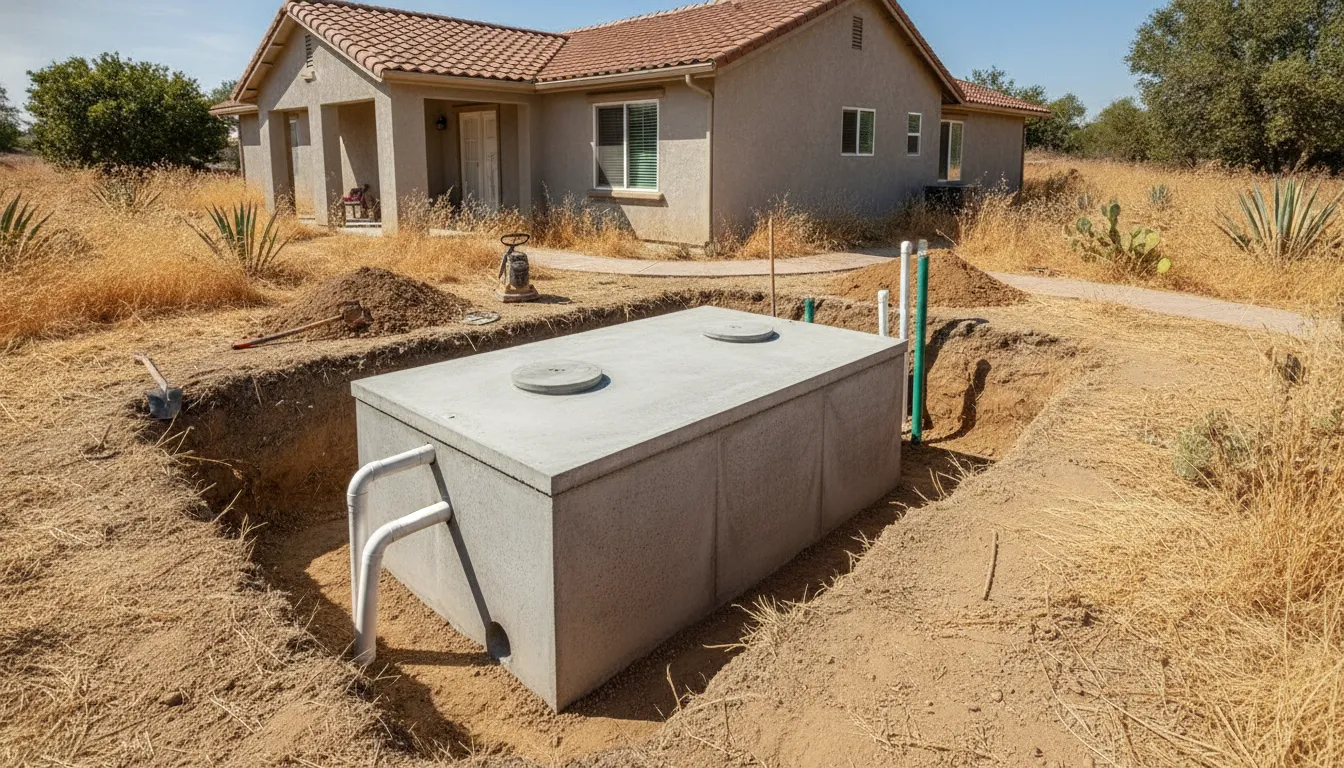
Septic tank size is the liquid capacity of the tank, measured in gallons, not the length of the hole in the yard. In Riverside County and San Bernardino County, that capacity is set from the home’s bedroom count or, when the plumbing is heavier, from fixture units. A three-bedroom house and a five-bedroom house are not sized the same way, even when both have two bathrooms.
Call (800) 674-9440 to review septic tank size
Diamond House Plumbing installs and replaces septic systems for homes and small commercial properties across the Inland Empire. A quote starts with the county rules for the parcel, not with a tank that happens to be in stock. The figures below come from the sizing tables those counties cite. They are a planning guide. The permit review for your lot is the final word. Age and material are a different question, covered in how long septic tanks last.
What septic tank size actually measures
A septic tank is a buried, watertight container. Heavy solids settle, grease floats, and clearer liquid leaves for the drain field or seepage pit. The U.S. Environmental Protection Agency describes that tank as the first treatment step before wastewater reaches the soil. Capacity is the liquid volume the tank holds while it does that work, not the outside length, width, or depth you see on a drawing.
EPA’s septic tank fact sheet says the tank should hold wastewater long enough for solids to separate. That hold time is commonly described as at least 24 hours of flow. A tank that is too small for the house fills with sludge faster. Solids then have a shorter path to the outlet and into the dispersal field. That is a sizing problem, not only a pumping problem.
Homeowners often ask for the tank size in feet. Feet describe the shell. Gallons describe whether the tank matches the house. Two concrete tanks can look similar in a photo and differ by several hundred gallons. The rating that matters is the liquid capacity stamped or specified for that model, checked against the county table for the occupancy.
Material is a separate choice. Concrete, fiberglass, and polyethylene tanks can all be watertight when they are certified and installed correctly. EPA lists those three as the main tank types and stresses that any of them must keep groundwater out. A leaky tank can overload the dispersal area even when the gallon rating looked right on paper. Riverside County also requires tanks to follow the current Uniform Plumbing Code and to be IAPMO certified. The size calculation has to be in the onsite wastewater report.
How many gallons by bedroom count
Both counties point residential projects to Uniform Plumbing Code Table H 201.1(1). San Bernardino County Environmental Health Services publishes that residential reading in plain numbers: bedrooms, estimated daily effluent, and minimum septic tank capacity.
| Bedrooms | Estimated daily flow | Minimum tank capacity |
|---|---|---|
| 1 or 2 bedrooms. | 500 gallons per day. | 750 gallons. |
| 3 bedrooms. | 670 gallons per day. | 1,000 gallons. |
| 4 bedrooms. | 800 gallons per day. | 1,200 gallons. |
| 5 or 6 bedrooms. | 1,000 gallons per day. | 1,500 gallons. |
The code table adds 150 gallons for each extra bedroom beyond that range. Apartments and other buildings use fixture units or design flow instead of a simple bedroom count, and the larger of those two methods controls. A one-bedroom or two-bedroom home starts at 750 gallons. A three-bedroom home moves to 1,000. Four bedrooms call for 1,200. Five or six bedrooms call for 1,500.
San Bernardino County is explicit that bathrooms do not set the tank. Its environmental health FAQ uses a 3,000-square-foot house described as two bedrooms with four bathrooms and nine other rooms. A 750-gallon tank is not appropriate there. The county example requires at least a 1,200-gallon tank. The real room layout is larger than the two-bedroom label.
Riverside County’s 2024 Local Agency Management Program says the same thing in design language. Dwelling occupancies are sized from Table H 201.1(1). If the home has more than 33 fixture units, the fixture-unit count is used as well. The calculation has to appear in the OWTS report. A remodel that adds a room can change the count even when nobody adds a bathroom.
These minimums are not a promise that a 1,000-gallon tank will serve every three-bedroom house in the desert or the pass. Garbage disposals, a large tub, an accessory dwelling, or a home used by more people than the bedroom count suggests can push the design up. The table is the floor the code sets. The site review can require more.
What counts as a bedroom in these counties
The gallon chart is only as good as the room count. Riverside County and San Bernardino County use nearly the same test, written into the Riverside LAMP and the San Bernardino single-family FAQ.
Set aside the living room, dining room, family room, kitchen, bathrooms, and utility rooms. Other habitable rooms of at least 70 square feet can count as bedrooms. Dens, libraries, studies, game rooms, sewing rooms, workshops, and lofts are on that list. A closet is not required. A private bathroom is not required.
A room is less likely to count when it opens to a living area, kitchen, or entry with one unobstructed opening and no door. That opening has to be at least half the wall and at least 6 feet wide. A room reached only through another bedroom is part of that bedroom, not an extra one. A sitting area inside a primary suite is the usual example.
Ambiguous plans can be reviewed case by case. If the fix is moving a doorway, Building and Safety may have to approve the structural change before Environmental Health signs off. A floor plan matters more than a listing that says “3 bed, 2 bath.” An office with a door can move a house from 1,000 gallons to 1,200.
Adding a bedroom to an existing house is a sizing event, not only a building-permit event. San Bernardino County says the tank and dispersal area must match the new count. An exception applies only when the original system was already oversized and a qualified designer certifies that it still fits. Many older Inland Empire tanks were installed to an earlier bedroom count. They are not automatically legal for the house as it stands today.
Tank gallons are not the whole system
Matching the table does not size the drain field, the seepage pit, or a pump chamber. Riverside County sizes leach lines and pits from percolation results and from the septic tank capacity. For every 100 gallons of required tank capacity, the dispersal area has to provide a matching amount of sidewall or bottom area. Fast soils and slow soils do not get the same square footage. The LAMP also caps tank size by soil rate. The slowest listed soils stop at 3,000 gallons. The fastest listed soils allow up to 7,500.
For non-house buildings, Riverside calculates tank size from design flow. Up to 1,500 gallons per day of waste flow, tank size equals that flow multiplied by 1.5. Above 1,500 gallons per day, the formula is flow times 0.75, plus 1,125. San Bernardino uses a similar commercial check. A 1,200-gallon tank already in the ground does not cover a large assembly use. Flow, not habit, sets the replacement size.
County design rules also shape the tank you buy, not only the number on the chart:
- Riverside requires at least two risers. One sits on the solids side and one on the effluent side. Risers extend to within 4 inches of final grade. Openings are at least 20 inches across, watertight, and secured.
- Tanks of 2,000 gallons or more need at least two risers on the solids side.
- An effluent filter has to stop solids larger than 3/16 inch from reaching the dispersal system. An NSF/ANSI Standard 46 filter at the outlet meets that Riverside rule.
- Tanks, lids, and risers under a driveway must be traffic-rated.
A pump is a separate review. Riverside looks at pump chambers only after the designer shows that gravity flow will not work on that lot. The pump does not replace tank capacity. If the field has to be dosed because the design is long, that equipment is added to the system. It is not subtracted from the gallons in the tank.
EPA notes that an effluent filter on the outlet keeps more solids out of the soil system. That filter is a maintenance item. It does not let you drop to a smaller tank. If you want the layout of tank, pipes, and field in one picture, the septic system diagram shows how those parts connect. Capacity is one specification on that tank, not a substitute for the field.
What to confirm before you choose a tank
Bring the floor plan, any prior septic permit, and the bedroom count you believe is accurate. A contractor who sizes only from the current listing can under-size a house that the county will count differently. Diamond House Plumbing checks that layout against the service the property needs. The tank, risers, filter, and dispersal path are confirmed before anyone orders concrete or fiberglass.
Use this sequence:
- Count rooms the way the county does. Include dens and offices of at least 70 square feet, not only rooms the seller called bedrooms.
- Compare that count with Table H 201.1(1). The common range is 750, 1,000, 1,200, or 1,500 gallons, plus 150 gallons for each extra bedroom.
- Ask whether fixture units exceed 33. If they do, Riverside sizes from the fixture-unit column, and that result can be larger than the bedroom column.
- Confirm the dispersal system still matches the tank. A new tank on a failed seepage pit does not fix the lot. Soil rate, expansion area, and setbacks are part of the same permit.
- Specify risers, a secured lid, an effluent filter, and traffic rating if the tank sits under a drive.
Homes that already show slow drains, wet ground over the field, or odors need a condition check before a size upgrade. Age and material tell you how long a tank may serve. They do not tell you whether today’s gallon rating still matches the house. This page stays with capacity.
Installation scope, including driveway seepage pits and traffic-rated work, sits on the septic services page. A full replacement is a different scope from matching a tank to an existing field. Start that conversation with the same floor plan. The county will still want the capacity math in the report.
Commercial kitchens, shops, and multi-unit buildings should not borrow the house table. Their flow can outrun a residential tank that looks large in the yard. Bring the fixture list or the expected daily use and let the design use the flow formula. Guessing from a similar house nearby is how projects stall in review.
Call (800) 674-9440 or send the floor plan through the contact page.
Frequently Asked Questions
What septic tank size does a 3-bedroom house need?
Riverside County and San Bernardino County cite the Uniform Plumbing Code table for this. A three-bedroom single-family home has a minimum septic tank capacity of 1,000 gallons. Extra rooms the county counts as bedrooms, or more than 33 fixture units, can push the requirement higher.
Do bathrooms decide septic tank size?
No. Both counties size residential tanks from bedrooms and, when it is greater, from fixture units. San Bernardino County has said a 750-gallon tank is not appropriate for a large house labeled as two bedrooms when other rooms show more use. In that example they required at least 1,200 gallons.
How big is a typical septic tank in feet?
Footprint varies by manufacturer, material, and whether the tank is one or two compartments. A 1,000-gallon concrete tank and a 1,000-gallon fiberglass tank will not share the same outside dimensions. Ask for the liquid capacity in gallons and the installed length, width, and depth for the model on your bid, including risers.
Can I keep my old tank if I add a bedroom?
Only if the existing tank and dispersal area already meet the size required for the new bedroom count, and a qualified designer can certify that. San Bernardino County says that otherwise the tank has to be replaced with the appropriate size and the dispersal area increased. Riverside requires the capacity calculation in the OWTS report.
Does a larger tank replace a failing drain field?
No. Tank capacity and dispersal area are designed together. Riverside sizes leach lines and seepage pits from the soil rate and from the gallons of tank capacity. A bigger tank on a saturated or undersized field does not correct the field. The field, the expansion area, and the tank all have to fit the lot.

Leave a Reply