
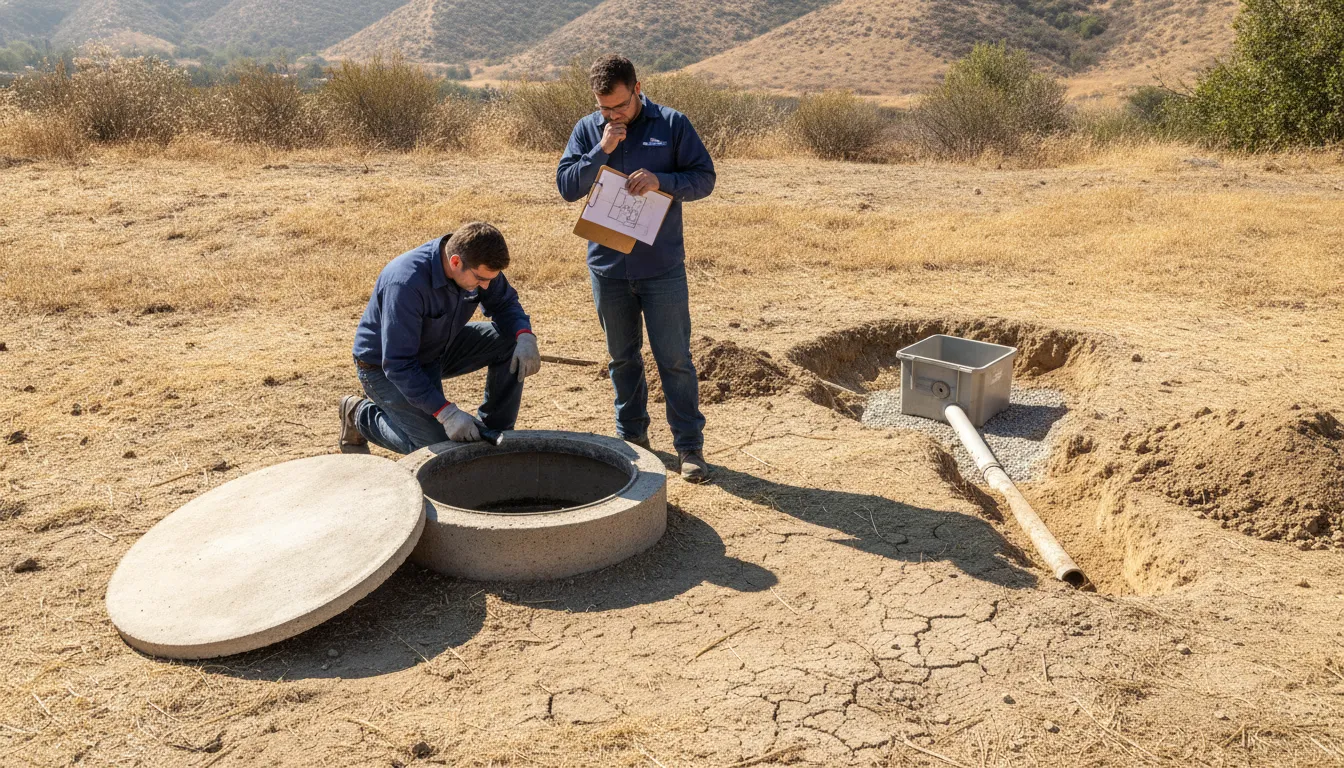
San Bernardino County septic system requirements depend on the parcel, not a statewide checklist. Before a new tank, a replacement, or a bedroom addition, confirm which office reviews the address. Also confirm whether a public sewer is close enough to require a connection. Diamond House Plumbing serves homes and businesses in San Bernardino County and Riverside County. We can discuss the local process with you before you choose an installation, repair, or drain-field project.
Call (800) 674-9440 to review your septic project
Which office applies San Bernardino County septic system requirements?
Start with the address. If the project is inside an incorporated city, the county flowchart sends you to that city’s Building and Safety department for the building permit and septic approvals. Unincorporated parcels go to San Bernardino County Building and Safety.
Environmental Health Services still has a distinct job. EHS reviews sewage-disposal reports, percolation reports, and parcel-specific options under the county Local Agency Management Program. Since January 22, 2024, design review for an onsite system, and applications for sewage holding tanks, go to Land Use Services through EZOP. Designated Maintenance Area and alternative-treatment operating permits still go directly to EHS.
A land-use approval is not the same thing as permission to build the system. The LAMP says obtaining local land-use approval and obtaining an OWTS permit are separate processes. A conditional use permit does not replace a Building and Safety permit, and it does not guarantee that a permit will be issued.
Which San Bernardino County septic system requirements need a permit?
Building and Safety Information Bulletin IB-00018 says a permit is required before installation of a new or replacement sewage disposal system. Single-family septic tanks, leach lines, infiltrators, and seepage pits are reviewed and permitted by Building and Safety. The submittal is a completed building-permit application plus an onsite wastewater plot plan.
That plot plan is specific. It needs the owner, job-site address, and assessor parcel number, the scope of work, and the size of the new or existing tank. It also needs a north arrow, property lines, street names, existing and proposed buildings, and the bedroom count, existing versus proposed. If a guest house or second dwelling shares the system, show it. Show the tank, the seepage pit or leach lines with size and depth, and the 100 percent expansion area.
The plan also has to show wells and water lines, both private and public. Add large trees over one foot in diameter, slopes, and groundwater. Show the distribution box and any stream or other flowing water. If the proposed system cannot meet the LAMP, EHS can require supplemental treatment or an alternative dispersal system.
A service visit is not the same as a replacement. If sewage is backing up, surfacing, or a component has failed, the LAMP treats that as a system that needs corrective action. Ask the reviewing office whether the repair you are planning needs an application before anyone opens the ground.
When must the property connect to sewer instead?
The LAMP will not approve an onsite system where a public sewer is available. For a new development, connection is required when the nearest property line is within 200 feet of an available sewer line. Each extra equivalent dwelling unit on the parcel adds 100 feet to that distance. An existing home that adds one more dwelling unit is treated as new development and must connect if the sewer is within 300 feet.
Before a new or replacement application is accepted, EHS or Building and Safety may ask for a “will serve” or “will not serve” letter from the local sewer agency. The letter has to be dated within one year. It must list the parcel number, the distance to the nearest available sewer, and whether that agency will serve the parcel. A signed official of the sewer agency has to complete it, and it is submitted with the percolation report or plot plan.
If the parcel sits outside a sewer service area but inside the connection distance, the LAMP says a connection can still be required. That can mean annexation or an out-of-agency agreement, and it can need Local Agency Formation Commission approval. A failed system inside the defined sewer distance is also not approved for another onsite system.
Connection steps, agency conditions, and what happens to the old tank are a different job from these siting rules. Our guide to septic to sewer conversion requirements in San Bernardino County covers that path.
How do lot size and bedrooms change the system?
For new development on a public water system, the LAMP requires one-half acre per dwelling unit. A new subdivision that uses both a private well and an onsite system needs parcels of at least two and a half acres, and each lot still has to meet the setbacks. Some areas the regional water boards treat as prohibition areas use a stricter one-acre minimum.
Older approvals are not erased. Parcels that received onsite approval for one dwelling unit before the original LAMP date of June 23, 2017, are exempt from the new minimum lot size. A new accessory dwelling unit on that parcel is not exempt. The LAMP requires a septic certification of capacity and function before an ADU is approved, and an undersized system has to be brought up to current sizing.
County bulletin IB-00018 sizes a single-family tank by bedrooms, using the same figures as the 2025 California Plumbing Code table it cites:
| Bedrooms | Design flow (gallons per day) | Minimum tank (gallons) |
|---|---|---|
| 1 to 2 bedrooms. | 500 gallons per day. | 750 gallon tank. |
| 3 bedrooms. | 670 gallons per day. | 1,000 gallon tank. |
| 4 bedrooms. | 800 gallons per day. | 1,200 gallon tank. |
| 5 to 6 bedrooms. | 1,000 gallons per day. | 1,500 gallon tank. |
Those flows are for one primary dwelling on a half acre. Any added structure that increases wastewater flow has to be reviewed and approved by EHS. A junior accessory dwelling unit of no more than 500 square feet, built inside the existing home or attached garage, is exempt from that bedroom table under the bulletin. A guest house used as a short-term rental is treated as an accessory dwelling unit.
Commercial projects are sized from total drainage fixture units and estimated daily waste flow for the whole occupancy, not from a bedroom count. The county flowchart is explicit about that split. On a commercial parcel, flow for each half acre cannot exceed one equivalent dwelling unit. The LAMP describes that unit as 250 gallons per day in the Lahontan region, or 300 gallons per day in the Santa Ana and Colorado regions, or 20 fixture units. Use whichever measure is more conservative.
Which setbacks does the plot plan have to meet?
IB-00018 publishes the minimum distances for new and existing sewage disposal structures. These are the planning numbers. The bulletin says they do not replace the rest of the LAMP, and several footnotes increase a distance near a public well, a deep pit, or a surface-water intake.
| Keep this far from | Septic tank | Disposal field | Seepage pit |
|---|---|---|---|
| Non-public water well. | 100 ft. | 100 ft. | 150 ft. |
| Public water well. | 100 ft. | 150 ft. | 200 ft. |
| Building or structure. | 5 ft. | 8 ft. | 8 ft. |
| Private property line. | 5 ft. | 5 ft. | 8 ft. |
| Stream or flowing water. | 100 ft. | 100 ft. | 150 ft. |
| Lake, pond, or surface water. | 200 ft. | 200 ft. | 200 ft. |
| Public domestic water line. | 25 ft. | 25 ft. | 25 ft. |
The same table also asks for 50 feet from a drainage course, 5 feet from a private building water line, and a 100 percent expansion area on the plot plan. Groundwater separation is 5 feet under a tank, with deeper separation under a disposal field, and 10 feet under a seepage pit. Systems over 5,000 gallons per day move the well setback out to 200 feet.
Seepage pits are not the default. The bulletin allows them only where leach lines are not feasible and groundwater separation is met. Daisy-chain connections between pits are not allowed, and County Code section 33.0893 prohibits seepage pits in mountain areas. EHS review is required before a seepage-pit permit application.
Leach lines have their own limits. A trench may be no wider than 3 feet, and no single leach line may be longer than 100 feet. Extra length is split across two or more lines. The LAMP also requires enough area for a full replacement dispersal field, so a tight lot can fail even when the tank itself fits.
Who can design, test, and install the system?
IB-00018 lists who may do each part of the work. A design may be prepared by a registered civil engineer, a certified engineering geologist, a registered environmental health specialist, a registered geologist, a geotechnical engineer, or a licensed Class A, C-36, or C-42 contractor. Percolation testing is limited to those professional registrations. It is not listed as contractor work.
Installation of a new or replacement system is limited to a licensed Class A, C-36, or C-42 contractor. Diamond House Plumbing installs and repairs septic systems and the plumbing around the tank, including distribution boxes, baffles, and drain-field repairs. A contractor license does not skip the permit. The installer still builds only what Building and Safety has approved for that parcel.
Every tank, leach line, infiltrator, seepage pit, and supplemental treatment application needs a design rate from an approved percolation report. EHS is the contact for that submittal. If a percolation test was already done, you can ask EHS to research the rate on file. The county charges for that search, and it does not guarantee a rate exists. New subdivisions, new development, and any site without a previously approved report need a current test by a qualified professional.
EHS is more likely to inspect a new system in a few higher-risk settings. Those include mountain lots, lots under two and a half acres served by a well, and sites that cannot meet setbacks. Steep slopes over 20 percent are on the list too. So are sites within 200 feet of a river, within 100 feet of a stream, or in high or perched groundwater. EHS can also inspect other sites when the system could affect water quality.
What changes for a repair, an ADU, or a commercial property?
A failing system is not a suggestion. The LAMP calls a system failing when the dispersal field fails or effluent pools. Wastewater at the surface, backed-up fixtures, a failed tank, or a failed component also count. So does a system that could affect water quality or public health. The owner has to repair, modify, or replace it on the schedule in any notice from EHS, Code Enforcement, or the regional board. Ignoring that notice can bring citations or fines.
Cesspools are not legal in California. When one is found, the LAMP says the owner must eliminate it within 30 days and replace it with a sewer connection or an onsite system that meets current standards. Above-ground discharge, including sprinklers, exposed drip lines, and lagoons, will not be approved. A graywater system does not let you shrink the septic system.
Adding an accessory dwelling unit is treated as new development when it increases flow. On a lot over one acre, two dwellings can share a system if the dispersal area is sized from the plumbing-code table plus 30 percent. On a half-acre lot, the bulletin says an advanced treatment unit may be required for the added structure. A plain connection to the primary tank is not allowed without it. On a lot under a half acre that was subdivided before 1989, the added structure also needs advanced treatment before it can connect. Confirm the lot size and the approval date with EHS before you design the unit.
Food businesses on a septic system have one more rule. A facility that produces fats, oils, and grease must have an in-ground outdoor grease interceptor, sized and approved by Building and Safety. Alternative treatment systems and sewage holding tanks also need operating permits and periodic inspections through EHS. Systems inside a Designated Maintenance Area need an operating permit and a biennial EHS inspection.
Riverside County uses its own environmental health process. If the parcel is across the county line, use the Riverside County septic system requirements guide instead of this one.
How should you prepare the property file?
Collect the records before you call. A clean file lets the reviewer answer the permit question instead of sending you back for basics.
- Write down the full address and the assessor parcel number, and note whether the parcel is in a city or in unincorporated county.
- List the work in one sentence: new system, replacement, repair of a named part, bedroom addition, or ADU.
- Gather any old permits, as-built sketches, perc reports, and the bedroom count of the existing house.
- Ask the sewer agency whether a line is available and request a current will-serve or will-not-serve letter if the county asks for one.
- Mark wells, water lines, streams, slopes, and the area you think is available for a replacement field.
- Call EHS or Building and Safety and ask which form matches that scope. Save the staff name and the date.
Diamond House Plumbing can inspect the tank, inlet and outlet, distribution box, baffles, and leach lines, then explain whether the property needs maintenance, a repair, or a new installation. We install complete systems for residential and commercial properties and repair or replace drain fields and leach lines when the dispersal path has failed. We do not quote a permit outcome or a fee. The county sets both, and they change by parcel.
Our septic services page lists inspections, pumping, repairs, and new installations across the Inland Empire. Broader home plumbing, including the lines inside the house that can mimic a septic backup, is on our residential plumbing page. If the symptom is a main-line backup rather than the tank, start with drain and sewer service.
Contact Diamond House Plumbing about your septic project
Frequently asked questions
Do San Bernardino County cities use this same process?
No. The county flowchart sends incorporated-city projects to that city’s Building and Safety department for the building permit and septic approvals. Unincorporated projects use county Building and Safety and EZOP, with EHS reviewing the wastewater reports. Ask with the street address so you are not using the wrong counter.
Is a permit required to replace a septic tank?
Yes for a new or replacement sewage disposal system. IB-00018 says the permit comes from Building and Safety before installation. A maintenance visit, such as pumping, is not the same as replacing the tank or the dispersal field. Describe the exact work and ask whether that scope needs an application.
How close can a sewer be before I cannot install a septic system?
For one new dwelling, the LAMP requires a sewer connection when the nearest property line is within 200 feet of an available sewer. Each added equivalent dwelling unit extends that distance by 100 feet. The sewer agency’s current will-serve letter is what the county uses to judge availability.
Can I add an ADU on a half-acre septic lot?
Only if the parcel meets the LAMP and the system is certified for the added flow. On a half-acre lot, the county bulletin says an advanced treatment unit may be required, and a simple tie-in to the existing tank is not allowed without it. Lots under a half acre that were split before 1989 have a similar advanced-treatment condition. EHS has to review the increase in flow.
Where are the official rules written?
Use the county sources, not a contractor summary. The Environmental Health Services wastewater page explains the LAMP, percolation review, and the January 2024 EZOP change. The design details in this article come from Land Use Services bulletin IB-00018 and the county LAMP. Rules are updated, so confirm the current bulletin before you submit.
Talk through the parcel before you dig
San Bernardino County septic system requirements are a parcel decision. That means city or county review, sewer distance, lot size, bedrooms, and setbacks. Diamond House Plumbing helps property owners discuss septic installation, repairs, drain-field work, and related plumbing needs across both counties. Send the address and a short description of the project so the conversation starts with the right scope.

Leave a Reply