
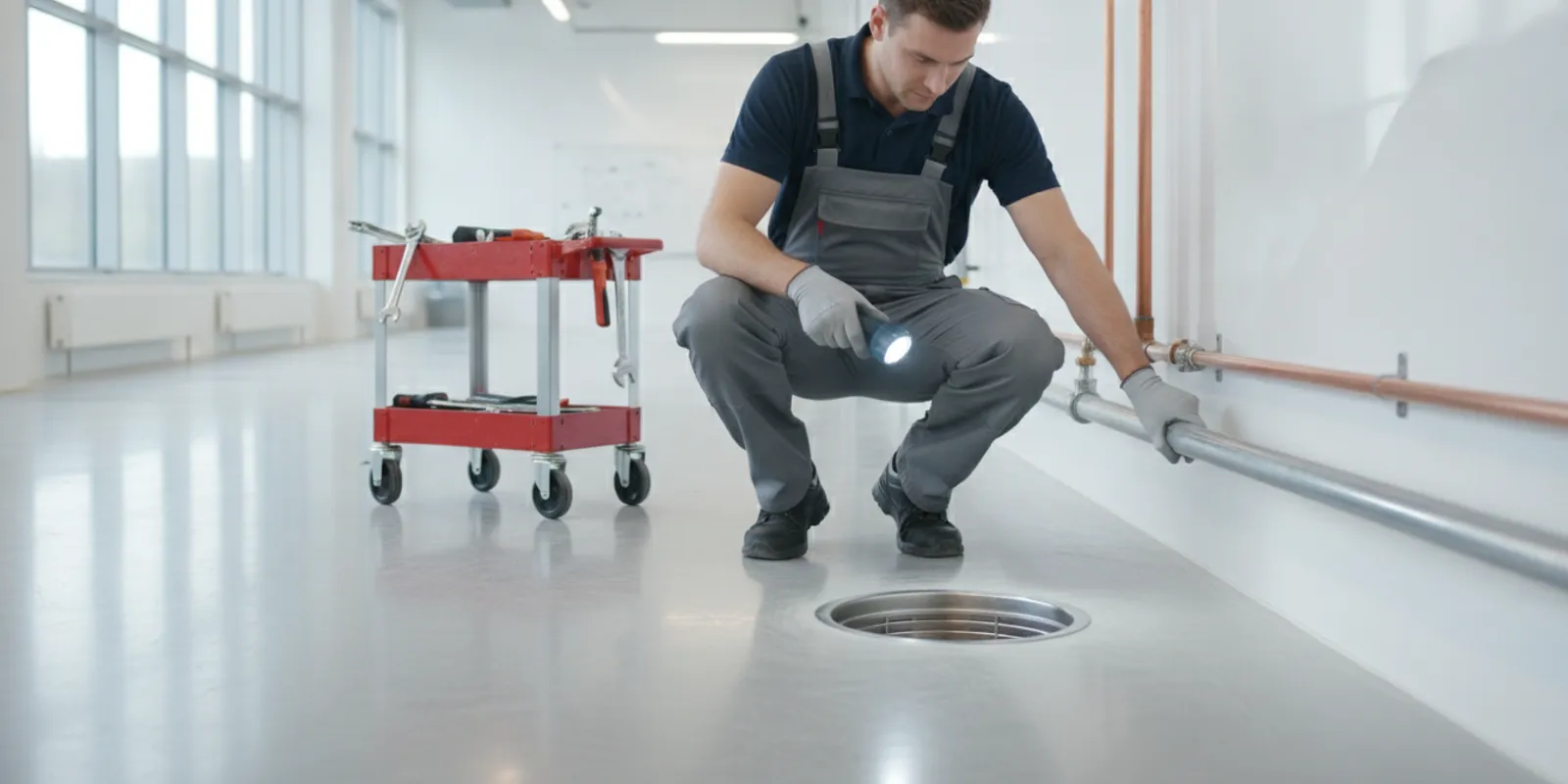
An emergency commercial drain unblocking problem can interrupt customers, employees, deliveries, and daily operations quickly. The right first steps are to protect people and property, limit water entering the affected line, and arrange qualified help. This guide explains what to do before a plumber arrives, what an inspection may involve, and how commercial property owners in Riverside and San Bernardino County can plan the next step.
Request commercial plumbing help
What makes a commercial drain blockage an emergency?
A blocked drain becomes an urgent commercial plumbing issue when it threatens health, property, operations, or access to the building. A slow sink in a low-use area may allow time for a scheduled assessment. A backed-up restroom, floor drain, kitchen line, or main building drain needs a faster response.
Commercial buildings often have more fixtures, longer branch lines, and higher water usage than homes. A blockage may affect several rooms even when the first visible symptom appears in one fixture. Wastewater can move through floor drains, spread across finished surfaces, or back up into occupied areas. An article about blocked drain emergencies describes the serious disruption that can follow a blocked drain.
What should you do first when a commercial drain backs up?
Start with containment rather than repeatedly testing the affected fixture. The goal is to prevent more water from entering the line while you identify the safest access point for a plumber.
- Stop using affected fixtures. Ask staff and occupants not to use nearby sinks, toilets, showers, floor drains, or equipment connected to the same drainage area.
- Pause water-intensive operations. If practical, stop dishwashing, laundry, production washing, irrigation, or other activities that could send more water into the system.
- Keep people away from wastewater. Restrict access with suitable barriers and follow the building’s safety procedures for contaminated water.
- Protect movable items. Move inventory, records, equipment, and electrical items away from wet areas when this can be done safely.
- Notify responsible people. Contact the owner, property manager, facilities contact, tenants, or responsible employee so no one restarts water use unknowingly.
- Call a commercial plumbing professional. Describe the affected fixtures, backup location, start time, and whether wastewater is still rising.
Do not enter standing water near electrical equipment. Do not open a pressurized or overflowing cleanout without knowing what is behind it. If the building has an emergency plan, follow it while arranging plumbing service.
Use a simple incident log as soon as someone can do so safely. Record when the backup began, which fixtures were in use, the first area affected, and whether stopping water use changed the level. Note any room closures, tenant notifications, and steps taken to protect stock or equipment. A short factual record is more useful than guessing at a cause while the system is still backed up.
How can you tell whether the blockage is local or affecting the main line?
The symptom pattern can help a plumber prepare, although it cannot replace an inspection. A problem limited to one sink may involve a trap, branch drain, or fixture connection. A backup affecting several fixtures often points farther downstream.
| Observation | What it may suggest | Information to record |
|---|---|---|
| One sink drains slowly | A local fixture or branch restriction | Fixture location and nearby fixture performance |
| Several fixtures in one restroom are affected | A shared branch drain restriction | Which fixtures back up and when |
| Fixtures in different areas back up | A larger building drain or main sewer restriction | Locations, timing, gurgling, and floor-drain overflow |
| Water rises from a floor drain | Wastewater may be unable to move downstream | Drain location, water level, and whether use has stopped |
| Odor or recurring slow drainage | An unresolved restriction, damaged line, or maintenance concern | Previous service dates and inspection reports |
These are clues, not a diagnosis. A commercial plumber may inspect cleanouts, test line sections, or use a camera to locate the restriction. See the drain and sewer service information for related plumbing support.
For example, if a single break-room sink drains slowly while nearby fixtures work normally, note that distinction and keep that sink out of service. If toilets and floor drains in two separate areas are backing up, report each location rather than describing the event as one clogged restroom. This helps the technician decide whether to begin at a local cleanout or investigate a shared downstream line.
What information should you give the plumber?
A clear first report can help the service team understand urgency and prepare appropriate equipment. Gather the following information if available:
- The business address and best entrance for the service vehicle.
- The name and phone number of the person meeting the plumber.
- The affected room, fixture, floor, or tenant space.
- Whether the water is clean, gray, or visibly contaminated.
- Whether the blockage is worsening or has stopped rising.
- Whether multiple fixtures or neighboring suites are involved.
- The location of accessible cleanouts, shutoff valves, or mechanical rooms.
- Any recent renovation, excavation, heavy rain, equipment installation, or plumbing work.
- Whether the property uses a municipal sewer, septic system, lift station, or other onsite equipment.
Photos can help if they can be taken from a dry, safe location. Do not delay the call while documenting every detail. The most important facts are location, severity, affected areas, and immediate safety concerns.
Before the technician arrives, arrange access to the affected rooms and any known cleanout locations. If a locked mechanical room or tenant suite is involved, identify who can authorize entry. Keep a clear path for tools and equipment, but do not move covers or dismantle plumbing components unless the technician asks and the work is safe. In a multi-tenant building, one point of contact can collect reports and reduce conflicting instructions.
How does emergency commercial drain unblocking usually work?
The process depends on the building and obstruction. A technician will generally review the symptoms and locate an appropriate access point. The inspection should identify both the blockage and its likely cause rather than only restoring flow temporarily.
1. Initial assessment
The technician may review the building layout, ask when symptoms began, and check fixtures, cleanouts, floor drains, and accessible pipework. This helps separate a fixture issue from a branch or main-line problem.
2. Safe access and line inspection
Depending on the system, the plumber may use a cleanout, drain equipment, or a sewer camera. Camera inspection can reveal buildup, foreign material, root intrusion, a damaged section, or a change in pipe alignment. Not every blockage requires the same method.
3. Clearing the restriction
Mechanical equipment or water-based cleaning methods may be considered after assessment. The technician should account for pipe material, access, condition, and the risk of moving a blockage farther into the system. In a commercial building, the work area and operating schedule also matter.
4. Flow testing
After clearing the line, the plumber may run water through selected fixtures and observe affected drains. Testing helps confirm that flow has returned and may reveal a second restriction or continuing drainage problem.
5. Recommendations and documentation
If the blockage relates to a damaged sewer lateral, recurring buildup, roots, or a capacity concern, clearing the line may not be the complete solution. Ask for an explanation of the finding, work completed, and recommended repair or maintenance. The sewer camera inspection guide explains why visual inspection can help when the cause is not obvious.
Ask the technician to distinguish what was directly observed from what is only suspected. For instance, a camera view may show debris at a certain point but not explain why it accumulated. If additional work is proposed, request the affected pipe section, access method, and reason for the recommendation in plain language. This makes it easier to brief a property owner or approve a defined scope without confusing emergency clearing with a larger repair.
What can cause a commercial drain blockage?
Commercial drainage systems can be affected by everyday use, building age, and conditions outside the structure. Common possibilities include:
- Grease and food material: Food-service operations can send fats, oils, and solids into a line when controls or maintenance are inadequate.
- Paper products and foreign objects: Restrooms, offices, and public facilities may experience restrictions when unsuitable materials enter the system.
- Accumulated sediment: Dirt and other material can settle in floor drains, exterior lines, or low sections of pipe.
- Tree roots: Roots may enter joints or damaged pipe sections and create recurring restrictions.
- Pipe damage or displacement: Cracks, collapsed sections, separated joints, or a low spot can prevent reliable drainage.
- Insufficient maintenance: A line with repeated slow drainage may need planned assessment instead of repeated emergency clearing.
- Septic or lift-station concerns: A building connected to onsite wastewater equipment may have a broader system issue rather than an isolated blockage.
The cause matters because the next step changes with it. Repeatedly clearing the same line without investigating the underlying condition can leave a business exposed to another interruption.
Operating habits can provide useful context. A restaurant manager might note whether symptoms appeared after a busy service period or near a kitchen branch. A warehouse or vehicle business might record whether an exterior drain began backing up after washdown or heavy use. These details do not prove what caused the restriction, but they give the plumber a starting point and may identify a recurring pattern across shifts or seasons.
How should businesses protect operations during the repair?
Commercial properties need a response that considers people, plumbing, and continuity. Ask the service team which areas must remain closed and whether limited use is safe while work is underway. Keep customers and staff away from tools, open cleanouts, wet surfaces, and contaminated areas.
For a restaurant, facility manager, retailer, or office, assign one person to communicate with the plumber and another to manage occupants. Record the time of the backup, fixtures affected, and operational interruption. This information can support future maintenance planning and discussions with a landlord, insurer, or owner.
If only one zone is affected, consider whether other areas can remain open without sending water into the same restricted line. Confirm this with the plumbing professional or building manager first; pipe connections may not follow room boundaries. Where a restroom or food-preparation area is involved, follow the business’s health and safety procedures and keep the affected space closed until it is safe to use.
If the building relies on a septic system, drainage symptoms may need to be considered alongside tank, pump, effluent, or dispersal components. Diamond House Plumbing provides septic system services in the Inland Empire, so a property owner can ask whether symptoms appear limited to an interior drain or may involve onsite equipment.
When is a permanent sewer repair worth discussing?
A permanent repair may deserve consideration when the same line blocks repeatedly, a camera shows structural damage, or the building experiences symptoms in several locations. Other warning signs include unexplained odors, repeated water intrusion, a line that cannot be cleared reliably, or a blockage that returns soon after service.
The appropriate repair depends on pipe location, depth, material, condition, access, and its relationship to neighboring property or public infrastructure. A proposal should distinguish immediate clearing from larger repair. It should explain what is known, what needs confirmation, and how work may affect access or operations.
For sewer laterals, ask which agency or district controls the relevant section and whether permits, inspections, or approvals may apply. Requirements can vary by location and project type. A clear scope helps prevent an emergency response from becoming an unexpected, poorly defined construction decision.
It may help to compare options in stages: restore flow now, investigate a recurring or unclear problem, then consider repair if inspection supports it. The first visit may solve an isolated obstruction, while a damaged or displaced line may require a separate proposal. Ask whether the recommended next step is urgent to prevent further backup or can be scheduled after normal operations resume.
How can a business reduce the chance of another blockage?
Prevention begins with understanding how the building uses its drainage system. A practical plan may include:
- Listing every restroom, floor drain, kitchen fixture, cleanout, and major drain-connected appliance.
- Recording recurring slow drains, odors, backups, and previous service work.
- Using suitable screens, strainers, and grease-control procedures for the operation.
- Training staff not to place unsuitable materials into sinks, toilets, or floor drains.
- Scheduling inspections for lines with recurring symptoms or known age concerns.
- Keeping cleanouts and mechanical spaces accessible to authorized service personnel.
- Maintaining contact information for the property manager, landlord, facilities lead, and plumbing provider.
- Reviewing whether a septic system, lift station, or sewer lateral needs separate maintenance planning.
Turn that list into a simple building record. Include fixture locations, the person responsible for each area, service dates, and notes on repeated symptoms. If a tenant reports a slow drain, record whether it was isolated or followed by other problems. This gives the next inspection useful history instead of relying on memory during an urgent call.
Planned work cannot guarantee that a blockage will never occur. It can make warning signs easier to recognize and help a business respond before wastewater reaches occupied or customer-facing areas.
What should you ask before approving emergency work?
Ask concise questions so the work and its limits are clear:
- Where does the technician believe the restriction is located?
- What access point and clearing method will be used?
- Is the line showing damage or only an obstruction?
- Will the affected area remain closed during or after work?
- How will flow be tested after clearing?
- Is additional camera inspection, repair, or maintenance recommended?
- Are permits, inspections, or utility coordination relevant to a larger repair?
- What should staff do if symptoms return?
These questions do not need to delay an urgent response. They help the owner understand whether the visit focuses on restoration, diagnosis, or both. If the proposal includes more than immediate clearing, ask for separate descriptions of each phase and a chance to review any non-urgent work once the site is stable.
Frequently asked questions
Can a commercial drain blockage affect more than one tenant?
Yes. If several suites share a branch drain, building drain, or sewer connection, one restriction can affect multiple areas. Report every affected location so the plumber can assess the system as a whole.
Should employees keep using unaffected restrooms?
Ask the plumbing professional or building manager before resuming use. An apparently unaffected fixture may still discharge into the restricted section. Limiting water use is often the safer temporary measure until the drainage path is understood.
Does clearing a drain fix a damaged sewer line?
Not necessarily. Clearing may restore flow through an obstruction, but a cracked, displaced, root-affected, or collapsed line can continue to cause problems. Inspection findings can determine whether repair should be discussed.
When should a business schedule a follow-up inspection?
Consider follow-up when the blockage recurs, the line was difficult to clear, the cause was uncertain, or the property has older or damaged drainage infrastructure. A planned inspection may provide more options than waiting for another backup.
Schedule a commercial plumbing assessment
For an emergency commercial drain unblocking problem in Riverside or San Bernardino County, protect the affected area, stop unnecessary water use, document the symptoms, and contact a qualified plumbing team for a prompt assessment.

Leave a Reply