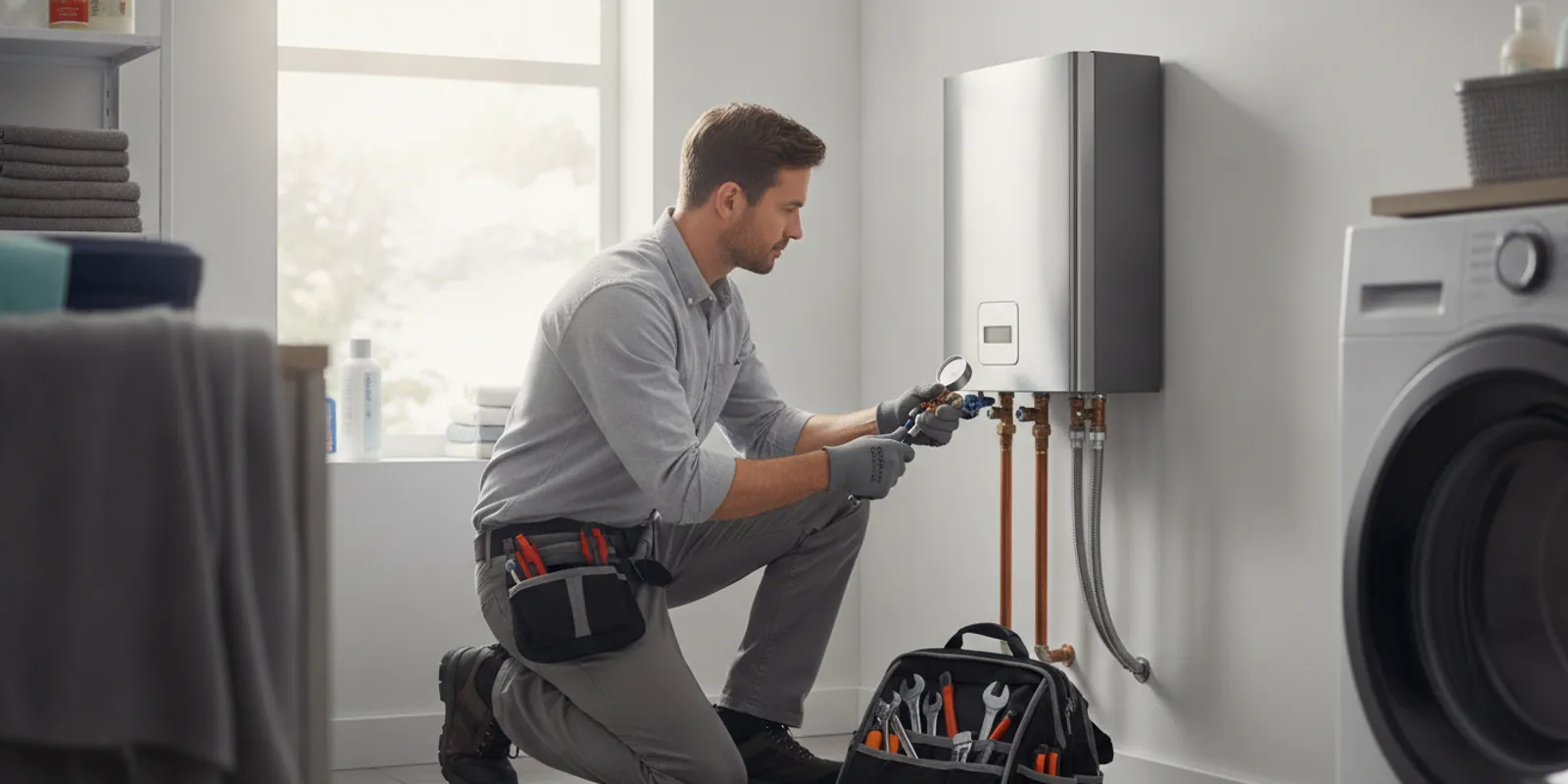
Tankless water heater repair can restore reliable hot water when a unit stops heating, displays an error code, leaks, or shuts down during use. The right solution depends on the symptom, the installation, water quality, the age of the heater, and the condition of its gas, electrical, venting, and plumbing connections. This guide explains what Inland Empire property owners can check safely, how a professional diagnosis works, and when repair or replacement makes more sense.
Schedule a tankless water heater assessment
What problems can tankless water heaters develop?
A tankless heater warms water only when a fixture calls for hot water. That design removes the storage tank, but it does not remove the need for correct flow, clean components, adequate fuel or power, and proper venting. A problem in any of these areas can affect temperature, performance, or safety.
Common symptoms include:
- No hot water: The unit does not activate, or it activates without producing hot water.
- Water that turns cold: Hot water begins normally, then becomes cool while a shower or fixture is still running.
- Temperature swings: Water alternates between hot and cool instead of staying near the selected setting.
- Low hot-water flow: The heater does not receive enough flow to activate consistently, or a restriction limits delivery.
- Error codes or repeated shutdowns: The control system detects a condition that needs attention.
- Unusual sounds: Popping, rumbling, rattling, or fan noise may point to scale, combustion, airflow, or mechanical concerns.
- Water leaks: Water may escape from a connection, valve, heat exchanger, condensate component, or another part of the system.
- A gas odor or exhaust concern: These require immediate attention rather than continued operation.
One symptom can have several possible causes. For example, a cold shower may result from insufficient flow, a dirty inlet filter, a fuel supply issue, a sensor problem, or a component failure. Replacing a part before identifying the cause can leave the original problem unresolved.
What should you do first when the heater stops working?
Start with information, not repeated resets. Note when the issue occurs and whether it affects one fixture or the entire property. Record any displayed code exactly as it appears. Also note whether the problem began after a power interruption, plumbing work, a gas service interruption, or a change in water pressure.
Property owners can take a few basic observations without opening the cabinet or disturbing fuel, electrical, or venting components:
- Confirm that the affected fixture is fully open and that the issue is not limited to one faucet or shower valve.
- Check whether the heater has power at its normal control or display. Do not remove covers or handle wiring.
- Look for visible water around the unit and nearby shutoff connections.
- Check for a noticeable gas odor. If you smell gas, leave the area and contact the appropriate emergency service or utility according to local safety guidance.
- Do not operate a unit that is producing exhaust indoors, showing signs of overheating, or repeatedly shutting down.
- Write down the model, approximate installation date if known, and the symptoms for the service professional.
A reset may clear a temporary control issue, but repeated resets are not a repair. If the same code or symptom returns, continued operation can hide a developing problem. Gas-fired tankless units also depend on correct combustion and venting. The U.S. Consumer Product Safety Commission has published recalls involving tankless water heaters and explosion or fire hazards, so recall and safety concerns should be treated seriously: review the CPSC tankless water heater safety notice.
How can you separate a fixture problem from a heater problem?
Before scheduling service, compare more than one hot-water outlet if it is safe to do so. If one faucet is affected while other fixtures receive steady hot water, the cause may be a clogged aerator, a shower cartridge, a local shutoff, or a restriction near that fixture. If every outlet has the same problem, attention should shift toward the heater, its supply, and the main hot-water distribution.
Timing also provides useful evidence. A heater that never activates has a different starting point than one that heats briefly and then stops. A problem that appears only when two showers run may relate to demand, flow, capacity, or a supply limitation. A problem that follows plumbing work may involve a closed valve, disturbed filter, trapped air, or a changed connection. These observations do not identify the repair by themselves, but they help the technician avoid an unnecessarily broad or incorrect diagnosis.
For a commercial property, record which rooms, tenant spaces, or fixtures are affected and whether the issue follows a particular operating schedule. A business may need temporary scheduling or a staged repair plan to reduce disruption. Sharing that information before arrival can make the assessment more focused.
Which tankless water heater parts may cause a failure?
A technician usually considers the whole system rather than guessing at one replaceable part. The likely causes differ between gas and electric models, but the main diagnostic areas are similar.
Water flow and inlet components
Most tankless heaters need a minimum flow to activate. A clogged inlet filter, partially closed valve, fixture restriction, or plumbing issue can reduce flow below that threshold. A flow sensor can also fail or provide inaccurate information. If only one fixture has trouble, the fixture or local plumbing deserves attention before the heater is blamed.
Temperature sensors and controls
Temperature sensors help the control board decide how the heater should operate. A sensor that reads incorrectly may produce temperature swings, an error code, or a shutdown. Control-board problems can create similar symptoms, which is why testing matters before a board is replaced.
Gas supply, ignition, and combustion
Gas models require adequate fuel pressure, reliable ignition, proper flame detection, and sufficient air. A blocked vent, incorrect venting, ignition failure, or combustion issue can cause a heater to shut down or fail to heat. These are professional service concerns. The North Carolina Department of Labor publishes safety alerts that include warnings about recalls involving tankless water heaters and carbon monoxide risk: review the boiler safety alerts for the importance of treating combustion and exhaust concerns as safety issues.
Electrical components
Electric models depend on the correct supply, breakers, heating elements, sensors, and controls. A tripped breaker may be a symptom rather than the underlying cause. Do not repeatedly reset a breaker that trips again, and do not remove the cover to test energized components.
Heat exchanger and scale-related restrictions
Mineral buildup can reduce heat transfer and water flow. Scale can contribute to noise, slower heating, temperature changes, and reduced efficiency. This guide is not a substitute for the separate tankless water heater descaling guide, which focuses on maintenance. The key distinction is that descaling may address mineral buildup, while a repair visit may need to investigate sensors, controls, valves, leaks, ignition, or other failures.
How does a professional tankless water heater diagnosis work?
A useful diagnosis connects the symptom to a testable cause. The service process may include the following steps, depending on the model and complaint:
- Review the history: The technician asks when the issue began, how often it occurs, which fixtures are affected, and whether the heater has displayed codes.
- Inspect the installation: The unit, shutoffs, piping, connections, venting, condensate handling, and surrounding area are checked for visible concerns.
- Verify power and fuel conditions: The technician checks the operating conditions required for the specific model. Gas and electrical testing must be performed with appropriate equipment and procedures.
- Check water flow: Inlet restrictions, filters, valves, and fixture conditions are considered when activation is inconsistent or output is weak.
- Test controls and sensors: Error history and sensor readings can help separate a control issue from a flow, fuel, or heat-transfer problem.
- Evaluate venting and combustion on gas models: The technician looks for conditions that could prevent safe operation.
- Explain the options: The final recommendation should identify the observed problem, the proposed repair, any related concerns, and whether replacement should be considered.
Ask for a clear explanation of what was tested. A good service conversation should distinguish a confirmed failure from a possibility. It should also explain whether the proposed repair addresses the cause or only one symptom.
What information should be ready for the service visit?
A little preparation can make the appointment more useful. Gather the model and serial information if it is easy to read from the exterior label, but do not remove a cover to find it. Write down the error code, the date the symptom began, and whether the issue is constant or intermittent. If the heater works at some fixtures but not others, list those fixtures.
Also describe recent changes. A new appliance, a plumbing alteration, a power outage, a gas interruption, unusual water pressure, or a long period without use may be relevant. Keep the area around the unit reasonably accessible. For a business, identify a contact who can explain operating needs and approve access to affected rooms.
These details do not replace testing. They give the technician a starting map and help distinguish a repeatable operating condition from an isolated event. They also make it easier to compare a repair recommendation with the actual complaint.
When is tankless water heater repair a practical option?
Repair is often worth considering when the unit is otherwise in sound condition and the problem is isolated. Examples may include a failed sensor, damaged valve, ignition component, control part, connection, or other serviceable item. Repair can also make sense when the heater is relatively recent, replacement parts are available, and the installation still meets the property’s needs.
Repair may be a better fit when:
- The unit has a clear, localized fault.
- The heat exchanger and cabinet show no major deterioration.
- The installation has adequate gas, electrical, water, and venting conditions.
- The required part is available and compatible with the model.
- The expected service life after repair is reasonable for the property owner’s plans.
Ask whether a repair includes testing after installation. The heater should be checked under operating conditions, and the technician should confirm that the original symptom has been addressed. If the recommendation involves a part that is not immediately available, ask whether the unit is safe to operate while waiting and what symptoms should trigger a shutdown.
When should you consider replacement instead?
Replacement deserves consideration when failures are recurring, the heat exchanger is significantly damaged, compatible parts are no longer available, or the existing unit does not match the property’s demand. An older heater with several unrelated problems may require more than one repair. In that situation, comparing the repair scope with a properly selected replacement can help you plan rather than respond to another shutdown.
Replacement may be the more practical path when:
- There is substantial corrosion, repeated leakage, or heat exchanger damage.
- The unit has a history of multiple failures.
- The model is obsolete or difficult to support.
- The heater is incorrectly sized for the number of simultaneous fixtures.
- The venting, gas supply, electrical service, or condensate arrangement needs major correction.
- The cost and uncertainty of repair are close to the value of a properly installed new system.
A replacement decision should include more than the equipment itself. The contractor may need to evaluate capacity, fuel type, venting, water connections, isolation valves, electrical requirements, condensate drainage, code considerations, and access. A new unit installed into an unsuitable setup may repeat the same performance or safety concerns.
How can you compare repair and replacement options?
Use the diagnosis and the condition of the installation to compare choices. Avoid choosing solely by the first price presented or by the promise of a quick fix. The table below provides a practical framework for the conversation.
| Option | Best fit | What the service may involve | Questions to ask |
|---|---|---|---|
| Repair | Localized failure on a supportable unit | Testing, part replacement, leak or connection correction, and operational verification | What failed, what test confirmed it, and what else was inspected? |
| Maintenance service | Scale or routine performance concern without a confirmed major failure | Model-appropriate maintenance and inspection of related components | Is maintenance addressing the cause, or is further repair needed? |
| Replacement | Recurring failures, major damage, obsolete equipment, or poor fit | Equipment selection, removal, new connections, safety checks, and commissioning | How was capacity selected, and what installation changes are required? |
| Emergency shutdown and assessment | Gas odor, suspected exhaust issue, active leak, overheating, or dangerous electrical condition | Make-safe steps followed by a qualified inspection | Is the unit safe to operate, and what must happen before restart? |
What questions should you ask before approving work?
Clear questions help you understand the scope and avoid treating a symptom as a complete solution. Ask what test identified the suspected failure, whether other causes were ruled out, and whether the unit can be safely operated before the repair. If a part is recommended, ask whether it is compatible with the model and whether testing will follow installation.
For replacement, ask how the new unit will be sized for simultaneous demand. Confirm which connections or venting components will change, how condensate will be handled when applicable, and what commissioning checks are included. If the work affects a business, ask how shutoffs, access, and restoration will be coordinated around operating hours.
It is also reasonable to ask for separate descriptions of confirmed repairs and optional improvements. A filter service or installation correction may be useful, but it should be explained as a distinct part of the recommendation. That distinction makes proposals easier to compare and supports a more informed decision.
What should Inland Empire property owners consider?
Inland Empire homes and businesses can have very different plumbing layouts, water demands, and installation histories. A property in Riverside may have a different access or venting arrangement from a home in Fontana, Redlands, or Rancho Cucamonga. Commercial properties may also need a plan that limits disruption to tenants, employees, or customers.
Before scheduling service, gather the heater model, error code, recent service records, and a description of the affected fixtures. If the problem is part of a larger plumbing issue, a contractor may need to evaluate adjacent piping, shutoffs, pressure, or other equipment. Diamond House Plumbing also handles broader plumbing services for Inland Empire properties, so the visit can be scoped around the actual system rather than one isolated symptom.
For a suspected leak, sewage issue, or urgent loss of service, explain the situation when you contact the company. The emergency plumbing guidance can help you identify information to provide before a professional arrives. If the concern involves another water or sewer symptom, related plumbing repair guidance may help you prepare questions, but a tankless heater with a fuel, electrical, venting, or active leak concern should be assessed by a qualified professional.
Frequently asked questions
Can a tankless water heater be repaired?
Yes. Many tankless units have serviceable sensors, valves, controls, ignition parts, filters, and connections. Whether repair is appropriate depends on the confirmed failure, the unit’s condition, part availability, and the safety of the installation.
Why does my tankless heater turn on and then shut off?
Possible causes include insufficient flow, a blocked inlet, a sensor or control problem, inadequate fuel or power, ignition trouble, or a venting concern. Because the same symptom can have different causes, testing is more reliable than replacing a part based on the symptom alone.
Is an error code enough to identify the repair?
No. An error code is useful evidence, but it may point to a condition that has several underlying causes. The technician should interpret the code for the specific model and confirm the related components and operating conditions.
Should I keep using the heater if it is leaking?
Stop using it and arrange an assessment if there is active leaking, a gas odor, suspected exhaust, overheating, or repeated shutdown. Follow appropriate utility or emergency guidance for immediate hazards, and do not open the cabinet or attempt to bypass safety controls.
How can I prepare for a service visit?
Have the model information, error codes, service history, and a list of affected fixtures ready. Describe when the issue occurs and whether it began after a utility interruption, plumbing work, or change in water use. Keep the area around the heater accessible.
Explore water heater service options
Plan the right next step for your water heater
Tankless water heater repair starts with a careful diagnosis of the symptom, the unit, and the installation around it. With that information, an Inland Empire property owner can make a more informed choice between repair, maintenance, emergency shutdown, and replacement.

Leave a Reply