
A weak shower, a slow-filling washing machine, or a faucet that barely flows can make a normal day frustrating. More importantly, a pressure change can be an early warning that part of your plumbing system needs attention. The most common low water pressure causes include a restricted fixture, a partially closed valve, a failing pressure regulator, a hidden leak, mineral buildup, and aging supply lines.
Schedule professional plumbing service if low pressure affects multiple fixtures or appears with signs of a leak.
The pattern of the problem offers the best first clue. Pressure that is low at one faucet usually points to that fixture. Low pressure throughout the home suggests a broader supply or plumbing issue. Inland Empire homeowners can use the safe checks below to narrow the possibilities without taking apart pipes or making risky adjustments. Explore Diamond House Plumbing’s completed plumbing projects to see the care brought to local properties.
Start by narrowing down the low water pressure causes
Before focusing on a specific component, take a few minutes to define what changed. A plumber will ask many of the same questions because the answers quickly separate fixture problems from whole-house problems.
Is the problem isolated or widespread?
Test several fixtures in different areas of the home. Compare a bathroom faucet, the kitchen faucet, and a shower. If one fixture has weak flow while the others operate normally, the restriction is probably close to that fixture. If every fixture is affected, the cause may be near the main shutoff, pressure regulator, service line, or water supply.
Does it affect hot water, cold water, or both?
At a faucet with separate hot and cold controls, compare both sides. Weak flow on only the hot side can point toward a water-heater valve, connector, or hot-water piping issue. Weak flow on both sides is more likely to involve the fixture itself or a broader supply problem.
Did the pressure change suddenly or gradually?
A sudden pressure drop deserves prompt attention, especially when it affects the entire home. It may follow a valve change, regulator failure, utility work, or a leak. A gradual decline often fits mineral accumulation, corrosion, or a fixture that has slowly become restricted. Note when the problem began and whether it gets worse when multiple fixtures run.
When low pressure affects only one fixture
One weak faucet or showerhead usually indicates a localized flow restriction rather than a problem with the entire plumbing system. Start with simple observations and stop if a part is corroded, stuck, leaking, or unfamiliar.
Check the faucet aerator or showerhead
Aerators and showerheads have small openings that can collect sediment and mineral deposits. If the flow is weak or uneven at one outlet, the outlet itself may be restricted. Follow the manufacturer’s care instructions for removable parts. Avoid forcing a component that will not turn easily, since damaged threads or seals can create a leak.
Confirm the local supply valve is open
A sink or toilet usually has a small shutoff valve nearby. A valve that was moved during recent work may not be fully open. Look at its position, but do not force an old or corroded valve. Aging shutoffs can begin leaking when disturbed and are better evaluated by a plumber.
Consider the faucet cartridge or supply connector
If the outlet is clear and the valve appears open, an internal cartridge or connector may be restricting flow. These parts vary by fixture. Replacement often requires shutting off water and selecting the correct components, so professional service is a practical next step when the simple checks do not restore flow.
A safe diagnostic sequence for low water pressure causes
A careful sequence prevents guesswork and helps distinguish a single-fixture restriction from a whole-house supply issue. Start by comparing several fixtures, then review recent changes and visible leak clues. Stop before forcing valves or adjusting a regulator. These observations also give a plumber useful details if professional testing is needed.
- Test multiple fixtures. Check fixtures on different floors or opposite sides of the home. Record whether the problem affects one outlet, one room, hot water only, or the entire property.
- Ask whether neighbors are affected. If nearby homes have the same sudden issue, a municipal supply change or local work may be involved. Check notices from your water provider before assuming the problem is inside your home.
- Review recent changes. Consider whether the pressure changed after plumbing work, irrigation work, a water-heater service, or use of a main shutoff valve.
- Look for visible leak clues. Watch for damp spots, water stains, soft flooring, pooling near the foundation, or the sound of running water when fixtures are off.
- Check accessible valve positions visually. Confirm that a main or local shutoff does not appear partially closed. Do not force valves or adjust a pressure regulator.
- Stop when the cause is not obvious. Whole-house pressure loss, sudden changes, leak clues, and recurring problems warrant professional diagnosis.
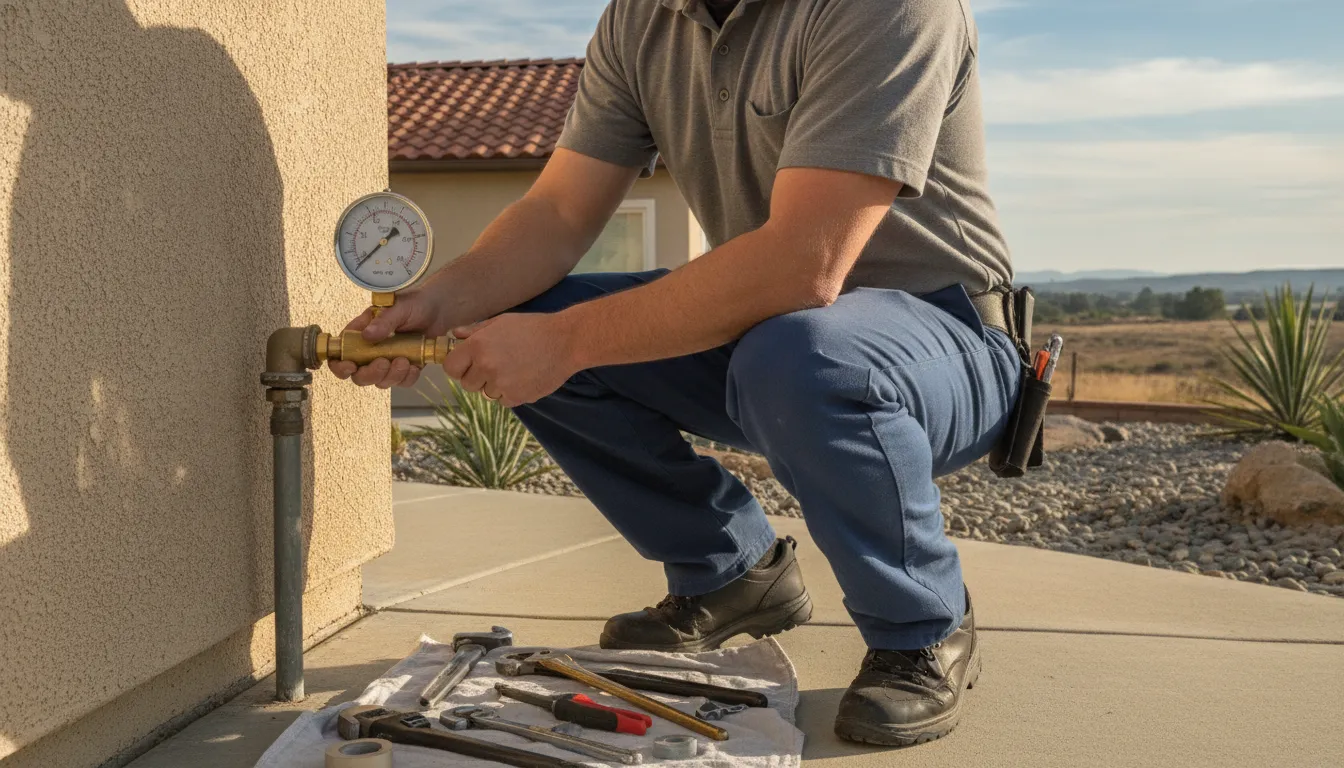
A pressure gauge can provide useful information when used correctly, but one reading does not identify the cause. Pressure can vary with demand and supply conditions. A plumber can interpret readings in context and test flow, the regulator, valves, and piping.
Why is water pressure low throughout the house?
Whole-house low pressure usually points to a shared component, such as the main valve, pressure regulator, service line, or municipal supply. Because these issues can create similar symptoms inside the home, pressure and flow testing is more reliable than replacing parts based on a guess. A sudden change also warrants checking promptly for a hidden leak.
A pressure regulator may be failing
Many homes use a pressure regulator to manage incoming water pressure. A worn or malfunctioning regulator can cause low, high, or inconsistent pressure. Because incorrect adjustment can create excessive pressure and damage plumbing components, leave regulator testing and adjustment to a qualified plumber. Review these water pressure regulator failure signs if the change affects the whole home.
A main valve may be partially closed
A main shutoff that is not completely open can restrict flow to every fixture. This sometimes happens after repairs or maintenance. Older valves can seize or leak when moved. If the handle position is unclear or the valve does not move normally, have it inspected instead of applying force.
A hidden leak may be diverting water
A leak in a concealed pipe or service line can reduce available flow while causing damage out of sight. Pressure loss may be accompanied by unexplained water use, damp areas, discoloration, sounds of running water, or pooling outdoors. Not every leak produces obvious evidence, so a sudden whole-house pressure drop should not be ignored.
Mineral buildup or corrosion may restrict piping
Deposits and corrosion can narrow the inside of pipes over time. The result may be a gradual decline in flow, especially when several fixtures operate together. Cleaning one aerator will not solve a restriction deeper in the system. A plumber can assess pipe condition and determine whether a targeted repair or broader upgrade makes sense.
The municipal supply may have changed
Temporary utility work, high neighborhood demand, or a supply issue can affect incoming pressure. If pressure dropped suddenly, check with neighbors and the water provider. When only your property is affected, the cause is more likely within the service connection or home plumbing.
Match the symptom to the likely cause
Symptoms are helpful clues, not a final diagnosis. Use this comparison to decide which observations are safe and when testing should come next.
| Symptom | Likely area to investigate | Safe first check | When to call a plumber |
|---|---|---|---|
| One faucet has weak flow | Aerator, cartridge, or local valve | Compare hot and cold flow and inspect the outlet | Flow stays weak after simple fixture checks |
| Every fixture is weak | Main valve, regulator, supply line, or utility | Ask neighbors and review recent work | Your home alone is affected or the cause is unclear |
| Pressure drops when two fixtures run | Restricted or aging piping | Note which fixture combinations trigger the change | The pattern is consistent or worsening |
| Sudden whole-house pressure loss | Leak, valve, regulator, or supply interruption | Look for visible leak clues and utility notices | Promptly, especially with signs of water damage |
| Only hot water flow is weak | Water-heater valve, connector, or hot piping | Compare hot and cold at several faucets | Multiple fixtures have weak hot flow |
Could a hidden leak be one of the low water pressure causes?
A hidden leak can reduce available flow while damaging walls, floors, a slab area, or the service line route. Low pressure alone does not prove a leak, but a sudden whole-house change combined with damp spots, running-water sounds, or unexplained water use deserves prompt professional testing.
Watch for changes beyond the faucet
Look for new stains, damp odors, warped flooring, soft drywall, unusually green patches outdoors, or water sounds when everything is turned off. Compare recent water use if that information is available. One clue alone may have another explanation, but several clues together justify prompt testing.
Do not open walls based on a guess
Low pressure does not reveal a leak’s location. Opening finishes or excavating without diagnostic evidence can create unnecessary damage and still miss the source. Professional plumbers can evaluate pressure and flow patterns, inspect accessible components, and choose an appropriate leak-detection approach.
Act quickly when pressure drops suddenly
A sudden, unexplained change throughout the home is different from a showerhead that has weakened gradually. If you also see active water, move belongings away from the area and contact a plumber. If you know how to safely operate the appropriate shutoff and active leakage is causing damage, shutting off the water may limit harm. Do not force an unfamiliar or corroded valve.
When should you schedule professional pressure testing?
Schedule professional testing when low pressure affects the whole home, returns after fixture cleaning, changes suddenly, or appears with possible leak clues. Testing is also useful when pressure drops sharply during simultaneous use or when an older plumbing system gradually loses flow. It identifies the actual cause before a repair is recommended.
Request a professional water pressure evaluation for a clear diagnosis instead of replacing parts based on a guess.
Testing separates pressure from flow problems
Homeowners often use the terms pressure and flow interchangeably, but the symptoms can come from different restrictions and conditions. A professional evaluation considers static pressure, performance while water is running, regulator behavior, valve condition, and the pattern across the home. That broader view helps avoid replacing the wrong component.
Local plumbing conditions matter
Inland Empire homes vary in age, piping materials, layout, and supply conditions. Mineral accumulation and aging components may contribute to gradual changes, but an inspection is needed to identify the actual cause in a particular property. Learn more about Diamond House Plumbing and its local service focus. A local plumber can recommend a focused repair rather than a one-size-fits-all response.
Diagnosis protects the rest of the system
Adjusting a regulator or forcing a valve without confirming the cause can turn a pressure complaint into a leak or high-pressure problem. Diamond House Plumbing provides professional plumbing services for homes and businesses across Riverside and San Bernardino County. A careful diagnosis provides a clear basis for the next step.
Contact Diamond House Plumbing for pressure testing when low pressure is widespread, sudden, or accompanied by leak clues.
Frequently asked questions about low water pressure
What is the most common cause of low water pressure in one faucet?
A restricted aerator, showerhead, cartridge, or local supply valve is a common explanation when every other fixture works normally. Compare hot and cold flow, inspect the outlet, and arrange service if simple fixture checks do not solve it.
Can a bad pressure regulator cause low water pressure?
Yes. A malfunctioning regulator can cause low, high, or inconsistent pressure throughout a home. Since incorrect adjustment can affect the entire plumbing system, have a plumber test the regulator rather than changing its setting based on symptoms alone.
Does low water pressure mean there is a leak?
Not always. Fixture restrictions, valves, regulators, supply changes, mineral buildup, and aging pipes can also reduce pressure or flow. However, a sudden drop combined with damp areas, unexplained water use, or running-water sounds warrants prompt leak testing.
Why does pressure drop when two fixtures run?
A large drop during simultaneous use can indicate restricted piping, supply limitations, a valve issue, or another whole-house flow problem. Note which fixtures trigger the change and ask a plumber to evaluate the pattern if it is consistent.
Should I adjust my home’s pressure regulator myself?
No adjustment should be made without confirming the existing pressure and the regulator’s condition. An incorrect setting can create excessive pressure or hide another problem. Professional testing is the safer route.
Get clear answers about your home’s water pressure
Low pressure is easier to solve when the diagnosis starts with the pattern, not a guess. If multiple fixtures are affected, the problem appeared suddenly, or you see possible leak clues, schedule professional water pressure testing with Diamond House Plumbing.
Schedule professional plumbing service to identify the cause and get a focused recommendation for your Inland Empire property.

Leave a Reply